Sunday, June 5, 2011

Broken Stones and Custom Orders

Many of you have heard it from me: “ok, I’ll do this custom order for you, but the gem may break.  In which case, you can pick an alternative or your money back.” 

Setters don’t like custom orders.  They know if they break the stone, you don’t make any money, and your customer might get mad at you.  But they still put their time into it.  So did you, plus materials.  You’ll try to re-use those, of course.  Still, botched orders have to be worked into your overall cost.

But who should pay for the broken stone?  The setter?  Not necessarily.  Consider another question first: why do so many Etsy sellers work only with certain gems (garnet, amethyst, citrine, peridot, diamond).  There are three answers: availability (also of different cuts and exact calibrations), price (except for diamonds), plus risk of breakage.  And certain stones break very easily.  Just last week, my most talented setter cleanly sliced through the middle of my stone when attempting to fold the bezel wall.  “I barely touched it,” he defended himself.  Well, it was kyanite!  Soft as butter.  It is the same with apatite, Mexican fire opal, and some other gems.  I no longer risk custom orders with those, unless I have a replacement handy.  And bezeling stones with corners is the worst.  Just a little pressure makes them crack.

In April, one of my customers bought a beautiful, large – and expensive – emerald from me.  She was going to have it set by a local jeweler, or someone else on Etsy, because she had a design in mind that I couldn’t replicate.  Her local jeweler quoted her $800 for the job and was willing to assume the risk.  Well, I hope so, because by my estimates, that price included the replacement of the gem at nearly retail value.    Meanwhile, nobody on Etsy wanted to set her stone, or assume the risk of breakage.  (So in the end, someone else made the ring and it is being shipped back to me for setting.  Lucky me.) 

Last week, someone asked me to bezel set her gem, an emerald cut (which has corners).  It was an expensive gem that the customer was still paying off.  I said “no.”  By contrast, I said “yes” to another customer who sent me two cheaper (cornerless, replacable) stones, which she assured me she is able to live without.  So if I break it I can give her something else in exchange. 

Last anecdote: this May, I sold an alexandrite to someone in Canada.  It was a gorgeous, and costly, pear shape with one slight inclusion in the tip.  The customer found a setter willing to set it in white gold for a fair price.  But: he would not assume the 5% chance of breakage.  All went well in the end.  Phew.

So, back to our question: should you ask your setter to pay for the broken stone?  I will give you a threefold (and hedged) answer.

1.      For cheap or easily replaceable gems (and especially cheap gems that are hard to set): you cover the cost, and don’t argue.  Have a replacement handy.  But pay for one setting job, not two.

2.      For tiny gems (what they call “melee’s”), including diamonds: they rarely break but they have a habit of vanishing.  They get stuck inside your plastic bag and thrown out, they fall off the workbench or disappear into a crack.  Do everyone a favor and include a few extra with your order (one extra at least, even if you’re just having a couple of stones set).  And don’t ask for them back.  Some setters will give them back to you anyway, others may have long forgotten when you pick up.  If you like your setter, drop the matter!

3.      For very expensive stuff (let’s say $100 and up): first, consider hiring an experienced setter.  Setters are like mechanics.  On 47th, everyone thinks they can do it.  But some are good and some are terrible.  Some charge just a few bucks.  If they do, that means they expect to set a couple dozen gems in an hour.  You’re abusing the cheap prices if you ask them to set a $100 stone for $5.00 and then ask them to cover the cost if it breaks.  Another setter may charge $100 but may take an hour or so to do it.  I once heard of a guy getting paid $1000 – he was setting a peridot of a $100,000 value.  He freed his entire afternoon for the “10 minute job,” and took hours bending each prong.  (Why? – Because no affordable insurance in the world can cover the gem, and most setters don’t have insurance anyway.)  Second: offer the setter extra money, perhaps double his rate.  Ask him to take more time.  Say it’s a valuable stone.  But don’t freak him out with the price or rarity of the gem because then he cannot work calmly.  Also, ask him to look at the stone and setting first to see if he anticipates problems.  If the risk of breakage is high, perhaps you should forget about it.  You might also discuss what happens if it breaks, and negotiate something ahead of time.  I.e. free work.  And last but not least, consider your own replacement cost when you price your item.  (This is something I continuously fail to do, but it is excellent advice.)

Let’s say you did everything right but the gem broke.  What now?  The setter, if he’s nice, will take it upon himself to refuse your pay, and be willing to help you replace the gem.  If he didn’t tell you it broke and he thinks he will lose you as a customer, he may try to find a replacement before telling you, and often, a gemstone dealer is willing to help him out with a low price if he knows what happened. 

But if that happens, keep in mind that may not get back the same type of stone you gave to the setter.  I once had a small unheated square Burma sapphire broken during channel setting and the setter replaced it without asking me first.  But he replaced it with a heated Thai sapphire.  I had him take it out.  The customer paid for Burma, not Thai.  The setter meant well, but he didn’t realize what you worked with was unusual or rare (and in so many cases, it isn’t).
Custom ring where Burma square was replaced

Princess cuts - notoriously hard to set


I once heard of a jeweler thinking he lost a $30,000 diamond.  That’s a whole other blog entry.  Anyway, he found it, but not before considering to mortgage his house.  Stones like that I cannot afford to work with, and very few people can, although some do it anyway, hoping that nothing happens.

The moral is this.  Most of the time, all goes well.  But occasionally, it doesn’t.  And in a very small number of those cases, there’s just isn’t a solution.  You work something out, but it won’t make anybody happy.  Personally, I try not to get too attached to a gem that’s not yet in a piece of jewelry.  And even then, I try not to, because I, too, can lose or break it!

Sunday, May 22, 2011

What is an Old-Mine Gem?

I’d heard the term many times, but couldn’t make much of it initially.  I looked it up online, but the only reference I found was to diamonds, where the term was used to describe a predecessor to the brilliant cut, dating back to the 1800s.  An old mine diamond is deeper, it has a smaller table and fewer facets, less brilliance but a nice warm glow in candle-light.  I have a few small ones – a fact that had escaped me until someone pointed it out – apparently they are worth more than regular diamonds, but true to form, I have sold most of them for regular price.  Diamonds just aren’t my specialty…
When I google “old mine” together with “colored gem,””gemstone,” or some particular gemstone name, the only thing that comes up, paradoxically, are my own listings.  “Circular reference,” we call that in philosophy.  But on the street, the term is loosely used to describe gems from earlier – and better – mining days (up to 40 or 50 years ago, let’s say).  All the emeralds and rubies I get from D. are old miners, many of the sapphires are, and some of the pink tourmalines as well. 

Whether or not an old mine gem is better depends – you guessed it – on the particular gem.  But in many cases – most certainly in the case of Burma rubies and sapphires, Kashmir sapphires, and largely in the case of Columbian emeralds and pink Tourmalines, old mines are better in clarity and color.  The stuff that comes out of the mines in Mogok (formerly Burma) nowadays has to be treated to be marketable.  Many recently mined Sri Lankan (Ceylon) sapphires are still very beautiful, but there, too, the majority is heat treated to melt the inclusions deepen the color (many Ceylons are too light for popular taste).
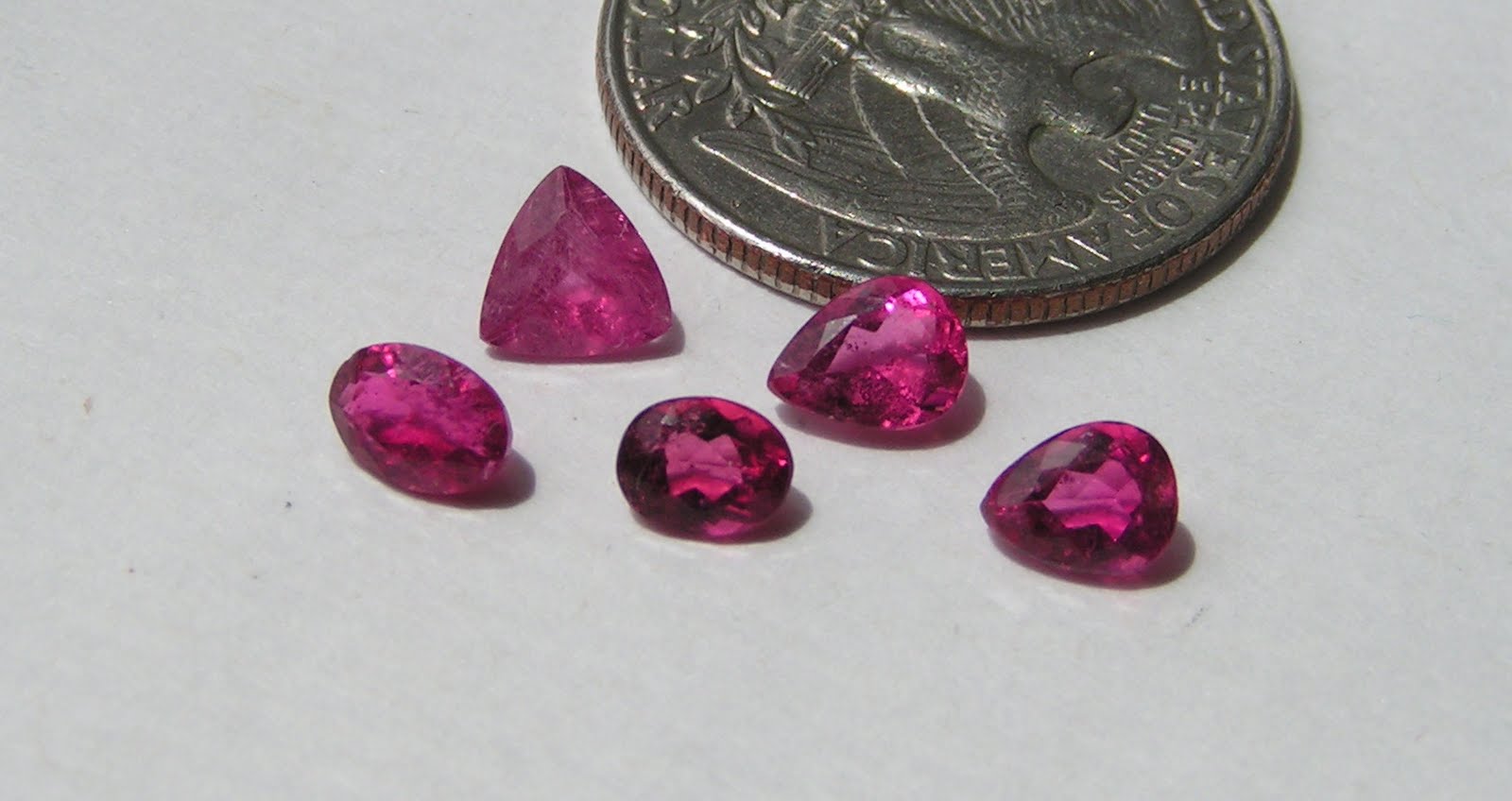
In some cases, certain hues of color are simply no longer found in the mines.  Take pink tourmaline, for instance.  In the picture below, the two pear shapes and the trilliant cut are old mine.  When you compare them to the oval in the front, you can see the difference.  There are more rose tones in the old miners, the color is softer and velvety.  In the picture that I took of just the pear shapes, this is more obvious.  And if I just look at them sitting on my desk, the color of the old miners just pops out more. 


The Kashmir mines (or its neighborhood) also still produce sapphires, but none have the beauty of the original material that came out of the mines in the 1880s.

There are drawbacks to working with old miners, however.  Often, their cut is bulky and heavy in the back, and the gem has less brilliance.  Modern settings often don’t fit these gems, and the setter, trying to make a square peg fit into a round hole, may either break the gem (common with emeralds) or the setting (I’ve seen that with sapphires a couple of times).  In some bezels, the gem sticks out so they can’t be used at all; and the hammer setting can burst the stone from inside.  With silver, which is much weaker than gold, the prongs can break if the setting is hollowed out to fit the gem.  (This is one reason why it is worth it to invest the extra $20-30 for a gold prong setting, especially in rings.)

To me, however, the headache is worth it.  Old miners don’t always cost what they should, given their beauty, because the commercial market has little use for them.  They are rarely treated (the emeralds can still be oiled, however), and they make each piece of jewelry I create one of a kind!

Wednesday, May 4, 2011

Gem Certificates: When and When Not

Last week I got asked again if I provide gem certificates with my stones.  Customers want to know this periodically, so let me share my thoughts on this.

Who certifies gems?  There are several recognized gemological labs in the U.S. The best known is GIA, and their main gem of expertise is diamond, but they also certify colored stones.  Other known labs are: American Gemological Laboratory (AGL), American Gem Trade Association (AGTA), and Gemological Appraisal Laboratory of America (GEMLAB).  All of these have locations in New York, but there are many others, and their reputations vary.

What does the certificate say?  Minimally, you can get a verbal or written gem id.  That’s useful if there’s a dispute about whether or not the gem is real, or when there’s a mixup of parcels.  A full lab report will also provides you with the gem’s origin, treatments/enhancements, comments on clarity and color grade, aside from the standard stuff (weight, cut, color, dimensions).

What does the certificate not say? A certificate does not provide you with the appraisal value of the gem.  Determining value depends a lot on the current market and on the purpose of the appraisal (an appraisal for insurance purposes is usually done at full retail value, a wholesale appraisal or an appraisal for an estate sale is much lower). 

What does it cost? A full GIA report costs over $200.  Minimally, if you want just a verbal gem id from a smaller lab, that’s $20, and GIA does not offer it as far as I know.  I only went to GEMLAB once, and they did it for me for $20. 

How about appraising an entire parcel?  That’s done by sampling.  So it doesn’t cost more.

Are gem certificates standard when you buy gems?  With larger diamonds, they’re fairly common, but with colored stones, no.  They are rare, in fact.  I’ve only ever seen them for gems that cost several thousand dollars. And even then, most gems don’t have certificates.

Are gem certificates 100% reliable?  No.  They are only as good as the expertise of the certifier.  Every week, someone asks my gemstone dealer, D. for a second opinion on a gem and lab report.  D. only uses only a gem microscope, he does not do refractive index tests or use other machinery, but when it comes to rubies, emeralds, and sapphires, from what I have observed, his opinion is more trusted than that of some of the labs.  And does he challenge what the report says?  On occasion, yes. 

Do gem reports affect the price of the gem?  You bet.  And not just by the cost of the report.  It can easily add another $1000 to the price of the gem because of credibility alone.

What about the certificates that are offered by online gemstone sellers?  I’ve never asked for one, but this is what I think: if the report or the website doesn’t identify the lab that’s used, then it’s just the seller printing you a guarantee.  But you don’t need that, because you can usually return any gem that you bought on the internet (you should double check that of course), and the seller is not supposed to lie anyway (a direct lie is illegal, don’t forget that, and the internet is public).  So what does the report give you that you don’t already have in the online gemstone listing?

How can you really be sure that your gem is real, untreated, or what have you?  After a year and a half in the diamond district, this is what I’ve learned: not all gemstone dealers are gemstone experts.  Many are knowledgeable, but others are just in for a quick buck, moving a parcel or a single gem from one dealer to another.  And they don’t know diddly.  Also, not all dealers know if and how their gems are treated.  But when you ask directly you will get the best answer they can offer because otherwise they will lose their reputation.  A gemstone dealer that cheated you on purpose may never sell on the street again if this becomes public knowledge.  In short, all he or she has is reputation, and you have the power to destroy it.  Other than that, you have to get to know your sources.  Choose a few trustworthy ones for the gems that are difficult and expensive.  For some of the cheaper stuff, or the stuff that’s easy to id and isn’t usually treated, you can, to a degree, take your chances.  For the expensive stuff, you have to assume that the gem is at least heat treated or oiled (in the case of emerald).  Very few dealers will guarantee that a gem 100% untreated. 

The anecdote that led me to write this entry.  On my way home the other day, I cut through the local mall and happened by a large jewelry chain that had a special sale.  They had an independent gemstone and diamond dealer there with lots of gems, mountings, and a professional setter who would work on the spot.  So you could pick your gem and have it set right away.  I stopped to look at the colored stone section  There were several sapphires, all neatly packaged with weights and sizes listed, as well as the price tags: $2000 and up for 1 carat gems.  I pointed at a purple sapphire listed at around $2000 (an oval of approximately 1 carat) and asked about the origin.  “We’re not given the origins,” the rep said.  Well I thought that was just ridiculous.  I left, but not without pointing out to the guy that origin greatly affects price.  For example, a 1 carat heated purple Tanzanian sapphire might sell for $100 on the street.  A 1 carat purple Ceylon of the right saturation might sell for $500 or more.  A x5 markup is expected for retail, because everyone has to get paid (the rep, the guy the rep bought from, the jewelry store, and everyone who works there).  A x5 might in fact just cover those costs, to be fair.  But x20 would be totally unacceptable, even at a retail outlet in the mall. 

So what do you get from a reputable jewelry store chain that you don’t get from a small time, reasonably knowledgeable gem dealer on 47th?  Apparently, nothing.


Approximately 1 Carat Burmese Ruby, Unheated (and untreated), No Certificate

Sunday, April 17, 2011

All Sales are Final: How to Save When Buying Gems

The wholesale price of any particular gem can vary drastically – as much as, I kid you not, 90% - depending on the context in which it is bought.  But: is extremely hard to get super low prices on gems, and unless you live in the right place, know the right people, and are willing to do a lot of hard work, it is simply not possible.  While I do manage to get gems at very good prices most of the time, even I rarely save that much. 

If you manage to save 40-50% over the average internet price of a gem, or perhaps 70% over a sale on T.V., then you’ve done good and your investment will retain its value over time.

What follows are some do’s and don’ts when you want to get low prices.

1. Don’t buy on the web or on T.V.:
Buy direct whenever possible.  A photo (or the flat screen) is never 100% accurate.  Also, when the “wholesale” website is open to the public, then that’s not really wholesale.  Prices can be lower than retail, but photos, listings, shipping, or producing a gem show take time, and time is money.  If you must buy on the web, make sure you get an inspection period and a return option.

The downside to buying direct: most sales are final.

2. Save by buying at shows:
Gem shows are definitely worth it.  Even gem dealers sometime buy from each other at shows!  Sellers have to make back the cost of their booth, and a show is a good way of advertising and connecting with potential new buyers.  But don’t rush yourself to buy. Walk around. Prices can vary drastically.  Take your time looking at the gems, and have them weighed before committing.  A low per carat price can fool you about the cost of a larger gem.  Make sure you have good lighting.  And ask questions about treatments.  If you don’t, you won’t be told.  Don’t just ask “is it natural?”  That just means it’s not synthetic.  Plus, many sellers think that “heating” does not mean “treating.”  So ask: “is it heated, oiled, glass filled?”  Finally, double check the invoice (make sure you ask for one).  Shows are busy, and both buyers and sellers can make mistakes.

The downside to buying at a show: gem show parcels, especially the loose ones in the little bowls, can contain scratched stones.  And sales at shows are definitely final.  It may be hard to get in touch with the same seller if you want to re-order (many are not on the web, and/or they live far away), and sometimes their non-show prices are higher.  Some sellers only sell at shows, period. 

3. Save by matching your own pairs for earrings:
When you try to match gems yourself, look for relatively uniform parcels – that saves time.  But: the more uniform the parcel, the higher the per carat price. Again: time is money. Use the groove between your index and middle finger on a tray to see how the gems will look against the skin.  Don’t work in dim lighting conditions and loupe your gems when you’re done.  Make sure you match color and size!

The downside to matching pairs yourself: some gems are incredibly hard to match.  Tourmaline and spinel are among the toughest.  You can think you matched your pair perfectly but when you go outside in the daylight you see that one gem is more pink, one more blue, etc.

4. Save by buying parcels:
This is definitely not for the uninitiated, but in rare cases, the savings are incredible.  However, a parcel may be large, so even if the per carat price is $1, you may have to dish out several hundred bucks for a ton of gems most of which you’ll never sell. 

When you buy a parcel, this is the most important rule of all: make your calculation based on one, ten, or a few more gems you know you can sell.  The sale should make you your money back on the entire parcel.  That’s how low the price has to be for you to make this investment.  80-90% of a parcel may be unusable material, and the lowest priced parcels are very uneven in quality.  So if you have time, put to one side the very best stones.  Regard the rest as garbage and recalculate the per carat price of the parcel based on what you’ve pulled out.  Is it still worth it?

Once, I was presented with a 50 carat parcel of untreated half to one carat Afghani rubies for a very low $40 per carat.  It was an “all or nothing” buy, no pick.  The parcel was very glittery and beautiful, but after I spent about 15 minutes pushing to one side the really nice stuff, the parcel that was leftover looked dull and unappealing.  Meanwhile, I had not even pulled out 10%.  That meant the per carat price was $400 for the good stuff, and that was way overpriced.

The downside when buying parcels: you can get sucked in by a few pieces of glitter and lose your shirt.  Parcels are for the long haul if you want to use most of it, or a quick turnaround based on one or two pieces only.  And – yes, you got it: all sales are final.

5. Save by Bringing Cash on a Friday:
First of all, most gemstone sales (except for shows and the web) are cash sales.  Most of the time, you can still get an invoice, just ask.  But some sellers travel, a parcel can have several bids on it on the same day, meanwhile, any check can bounce.  A credit cared sale can be challenged.  Cash is the guarantee.  Cash down on a memo of 60 days is a possibility, but cash is paid down first, and cash is king.  Cash on the table, not in your wallet (you might literally have to put it out there to get the lowest price).

And what’s the story with buying on a Friday? Gemstone dealers go home for the weekend, and they need some money to bring home.  The younger ones want to party.  So if you pay cash out on a Friday, especially later in the cay, you’ll get the lowest prices of the week.

The downside to cash buys: an experienced gemstone dealer will ask you one of two questions you should not get suckered into answering (or answering honestly).  One: “how much cash do you have on you?” And Two: “what is your budget?”  If you give an honest answer, the price they give will reflect what you said.  Then you will never know how low the offer was really going to be.  So just look at the parcel, then ask for a price.  If the price is more than you want o pay and you say that you don’t have that much on you, you’ve got the upper hand.

The Final Word: if you have someone in the industry that you trust, use their expertise.  Let them help you, and if you can, show them what you are considering buying.  People who have done this for a lifetime always know more than you do.  By the same token, if you’re a repeat buyer, you are always honest and you always pay (on time), sooner or later you will be offered very good deals.  In the long run, honesty pays – both for the gemstone dealer and for you.  A lost reputation is a lost future opportunity.

A Parcel of 2.5mm Burma Pink Sapphires: looks very sparkly but only 10-20% are usable.

Sunday, April 3, 2011

“Could This Gem be a Little Bigger?” (How Big is Your Wallet?)

I get asked the question posed in the title about once a week.  Two out of three times I don’t hear back after my response.  I guess it's time to cut down on some of these questions, and put the request for bigger gems into perspective.

Let’s start with basic gem sizes and weights: each mm increase in diameter roughly doubles the weight of the gem.  Since gem prices are determined by weight, this also doubles the cost (or more, but I’ll get to that later).

An approximation of colored stone weight can be given by referring to standard diamond weights.  Here’s the standard table for brilliant cut diamond rounds:

1.3 mm
.01 carat
2.1 mm
.04 carat
3 mm
.1 carat
3.4 mm
.15 carat
4 mm
.25 carat
5 mm
.50 carat
6 mm
.85 carat

Now let’s make some sample adjustments for other cuts:
4mm round = 5x3 oval (1mm more in length, 1mm less in width, now you can do the rest)
5mm square = about 1.5 times the weight of a 5mm round (because you have to add in the corners)
5mm triangle = about 1/3 less than a 5mm round (because you cut down from the diameter)

Note that cabochons weigh roughly twice the amount of the same size faceted gem. 

Next, there are some basic adjustments for colored stones:
1. Most colored stones are denser, so they weight a little more.
2. Most colored stones are cut more deeply for color, so they weigh more again (if they are brilliant cut, they are cut like diamonds, but step cut for instance is rounder in the back and therefore heavier).

A good rule of thumb is that colored weigh on average 1/3 more than diamonds of the same weight.  So a 6mm round, or a 7x5mm oval weighs about 1 carat or a little more.

Finally, with some gems the size affects per carat price – drastically.  So let’s look into that.

First, we can exclude some gemstones where the per carat prices stay relatively constant, regardless of size.  That’s Amethyst, Apatite, Citrine, Chrome Diopside, Iolite, Mexican fire opal, Moonstone (and Labradorite), Quartz (any not already listed), Spessartite, Topaz (any)
Zircon.  Take this list with a grain of salt; there are always exceptions for special cuts or huge sizes.

Next, here are some gemstones where the per carat price jumps only in the large sizes.  The equal sign denotes price constancy.  The multipliers are in terms of the base price.  Also, I am only here talking about untreated stones.  So no heat, no oil, no glass filling   Oiled emeralds are probably similar in price, heated sapphires might be up to half these prices, but glass filled rubies are essentially worthless.

(Disclaimer: these multipliers are rough guidelines at best.)


Below 1 ct
1-2 ct
3-5 ct
5+ ct
Aquamarine
=
=
x 4
x 10
Peridot
=
x 2
x 2
x 10 minimum 
Red Garnet
=
=
=
rare
Rhodolite Garnet
=
=
x 3
x 5- x 10
Spinel
=
x 5 or more
rare
NA
Tourmaline
=
x 2
x 10
x 10
Tsavorite Garnet
x 5 after .25 carat
x 10
rare
NA


There are many exceptions to this, i.e. huge sizes in aqua or peridot can command prices in the hundreds of thousands.  Origin also plays a role with most of these gems.  Other prices fluctuate according to demand. 

Lastly, here are the gemstones where the per carat price jumps drastically starting with small sizes:


.10-.25ct
.25-.5ct
.5-1ct
1ct
2ct
3ct
4-5ct
Alexandrite
x 2
x 4
x 10+
x 20+
Rare
NA
NA
Diamond
=
x 2
x 4
*
*
*
*
Emerald
=
x 3
x 6
x 10
x 15
*
*
Ruby (Burma)
x 2
x 5
x 20
x 45
x 100
x 1000
x 1000
Sapphire (Ceylon)
x 2
x 4
x 12
x 30
x 30
x 30
*
Sapphire (Australian, Thai)
=
=
x 4
x 8
x 10
x 15
*


* These are prices I was asked not to provide.  Not so much that they’re a secret, but the fluctuations can be drastic.  Suffice it to say that a large diamond approximates the price of a large ruby, or more.  Diamonds are more available but controlled, rubies (Burmese, untreated) in the 3+ carat size are nearly non-existent.   So those two are more or less the two most expensive gems you can buy in large sizes.  Emeralds are cheaper and larger sizes are available, but they too can be in the hundreds of thousands in the very large sizes (5 carats or more).  Sapphires are also more abundant and will cost quite a bit less than rubies in the large sizes.

To those of you who have been quoted prices by me that are blow this list: congratulations. I probably got a good deal and passed it on. 

More about how to beat prices on gems in my next entry…


Matched Pair of 4mm Unheated Ceylon Sapphires I recently acquired