Monday, September 26, 2011

Addicted to Spinel

You must have wondered: how much more spinel can she list on her Etsy site?  Well, instead you should ask: how much spinel does she buy?  A lot, apparently.  I’m addicted to the stuff.

Spinel is its own mineral, but it is often found together with corundum – sapphire and ruby in other words.  Spinel comes from Sri Lanka (Ceylon), Myanmar (Burma), but also Vietnam and Cambodia, Madagascar, Nigeria, Tanzania and Thailand, to name a few.  The spinel I’ve dealt with has been from Sri Lanka, Myanmar, Vietnam and recently, Tanzania.  I’ve not seen other origins on the market.
I like spinel because it is very sparkly and because right now, there are no known treatments or enhancements for it, so it is not that tricky to buy.  Spinel is a fairly sturdy stone with a hardness of 8, and it always totally natural. (There is synthetic spinel, of course, but I’m not talking about that.)

Spinel comes in red, pink, purple, blue, and sometimes orange, yellow and green.  The value is determined more or less in that order as well, though there are exceptions, depending on origin.  There’s also black spinel, but what is sold under that name can also be garnet, and sometimes even black onyx. 

Red spinel used to be confused with ruby but if you’ve ever seen red spinel, this is hard to believe.  Most ruby nowadays is more pinkish, and usually more included.  Spinel is very crisp and clean.  Word has it that there used to be rubies like that, but they are now exceptionally rare.
Red Spinel, Diamond and 14K Gold Ring - Custom Order
The rarity factor: yes, spinel is rarer than corundum, and some people think it is therefore more valuable.  Well, value is determined by demand, and there’s much less demand for spinel because it is less known and not used in the mass jewelry market.  So the cat chases its own tail: because it is rare, spinel can’t be commercialized, and because of that, it costs less.

I think spinel will probably never be as costly as sapphire, but it will also retain its value.  Some say it might move slightly ahead of inflation.  But right now all gemstones are ahead of inflation because many people are looking to invest in something other than stocks.  So as gold and silver go up, diamonds go up, and then colored stones go up.

So what’s the most valuable spinel?  Probably Burmese red, if it’s clean and large enough (1 carat at least).  I’ve never seen any that size.  Some websites offer Burmese reds at over 1 carat, but they’re lightly included and darker color.

The next most valuable spinel is the neon pink stuff from the Mehenge mines in Tanzania.  That material is really really bright.  Mahenge spinel has an absolutely phenomenal color, it’s almost fake looking.  It is also rare, and it already trades at high prices.  I only know one dealer that carries it.
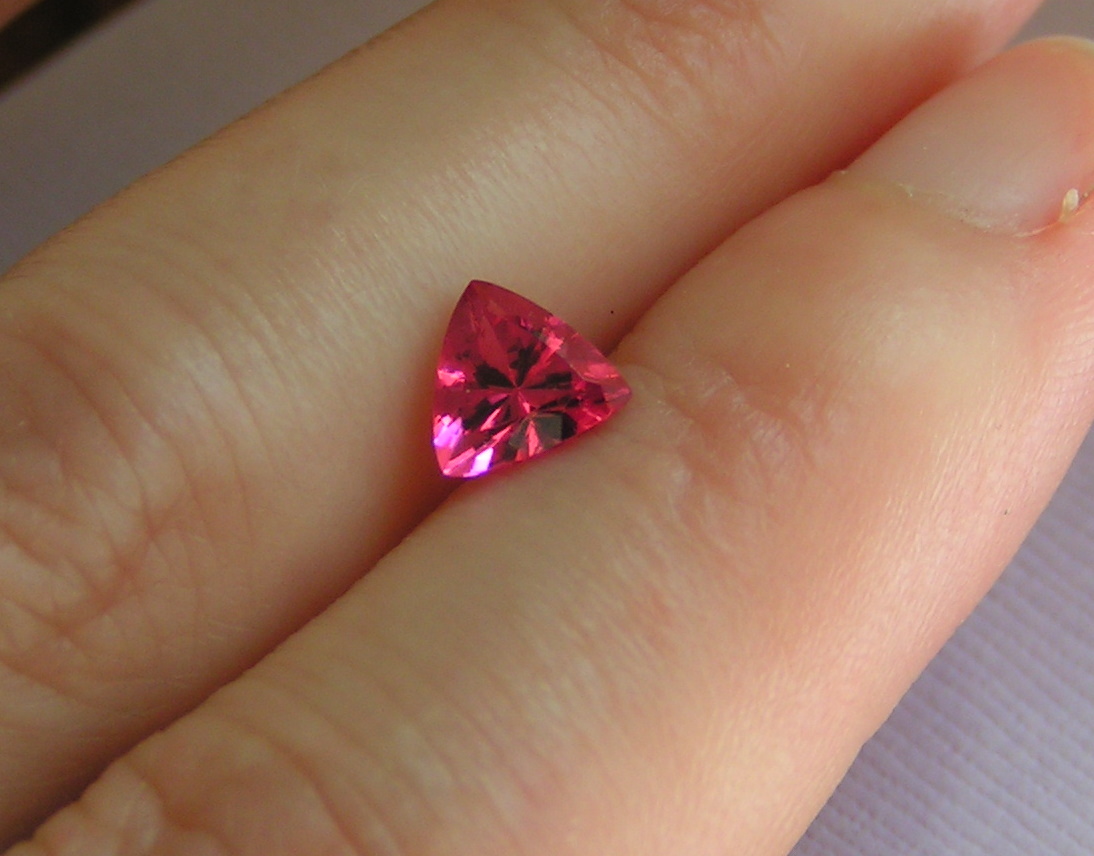
Mehenge Spinel Currently on my Site

Sri Lankan stones, which are mostly pink, purple and blue, definitely cost much less (about 80% less on average) than Burmese or Tanzanian.  They come in bigger sizes, though, and are equally clean. 

 There’s one other very important factor to consider when you buy spinel.  You must look for “open color”:  a red stone, for instance, should be bright and sparkly, it should pop out at you.  It should not look like garnet.  In other words, you are avoiding what is sometimes called “grey mask”.  This doesn’t make the stone look grey exactly, but as any graphic or interior designer will tell you, adding grey subdues a color.  So a stone with grey mask has less presence, it looks a little lifeless.  When I browsed the web for this blog entry, I came upon a site where you can see the grey mask in some of the purple and blue stones: http://awesomegems.com/spinel.html.  I think you’ll see it clearly.
Ceylon Spinel Ring

Wednesday, September 7, 2011

Can You Live off Etsy?

Everyone in my craft group has an Etsy shop, one is even an Etsy co-founder.  Some have been in the Indie craft scene for over a decade.  But everyone is a hobbyist.  At one of our recent meetings, someone asked if you could actually make a living with an Etsy shop.  There are no studies on this, so we all took our best guess: unlikely.

I could not stop thinking about this.  I have an active shop, but I don’t think that the number of sales a shop has necessarily determines your income.  You can have a lot of sales, and still not make any money.  You might be putting way too much time and material into the shop without calculating the required return.  So let’s talk about that.
Let’s start by asking how much money you want to make.  $50,000 before taxes, working 40 hrs a week, would not be an unreasonable figure.  Here in NJ, you can’t raise a family on that, but you can make a single living.  And I want to look at the possibility of making a living, not “contributing to family income.”  (If this figure sounds too high or too low for you, just make a mental adjustment.)

Divided by 50 weeks of working and taking 2 weeks off for vacation, this means that you have to make $500 each week.  How much is that in sales revenue?  I’m going to say $2000.  Here’s how I did the math for this:
Income                                                             $500 / 25%
Materials                                                          $600 / 30%
Fees (Etsy, Paypal, Listing Fees)                 $140 / 7%
Equipment, Tools, Packaging, Printing     $200 / 10%
Overhead (Electric, Internet)                       $100 / 5%
Wasted and extra materials                          $100 / 5%
Breakage, botched designs and orders       $100 / 5%
Growing inventory and materials                $200 / 10%         


That’s 97%, with 3% wiggle room.  I am here falsely assuming that you sell ALL the items you list.  I am also assuming that you already have a running Etsy shop with a good number of listings.  This is not a startup calculation.
How many items do you need to sell to make this?  If your average item is $50, then that’s 40 items.

Anecdote: I recently ordered a dress on Etsy for $88.  I am not a taylor, but friends estimated it took about 3 hrs to make that dress.  Can the seller make 20 dresses in one week?  No because that’s 60 hours just spent dressmaking.  Her dresses are seriously underpriced.
But let’s say it takes you an average of 1 hour to make an item and your average item costs $50.  That means you need to make 40 items in any given week.  Can you do that?  I doubt it.  Why?  Because we’ve only taken account of the time spent making the item.  But that’s hardly all that’s involved.  What else takes time?

1.      Photos (for 40 new listings, that’s 200 pictures minimum).
2.      Writing up 40 listing descriptions.
[Observation: if you make 40 different items, you will kill yourself just taking photos and making listings.]

3.      Other internet time: convos, blogging, promoting …
4.      Packing and shipping (for international orders, trips to the post  Office).
5.      Shopping for supplies.
6.      Bookkeeping, working out pricing for custom orders etc.
Would it be fair to say that items 1-6 will fill up to half your week already?  Then you can make only 20 items and your math is way off.  You need be faster or you need to double your prices. 

Somebody said this to me once: if you want to make money selling crafts, remember that you will spend up to 60% of your time selling, and 40% of your time making stuff.  Seems right, doesn’t it?
If these observations have you pondering, or worse, have you worried, do this: next week, keep a log of all your time spent, sorted by the categories above.  Better, do it for a month because no two weeks are the same.  If the math doesn’t add up for you, you need to rethink your shop. 

Tuesday, August 23, 2011

Jewelers Prefer Prongs. You Don’t.

Why don’t you like prongs?  I so wish you did!  Deep down, this is what I want to say whenever I get a new custom order for bezel set gems.  But I hear you.  It just looks so nice, and it’s a very protective for the stone, too.  So if we’re going to bezel set your stone, there are some things you need to know.

First of all, let’s talk about why jewelers prefer prongs.  For one, prongs can better accommodate odd stone sizes and depths.  There are no prong settings for cushion cuts, but very often a round or a square setting will work.  And most existing bezels for pears are 8x6, 7x5, and so on.  Whereas most pear shapes are fatter, shorter, or longer (i.e. 8x7, or 7x3).  But prongs can be opened up just a little, and in a 4 prong setting, the gem can stick out on both ends and that won’t matter.  You can also take a prong setting, cut some metal from the bottom half, then re-solder the wire to make a narrower setting.
Another reason why jewelers prefer prongs is because the stone is less likely to break during setting.  Paradoxically, it is the soft stones you would want to bezel set for precisely that reason.  Oh well….

So as you’re dreaming about the next bezeled ring or pendant, keep in mind a few simple rules.
1. Bezels come in standard sizes, gems don’t.   For rounds, there are full and half mm sizes; and with straight, as opposed to tapered bezels, the stone has to fit exactly.  If it’s 1/10th mm too big, it sticks out and the walls don’t fold.  If it’s 2/10th mm too small, it will fall through the back.  For ovals, pears, and emerald cuts, the easily available sizes are 5x3, 6x4 etc., but not 5x4, or 6x5.

2. There are tapered bezels and straight bezels.  The straight bezels require a nearly perfect fit, the tapered bezels can be shaved down a little from the top if the stone is too small (for a perfect fit, it should line up with the rim of the bezel).  Most tapered bezels on the market have an airline, however.  That means they are not fully closed but have an opening on the sides that goes around the stone.  This allows for more light to fall in.
Two straight bezels (an oval and a princess), a round tapered bezel with airline and a half-bezel, similar to a tourmaline setting (with a tourmaline sitting in it).
3. Not all stone shapes have bezels you can buy.  Here’s a big mystery for you: there are no cushion shaped bezels available anywhere.  Who knows why.  It is the same with baguettes.  For baguettes, you usually use prong settings or a setting (called tourmaline or baguette) that has two walls folding in on the stone on the outer ends.
4. If you buy 14K, you usually have more choices available, because in the industry, gold is still used far more than silver.  For now…
What happens if the bezel you want doesn’t exist and that you need to have it made?

There are two ways to make a bezel (that I know of).  The easy method is to use step bezel wire which has a second inner wall that will serve as the seat for the gem (look at the picture with the bezels, the way the straight bezels look gives you an idea of the shape of the wire).  This wire gets folded gently around the stone, with grooves filed on the inside to allow corners to fold in, and the ends soldered together (or if you cut three pieces for, say, a triangle, then you solder the three seams).  Making this kind of bezel takes about a half hour on average.  And: I know how to do it!

The hard method is to take a block of silver, or a block of wax if you like, and shave out the opening for the stone with a drill, then shave the outside to suit.  That’s like sculpting, essentially, just with different tools.  Like Michelangelo, you’re digging out a little cushion shaped David from a piece of metal or wax. 
This, by the way, is the only way to make a tapered bezel for an oddly shaped stone.  But I cannot do it for you.  I can hire out, I did it once for my 6mm cushion bezel.  But it cost $60 and it took the guy all afternoon.  I’m glad I did it because I had it cast to make more, but now all I have is that one size.  I can shave the top to make it smaller, but I sure can’t make it bigger. 

Ring with My Handmade Cushion Bezel
Lastly, there are three reasons for why you, too, might prefer prongs.
1. Your stone is likely to break if bezeled.  If it’s a soft stone (kyanite, sunstone, Mexican fire opal, apatite), and especially if it has sharp corners like a princess cut, forget bezeling it. 

2. Your stone is too deep.  Some stones are so deep they stick out the back of a bezel.  This is not such a big deal for a pendant, but in a ring it may be uncomfortable to wear.
3. Your stone is too dark.  Normally a bezel is recommended for medium to lighter gems because the bezel takes away the light.  Sometimes, what I do in that case is solder the bezel on top of the ring shank because the silver behind it will brighten the gem.  But if it’s a deep bezel, that won’t work.

Happy designing!

Sunday, August 7, 2011

Can You Get a Gem Like This? Some Brief Notes on Odds

I periodically get questions like these: can you get a 5mm princess cut blue tourmaline?  Or: do you have a matched pair of 4mm round Ceylon sapphires?  And sometimes that’s a “yes”.  Mostly, though, it’s tough.  To communicate how tough, let’s play a numbers game by multiplying out the possibilities. 

1.      Gemstone shapes: There are 8 basic gem shapes: round, oval, emerald, baguette, trillion, princess, cushion, pear.  There are also lots of odd shapes, most of which don’t fit into stock settings, let’s skip those.
2.      Gemstone sizes: Let’s assume that there are 10 sizes for each shape.  For instance, rounds, trilliants and squares will be 1mm, 2mm, etc, ovals and emerald cuts will be 2x1, 4x2, etc, and baguettes 6x2, 8x4, etc.  Baguettes can also be 8x3 or 8x2, and of course there are tons of in between sizes.  We’ll ignore them all.
3.      Gemstone cuts: there are tons, and they matter at least somewhat.  I.e. it matters for setting if the back of a stone is brilliant cut (shallow) or step cut (deep).  For looks, the surface matters.  Some people like checker top, for instance.  Or no facets on the top, which is called “buff cut”.  Rectangular stones are sometimes radiant cut in the back for more brilliance.  All the square cuts, which I inaccurately lumped under “princess cuts”, divide at least into square, princess, or French cut.  There are dozens of cuts out there, not counting combinations.  But let’s just say there are 2x2 relevant cuts for each gem.  That’s two for the top side, two for the bottom side, meaning 4 in total.
4.      Gemstone colors: This is difficult.  Some stones (peridot for instance) all look nearly the same, whereas others (tourmaline) almost never do.  Some colors are rare (blue and turquoise tourmaline for instance), some popular (royal blue sapphires).  For tourmaline, it would be an understatement to say there are 10 different greens, for peridot, it might be an overstatement to say there are three.  A conservative medium might be to say there are 5 different colors per gem, including shades.  I.e. sapphire might be light, medium to royal blue, midnight blue, or purple.  Fancy sapphire might be pink, yellow, orange, green, white, not including any hues.  Tourmaline might be blue, turquoise, grass, forest, and olive, excluding shades.
5.      Gemstone origins: This doesn’t always matter, but let’s restrict ourselves to when it does.  So we won’t care about amethyst, red garnet, citrine, or other quartz.  We will care about emerald, which can be Columbian, Brazilian or Zambian, for sapphire (which comes from Sri Lanka, Madagascar, Australia, Burma, Tanzania…), ruby (Burma, Afghanistan, Thai…), aqua (Brazil, African…), spessartite (Tanzanian, Kenyan, Nigerian…), tourmaline (Brazilian, African…), etc.  With these and other gems, origin matters because of color, quality, and of course, price.  I am going to settle on an average of 3 origins per gem.
6.      Quality: obviously this is very important, but the quality of a gem can range so vastly that I will exclude it.  Let’s say that in general, you want the medium to nicer stuff.

Blue Apatite and Green Zircon Mixed Shapes
Now let’s multiply the odds of finding your gem:
8 (shapes) x 10 (sizes) x 4 (cuts) x 5 (colors) x 3 (origins) = 4800 possibilities

So the odds of finding your gem are an average of 1:4800 for EACH gemstone in at least these categories: sapphire, ruby, emerald, tourmaline, spessartite, tsavorite, alexandrite (the odds will be a little less there, but of course you have to find it in the first place), aquamarine, spinel, and I don’t even know what else. 
Different Kinds of Ceylon Spinel
Caveats:
1.      Most gems are cut according to the shape of the rough, other cuts are uncommon (I’ve never seen a spinel or a spessartite or a tsavorite cut as a baguette).
2.      Certain stones are cut for color retention (so it is hard to find a brilliant cut Ceylon sapphire).
3.      Many gems are cut for maximum size (which is why princess cuts are hard to find).
4.      Some gems don’t exist in certain sizes, or are extremely rare (it is hard to find very small topaz, and hard to find very large alexandrites or rubies).
5.      Some origins are rare.
6.      Matched pairs make for two needles in a haystack, not one.
7.      Untreated gems (in some cases) are rare.
8.      Reminder: we totally excluded the category of quality.

All this affects the odds, mostly by way of increasing them.  The odds of finding a true padparadscha sapphire (meaning Ceylon origin and real salmon color) in a size larger than 2 carats are very small.  Recently a customer asked for a 1 carat round alexandrite of 6mm or larger.  You know what the alexandrite dealer said?  It will be 1 carat, but it isn’t going to be round.
So yes, you can keep asking me to find you certain stones.  I seem to be producing an ever increasing variety of gems (even I am surprised).  But be flexible.

A Few Different Australian Sapphires

Saturday, July 23, 2011

How to Judge a Ceylon

It’s been an interesting year for Ceylon sapphires.  Last summer, they were fairly reasonable in price, and I bought one for myself for a ring.  Ever since then, customers have wanted a gem like mine: larger size (about 2 carats), nice rich popping blue, clean and sparkly, and unheated of course.  But I couldn’t find any.  The guy from Sri Lanka, from whom I bought my stone, was supposed to come back in spring, but spring came and went, but there was no sign of him.  D. has only 1 carat pieces.  Other guys have heated material only, and they wanted something like eight times what I originally paid for mine. 
               In June, the guy from Sri Lanka finally showed up on the street, and I lined up to be the first buyer.  The unheated parcel was small, with perhaps 20 gems, no more.  I just go by sight at this point.  It’s hard to explain.  I pick what I like best, then I loupe it to make sure I didn’t miss anything (scratches, inclusions, uneven color).  I rest the gem between my index and middle finger to see if I can see through it (when you can, it’s called “window” and it’s not good).  Then I tilt it in various ways to see if it still looks nice.  I put it against silver to see if that brightens it up or darkens it.  I pop it into a setting if I have one to see how it changes color.  If it gets too dark I dismiss it. 

               Here’s a picture of the gems I picked, and one that D. bought (but he got it elsewhere) - his is the one next to my ring. 


               One of my customers, Anya from Baltimore, wanted the first stone, and we spent almost an entire afternoon sending pix, questions and answers back and forth.  In that process, we both learned a lot, and I thought it might be fun to share.  So here, in no particular order, are our thoughts:
1.      Color: the perfect Ceylon should be medium-dark blue.  The color that marks a typical Ceylon is called “cornflower” but I’m still not sure what that actually is (neither are many people on 47th Street).  So instead, I’m going to describe it as a medium to darker royal blue.  If it is too light, the value decreases, if it is too dark it won’t look good.  Ceylons are often too light, whereas Thai material is often too dark.  You want a color that totally pops out at you.  Ceylons have less purple in it than Burmas (Burmas have about 15-20%), sometimes they have no purple at all.  In the picture below, two of the gems have a little more purple in them than the other two.  Can you see which?


2.      Brilliance: Burmas have more of a sleepy quality to them, and they are darker in color.  A good Ceylon should be crisp.  It should sparkle.  Now the darker the gem, the less brilliance it has.  That’s just the effect of the color and that’s ok.  But it should still sparkle.  In our parcel, the one with the most brilliance is D.s gem.  High brilliance is often the mark of good cutting and many facets, but it also means that the gem material itself has few to no inclusions.


3.      Inclusions: In the high end gems, there should be few to none visible to the naked eye.  There will be some “silk” when you loupe it, though.  Those are fine white lines.  They’re ok, but nothing should be distracting when you just look at the gem.  That makes it look ugly and devalues it.  But I have seen a few very large (over 10 carat) Ceylons that did have a visible inclusion.  In that size, however, this is not such a big deal.   The size will outweigh it.  But the smaller the gem, the more squaky clean you want it to be.

4.      Zoning: this is the mark of a Ceylon and clearly distinguishes it from other sapphires.  Zoning refers to uneven color distribution in the gem.  If you turn any Ceylon upside down you will see the zoning.  Sometimes, when you look at it from the side, you see that the most color is in the tip, the culet.  The gem is cut in such a way as to make that color look even from the front.  If you re-cut the gem so that it is flatter, you will lose all the color.  That’s why Ceylons are often heavy and bulky in the cut.  On rare occasion you see a flat gem with very even color distribution.  That’s ideal, because it also lowers the weight and hence the price.  In my array, the most even color distribution is in the cushion cut near the fingertip (from the front, they’re pretty much the same).  Any Ceylon will have some zoning, and in a way that is good because you will be able to tell that it is genuine.  A fake won’t have zoning (or inclusions, for that matter).  The key is to minimize it, and to make sure it isn’t visible from the front.  From the back it won’t really matter, unless you plan to set the gem upside down for some reason (and I have no idea why you would).

What’s the upshot when it comes to our four gems?  To some degree, this is simply a matter of taste.  The one on the left is judged to have twice the value of the others (and it cost twice as much).  This is because it has the most even color distribution, the most brilliance, and the fewest inclusions.  But if I were to pick one, I’d go for the cushion.  It has a little more purple in it, a little more color.  And it is nice and flat (so it costs less).  But I already have mine.
Anya picked the larger oval (the second from the left in the first picture – can you see where it is in the other pics?  Look at the overall shape of all gems, and look at each table to tell them apart).  Anya’s gem also has more purple in it, it is inclusion free and has a lot of sparkle.  The color really pops out at you, and I would have favored that one as well, depending on what design I liked for it.  Ovals are easier to work with than cushions.  Both Anya and I thought that the most expensive gem was stunningly beautiful but it just costs a lot of money.  It’s a great buy, but you need to have more disposable income for it – but if you have that, I highly recommend it.

Sunday, July 10, 2011

Ceylon Gems from Germany

As some of you know, I was just on vacation, taking a break from research, my Etsy shop, and my gems.  Or so I thought, until my aunt suggested I take a trip to Idar-Oberstein.  This small and sleepy town, located in a valley in the middle of nowhere (insofar as that’s possible in Germany), turned out to be the European Taj Mahal of gems.  Had I not pulled myself together, the effect on my wallet could have been as devastating as any NY gem show.  I am good with money.  Very good.  Except when I buy gems.

The gemstone history of Idar-Oberstein dates back to the 13th century, when the town was known for its agate mines.  First reports gem cutting date back to the 1500s, and in 1974 Idar-Oberstein established a gemstone exchange.  Stores are open year-round, and its annual trade show draws in gem dealers worldwide.  You can also visit a local copper mine and about a dozen gemstone cutters whose shops are open to the public.  And of course there is a museum.  Germans love museums.  The town business directory – the first thing I grabbed when I got there – lists over 250 names revolving around gems: cutters, jewelers, silver, gold, diamond and colored stone dealers, as well as a jewelry design school.
Google Image of Idar-Oberstein
In the center of the “Oberstein” half of the town, there’s a touristy section where you can look at anything from the latest jewelry creations to gems, beads and tumbled rocks, or you can sit in a restaurant and eat the town’s (supposedly) famous “Spiessbraten,” grilled pork roast.  (Germans also love pork.)
Spiessbraten
But of course I didn’t drive 90 minutes at German gas prices for a pork roast.  Nor did I want to spend $140 per carat on 4mm tourmalines or $90 per carat on red zircon – stones that I eyed in one retail store whose owner wiped everything I touched enough times to make me feel unwelcome.  Gems are meant to be played with!  This retailer did, however, offer an emerald slice identical to one that I had a while back (it sold for about $160 in a ring).  The $500 price tag taught me a valuable lesson about my pricing strategy, or rather, the lack thereof.
My annoyance that perhaps I had wasted my time coming was eased when I went inside the store of a stone cutter.  In the (retail) bargain bin I found a pretty pink imperial topaz, and some reasonably priced watermelon tourmaline slices.  And later, inside the garage of a wholesaler, I saw literally dozens of amethyst geodes that were between 5 and 9 feet high.  There they were, just sitting around in the dirt, gathering dust.  No wonder amethyst is so cheap. 

And then I found the guy from Sri Lanka.
Which went like this.  My mom and I decided to leave the tourists behind and check out the lesser known “Idar” half of the town.  On the map, it looked really close so we thought we’d walk it.  After about 45 minutes of trecking down the dusty Hauptstrasse in the scorching midday heat, we started to see more signs for wholesalers.  But it wasn’t like in the diamond district.  Everything was (far too) stretched out.  And there were no window displays, no actual shops, just signs at private homes, signaling a gem dealer, with “wholesale only” written underneath.  I felt awkward about just ringing a bell, but then my mom was like, “look, that’s what we came here for, didn’t we?”  So I hesitatingly pushed the next buzzer.  No answer.  Another bell didn’t work, in yet another case we couldn’t figure out where the buzzer even was.  Perhaps the sign was old, because some of the places looked deserted.  Then I saw foreign sounding name on the side of a building, and underneath it some words to the effect that the seller specialized in Ceylon gems.  “That’s the one,” I decided, took another deep breath and rang.

I was beckoned inside by what turned out to be a Sri Lankan dealer who had immigrated to Germany some 30-odd years ago.  I had nothing on me that identified me as a wholesale buyer but it didn’t matter.  Let’s just say that after a few questions, any good dealer can “make you.”  Then, when you look at the first gems, they know your level of experience as well (it’s about how you handle the tweezer for instance, or the way you tilt a gem to catch the light).  I bet this guy could even guesstimate how long I had been doing this (not nearly as long as him, for instance), and what price range I might shop at (baby prices). 
To test him in turn, I asked for the per carat price of Swiss blue topaz, which, I figured, would be the same worldwide for wholesale.  The figure he quoted – in U.S. dollars, by the way, which is apparently the custom – was the one I had hoped for: it indicated pretty much the lowest available market price.  That settled it for me: I needed to have a closer look.

I have to say I got the royal treatment.  The gemstone dealer just put one of his briefcases onto the desk, opened it and said “here.”  I could pull out the trays and look, ask for prices, open the boxes and play.  His wife kindly brought us water.  I was seriously dehydrated at that point but when I get gem fever, I barely notice.  For my purchase, I settled on the spinels you see below.  Ceylon material, precision cuts I’d not yet seen (hexagons, square emerald cuts, and little 5mm trilliant cuts).  I got parcel price for choice to make matched sets (I already know I will be asking him to ship me the rest of those hexagons, and perhaps he knew that, too).  And I got the nearly 5 carat violet spinel you see below as well.  After red, purple is the most sought after and rare color of spinel, and larger gems are always the better investment.  This piece is flawless and will make for a great ring or pendant.  (I’ll be listing it for sale as soon as I have sufficiently mused over my asking price).
Ceylon Spinel: 4-5mm pairs, calibrated cuts

4.7 Ct Violet Ceylon Spinel
Out of curiosity, I also asked for Padparadscha sapphires.  In Ceylon sapphires, they are the rarest of all.  Their pinkish orange color is unique among gemstones, and their brilliance unrivaled.  In NY, I have never seen a Padparadscha (I’m not counting sapphires of similar color from other regions like Tanzania).  But this dealer had several pieces, gorgeous stuff, the prices in the tens of thousands.  And he had 10+ carat blue sapphires, all of this, the stuff of legends.  You might find this surprising, but at that size, natural – unheated - blue Ceylons are extremely rare.  And the mines yield less each year.  The other Sri Lankan dealer I know, a guy who comes to NY periodically, had nothing over 3 carats with him this time - in the unheated variety that is.  And he only had about a dozen of those.  In case you are now curious because you had heard me mention him before, I caught sight of him on the street the day before I left, and with the help of D., I picked two pieces.  If D. hasn’t sold them while I was away (I stashed them in his safe before I left, so this is entirely possible), I will be offering them out for sale very soon.  But I already have a couple of people waiting in line to see them.  That’s how it is with Ceylon blue, even in these “smaller” sizes.

The good news, however, is this: if mine, and your wallet is big enough, I can now get more and larger Sri Lankan material (sapphire, spinel, also moonstone), because I can have them shipped to me via the small and sleepy town of Idar-Oberstein.  LOL.

Tuesday, June 21, 2011

Trading with Gems

Sometimes I can be a ditz.  It took me a while to figure this out: among many other things, 47th Street is a commodities exchange for gems and diamonds.  This only occurred to me after one of the gemstone dealers I know, who was set up at his booth at a local show, said to me “if you see any great gem deals around here, let me know.”  “Why do they buy from each other?” I wondered.  “Aren’t they there to sell their own stuff?”  Yes, but they also buy from other vendors, mark up the gem and sell it again.  Sometimes on the same day, in the same hour even.  A buyer like me falls into a totally different category for them.  I’m more or less their end user, the person who actually makes jewelry with the gem.  So most people like me are basically at the end of the scale for wholesale prices.

Some gemstone dealers, it turns out, don’t keep any stock at all.  They are brokers.  They borrow gems from a source, from “a guy down the street” (it’s improper to ask who that is), and show them to another dealer at a slightly higher price.  If the deal doesn’t go through, they bring the gems back.  Others may actually buy a parcel, then break it up and sort it into smaller parcels and resell those (all the gems of a certain size, shape, or cut together, for instance).  Yet others are more like runners.  They show up on the street one day, maybe get an introduction through a friend, or just start hanging around and make friends on their own.  At some point, a dealer may ask such a guy to make a run: bring a gem over to another dealer, perhaps to show to a customer (someone like me, that is).   So the guy walks the gem or parcel to the address he’s given, and if the other dealer buys, he will get a percentage.  Said guy (I’m not being sexist, it’s mostly a guy), will be given cheap gems at first, larger parcels eventually (up to perhaps a thousand dollars, probably not much more than that).  The runner may not know even the name of the gem, it’s not his job to make a price judgment, he just passes on gems and messages (“too expensive, customer won’t pay that kind of money, too small, too large,…”).  And it’s his job to collect the money at the end.  To make his delivery, he may have to circumvent customers standing at the booth.  He may have to wait at the door until the dealer sees him and walks over, he may meet the dealer outside in front of the exchange, or he may wait until the end of the day.  That way he can pass on relevant information without the customer overhearing.  And unless you pay attention, you, the customer, may not even be aware any of this is going on.  Meanwhile, the dealer will not tell you he only borrowed the parcel for your viewing. 
How much money do people make that trade in gems?  Well, a runner might make five percent on a deal.  A broker will make the same, unless he’s very good.  If he knows his gems, he might know he can get a lot more for something, and then he will mark up what he borrowed accordingly.  Some brokers make a lot of money that way.  The price of a gem also varies according to how urgently someone needs it.  For custom orders the price may be higher.  To help out a setter who broke a stone, a price can be lower.
But the dealer who hangs on to his stock, who has old stock, or a secure supply line, will make the most money.  He also has the most risk.  Gems can get lost or stolen (insurance for gems is exorbitant, so it’s better to have a good safe), parcels don’t get returned (it’s rare but it happens), or demand for what he has decreases.
When the economy was at its lowest, perhaps a year and a half ago, nobody was buying anything.  It was “survival mode” only.  Markups were low, sales quick, and everyone was looking for a customer like me (= inexperienced and pays at once).  Now business has picked up, a little at least.  And the demand for untreated stones is returning.  Ceylon and other nice sapphires have increased in price, in some cases as much as double.  Alexandrite has gone up.  Tourmaline has gone up. 
A good dealer can get a feel for the market at a show, and he can size up a customer or another dealer in minutes.  If someone is desperate for money, he pushes the purchase price down.  If a customer really needs the gem, the price goes up.  The dealer might also hold on to a parcel on memo for a while and negotiate.  In the meantime, he tries to get a feel for its current market value by showing it around.  If he finds a potential buyer for a couple of pieces, he’ll firm up the deal.
So if business is good, everyone wins, a little at least (every trade ups the value of the gem, all the way to me who sells it to you in a piece of jewelry).  But if business is bad, it’s very bad.  A dealer can sit on a mountain of glitz that could just as well be glass.  Hundreds of thousands of potential dollars of gems won’t add up to a single meal.
Columbian Emeralds, Pear Shaped, Unoiled