Sunday, March 16, 2014

Custom Orders Revisited

Last year my gemstone category outsold every other category I have on Etsy. So I have upped my gem offerings, as you no doubt have noticed. As a result, I have gotten a lot more custom order requests. This is loads of fun, but way more time consuming - plus many quotes don't go anywhere. This is because on the customer's part, there is the experience of sticker shock. What makes custom work so ridiculously expensive?  

 Well, the average labor cost for jewelry work in my area is about $50 per hour. And if i don't do the work myself - I often don't because I don't have the time or the expertise - then that's not money I make. My earnings are Incorporated into my markup formula. That's why so many jewelers manufacture overseas. But I like supporting local artisanship and I don't like not having any control over what happens with my designs and my gems. Nor would my customers like it.

Some pieces I make take perhaps an hour. Soldering just a bail is only a few minutes. But there are labor minimums. Which can be reflected in a per piece price. Making a five stone ring can take 3 hours if done from scratch. The channel wire pieces that are so popular in my shop take about an hour. 

Made For Tracy: Three Hex Bezels Soldered Together Plus Bail
This is why, whenever possible, I use stock settings that I have developed, and occasionally I buy supply parts like pre-finished settings or shanks. Stud earrings for instance come ready made as most etsy sellers that carry studs will tell you.

Another expensive item can be CAD -computer aided design work. This is also billed at $50 per hour. Now, when I commission CAD work, my goal is to cast several pieces and sell all of them. That distributes the cost. But when I make a custom design for one person, the customer has to pay it all. Plus 3-d printing and mold and casting labor.

Made For Julie, Using Channel Wire and Petal Settings
Adding all that up, a custom design might cost a few hundred dollars before any materials and before markup. 

So let's discuss markup. What is that for, and why is it 2-2.5 x cost for wholesale and double that for retail?

Take my case. I do Etsy 30 hrs a week minimum and that's not making any jewelry. 

I also pay my assistant for 1-2 full days. Not making jewelry. What do we do? Photos, listings, convos (oodles and oodles of convos), quotes, bookkeeping, shipping. That's the work at home, 20 hrs minimum.

Then we buy supplies, pick up castings, place orders, wait for pre polish, take the pieces home, inspect, fit the gems, pack each order for setting, go to the jeweler that helps me (or the engraver, or the wax carver), pick up and drop off from setting, inspect again, drop off for electro plating, or final polish, or get rhodium done. Inspect again. That's 2 full days each week with lots of waiting at suppliers when it's busy, or waiting to have a bill done, go over each item. I work on 20-30 items each week. So it's a ton of running around, the convo system always going off in my iPhone. 

Made for Lynne, Channel Wire and Hex Bezel
Let me throw in one more piece of the puzzle: pieces that don't sell and new items you want to produce. That costs money. Production and development that's called. It's so you can grow. But you can't grow unless you have extra profit worked into your formula. 

Long story short, if something you want done costs $20 in materials and $50 in labor, then you might pay $150 at my shop and $300 in the store if its made here. And if I don't charge that, I fold. It's that simple. And that expensive. 

Made for Julia, Hex Bezels and Rose Gold Chain

Sunday, February 23, 2014

RISK! How to Deal in High End Gems and Not Lose Your Shirt – or the Gem

Last November, I was approached by an Australian customer to source an engagement stone for her.  She wanted a Ceylon sapphire, 4 carats, emerald cut, no heat, with cert.  The budget: $15,000.  Needless to say I don’t have those kinds of stones lying around.  Not in that price range for sure, but I also don’t have the kind of inventory in larger sizes that allows for such specifics.  Nonetheless I was intrigued to see if I could make this happen.  But where would I get the stone, how would I ship it, and what if the customer didn’t like what I picked?  Would I be saddled with an expensive gem that I couldn’t use, and a huge tab?

This little anecdote illustrates how much risk is involved in buying and selling gems.  There are risks concerning storage, transport, theft and last but not least, enormous risks of financial loss.  How is this risk managed?  Part of the answer is easy: you can get insurance, you can have a safe, and you can get an alarm system.  But that’s not the whole story.  Most insurance companies have a high deductible and demand high premiums, so it only pays to have it when you carry high end inventory.  When I looked for insurance for my jewelry business, I was offered a deductible of $5,000 at a premium of $5000 per year and a $50,000 insurance max.  This basically made no sense for me.  I don’t own anything that’s $5000.

4 Carat Sapphire, Ceylon, No Heat
The most interesting risk calculation, however, involves risk of return.  What if the customer isn’t happy with her purchase?  Who pays?  In cases like this, the safe spot is that of middle man.  You memo out a gem the customer might be interested in, and you work out the terms of the memo.  Most memo agreements are only 1-2 weeks, longer terms involve either strong relationships or good references.  A purchase, in the gem trade, cannot be refunded.  I think the reason is simply that even a gem trader may not own all of his inventory (yet).  Or more precisely, he may not have it paid off.  So as he makes sales, he pays his bills, and his own supplier is waiting for that to happen, because that supplier may be in Sri Lanka or India or Africa without access to a wealthy market.  So, until the gem is with its final owner without return, everyone may have to wait.  The risk of loss or breakage, meanwhile, remains with the person who has the stone in their possession. 

Let’s now return to my Aussie customer.  We proceeded with great caution in conducting the sale.  I first investigated possible gem candidates.  I put word out and my search led to an Indian gem dealer who requested some reference before dealing with me.  After passing that test, and having a nice chat in his office during which he evaluated my gem expertise, I looked at the stones, snapped some pix, and forwarded specs, prices, and certs to my prospective buyer.  She preliminarily chose one stone and I went back for more pix.  After more back and forth on Etsy, her asking certain questions about the stone, my trying to answer them, she decided to purchase.  I memo’d the stone, which I ran by my own lab for a quick second look (because I, too, needed to be sure about the seller). 

Hand Shot of the Sapphire
I collected the money via PayPal, then shipped FedEx but through a private insurer. This cost $100 with a $10,000 insurance policy, and my customer had to pay hefty custom’s fees.  (But these were all things we sorted out before I even memo’d the stone.)  I got 1 month memo terms and promised to stay in constant touch with seller and buyer.  As soon as my customer had the stone in her hands, I let my seller know.  Before purchase, my buyer and I had negotiated a 2 week inspection and return period, which my seller had agreed to wait out.  The buyer loved her stone and all was good, no return necessary.  At that point I paid out the seller.  Longer returns are not feasible given the great complexity of these transactions.  These aren’t shirts from Macy’s.  They’re more like real estate transactions – as much as possible, the checking is done beforehand to minimize trouble.  By the time you sign the dotted line, you have 3 days to withdraw, and that’s it.

At no point during this complicated transaction was this gem at my house!  At no point was it in the subway.  I shipped it on the day I memo’d it and I had a friend with me to walk me over to the lab and to my gem dealer friends who shipped it.  They kept it in their safe, in a very secure building, until FedEx picked up.  To this end, some NY gem dealers actually have a lock box at one of the many banks that surround 47th Street.  That way nothing leaves the area, which is generally very safe (practically every other person on the street is a security guard).  That way they can keep what they memo’d right in the bank in their secure lockup.

Almost every week people ask me if I can get them a “this” or a “that” to look at.  This I am happy to do but when the “this” goes much above $1000, it turns into a complicated matter.  Perhaps this blog entry helps explain why.


Sunday, February 9, 2014

The Spinel Craze

As you have probably noticed, I put nearly a half a dozen Mahenge spinels on my site in the last 2-3 weeks, and almost all of them sold.  What is going on? 

Apparently the market on spinels is extremely tight right now.  While there is almost no interest in the Ceylon variety – mostly because they have grey mask, Mahenges but also Burmese reds are flying out the door.  The famous neon spinels are produced only in one location around the world (Mahenge, Tanzania), and Burmese reds, especially the slightly larger ones with open color, are also hard to find.  In general, gemstones that have pure and bright colors are more popular.  They simply catch all the attention, even in the smaller size.  I have earrings that use 3.5mm spinels as a connector gem, with chrysoberyls on the bottom.  Still, everyone asks about the little pink stones.  This would never happen if the gems were garnets.  So the market gets tight when supply and demand are no longer in sync.  Prices jump up, and right now they are jumping on a faster than quarterly basis.  Production of Mahenges is steady but not huge, and demand keeps outpacing supply.

So what makes a top quality Mahenge or Burmese spinel?  Both are judged primarily by intensity in color.  Burmese spinels should be bright, stop sign or fire engine red.  Many Burmese gems have an orange modifier but that is much less desirable.  Definitely they should not look like garnet.  They should be more pink than pyrope garnet but less purple than rhodolite.  The red of a top quality Burmese spinel is extremely pure, and it radiates out.


Burmese Spinels, Top Color
Mahenge spinels, the top color anyway, are neon pink.  Not baby pink, not orangy or rosy pink.  But straight bubblegum super strongly saturated neon.  The ones with the orange modifier are next, they can look peachy, almost like an intense padparadscha sapphire.  They would definitely rank above orangy looking Burmese stones, which end up looking less peach but more orange.  Washed out Mahenges are still expensive, but not generally of collector’s interest.

Mahenge Spinel with A Tad of Peach

Cutting for Mahenges should be top of the line, because that’s what most stones entering the U.S. are like.  For Burmese material, you will sometimes have to resort to native cuts, or older cuts.  Many are step cut, not brilliant or Portuguese.

Mahenge Spinel, Portuguese Cut, Top Color
Clarity should be judged the same.  A spinel should be clean or have only extremely minor imperfections. If it isn’t, it’s better to buy a cabochon.


In terms of price, both Mahenges and Burmese spinels are about equal.  Price jumps are every half carat, not every carat.  Retail (gem dealer retail, not store retail) for a .5-.99 ct stone is about $500/ct, for a stone that’s 1-1.5 ct it’s $1000.  Then $1500, and $2000 respectively.  Or more.  After that, astronomical.  Fuhgettaboutit, as they say in Brooklyn.

Monday, January 13, 2014

The Seahorse Ring: A New Design Journey

Several months ago I took on a project that involved setting a customer’s diamond, an old miner, into a ring completely designed from scratch.  My customer, Lynne F. works as a marine biologist in Florida and wanted a motif that involved sea horses.  And I wanted to see if I could make this happen.  Obviously, there’s nothing out there design wise I could borrow from, and these sea horses would have to be absolutely miniscule.  Who would make sea horses for me, and how?

After Lynne insured the diamond and sent it to me (no way I would have taken this on without the owner insuring her stone!), I made a bunch of sketches.  With help from Brandy, my assistant, CAD designer and friend, we decided there’s only one place the sea horses could go – they would have to form the seat, or gallery, or part of the prongs.  Directly under the diamond, in other words.  Lynne also wanted the culet visible, and she wanted the girdle to be above the seat, so we needed a prong setting for sure.  We sketched out some options and then took the design to another jeweler friend to get suggestions.  The ring would be high, this was unavoidable because even tiny sea horses need room.  Lynne was ok with that.


Sketch of Seahorse Ring by Brandy
Generally, there are three ways you can make a piece of jewelry.  You can make it entirely in metal, soldering all the pieces; you can make it in wax and then cast; and you can make it in CAD and then print and cast.  CAD didn’t lend itself to this project because of the organic look of the sea horses – CAD works on a mathematical basis so geometric designs are easier to accomplish.  The challenge in metal was how to make four sea identical sea horses that would hold up the stone.  The soldering job was going to take forever, and you can’t carve in metal.  That left wax carving.  However a wax design would not allow for enough detail, which meant we would have to have that engraved in the metal as a last step.

So I set out to collect references for a wax carver and found Max, an Argentinian who owns a little jewelry shop in the East village.  We met, discussed a price, I showed him the drawings, and off went the diamond with Max to disappear for a few weeks.  Max needed the diamond because he was going to make the ring fit this stone exactly.  Obviously, these kinds of transactions involve a lot of trust!  Some back and forth later – shaving down the shank some more, adding prongs, we had the basic piece you see in the photos below.  Max was ingenious, he actually shaped the sea horses out of two pieces of round wax “wire” and then sliced off four pieces.  This way each sea horse had the exact same dimensions.
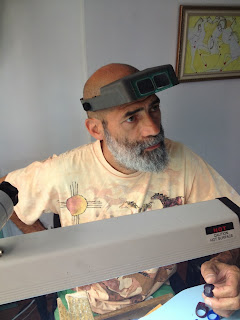
Max Discussing the Ring with Us


Seahorse Slices

Wax Carving Tools
My first casting of the ring was in silver which my jeweler Vasken polished with great care (the castings often leave extra metal around these tiny shapes), and I shipped it to Lynne for her approval.  I added a similar shaped gem so she could try it out.  Wax shrinks so we also had to resize the ring a bit more.  Then we made the platinum casting.

Silver Casting of Sea Horse Ring
The idea then was to add diamonds on the shank.  The center stone was a J color and the platinum is fairly white, so I initially thought to go with a lower color.  But then I settled on G/H, and as clean as possible so it would really sparkle.  I got the best cuts, too – Swiss cut, not India cut.  They cost 30% more but it was worth it.

Enter Ethan, the setter.  I got the recommendation to use him from Brandy because we wanted someone who specializes in micro pave.  Ethan works full time for a company that sets almost exclusively for Tiffany and Tiffany uses tons of micro pave.  So I got Ethan to work on my ring over a weekend, and he didn’t disappoint.  The result was near perfection.  All stones facing the right way, tables totally straight, diamonds tightly packed, the beads perfect little round balls, and no. 7 millgrain on the sides to give the ring an old fashioned look.

Close Up of Ethan's Setting Work
Engraving was last.  Again, I asked around and several roads merged with Alex, the Russian engraver.  You can see his work here: alexhandengraving.com.  Alex came here from Russia a few decades ago, where he used to help restore old churches – in particular, some of the reliefs that decorate them.  He said working in Russia met the old cliché: they pretend to work and the government pretends to pay. 

Alex took his assignment very seriously.  He wanted pictures of the sea horse, and together we went over every detail: waves on the inside of the shank, adding millgrain on the inside, extending the pave down the sides of the shank past the diamonds, eyes for the sea horses.  Alex also proudly showed me other examples of his work.  All his work is done under a microscope, and the detail is incredible.  I felt in great hands.  So again, I left the ring, fully set, in someone else’s hands.  I asked if I should pre-pay the fee, and he laughed: “But I have your ring, he said.”  True.

Two more weeks went by, and I got a call from Alex.  “The masterpiece was ready,” he said.  I asked for emailed photos but he said that would not capture the work.  So I went into NY the next day.  I was stunned by the result.  I had to study the work with a loupe to fully appreciate the detail.  How can a human hand perform such a tiny miracle?


Alex's Engraved Ring
Detail Photo
 Needless to say, I now want something else engraved.  I just don’t know what.  I could do something for a cast design – the engraving has to be deeper so it comes out in the casting, but it’s doable.  Suggestions are welcome!


Sunday, December 29, 2013

Mandarin Garnet

I haven’t written much about Mandarin garnets because I don’t really like orange as a color, and so I’ve ignored this gem for a long time.  But now I think I didn’t do it justice.

Spessartite, the garnet group that Mandarin garnet falls under, has only been on the gemstone market for a little over 10 years.  Although tiny amounts have been found in Germany, California, and Sri Lanka, among other places for a couple of hundred years, it was so rare that it was considered a collector’s stone.  Marketable quantities have only shown up in Namibia, then Nigeria and Mozambique in the last decade or so.  In 2007, there was a find of facet grade Spessartites of beautiful bright color near the town of Loliondo, Tanzania (it's basically a location in the bush, some 10 miles off of a dirt road in the middle of nowhere).  A gemologist friend of mine travelled there a few years ago and got some nice crystals – a dangerous journey that necessitated an ample supply of weapons for security.

Die Lagerstätte Nani
Spessarite "Mine" near Loliondo, Courtesy of Jentsch Mineralien
The color of spessartite ranges from a light orange to a deep reddish brown, with the bright and pure neon-color oranges being the most desirable and the most expensive.  The trade has termed them “Mandarin” garnets.  Initially these garnets came from Namibia, and then Loliondo, Tanzania.

Here's a sampling of my purchase, the stone with the best color is the second to the left
Like most garnets, Spessartites are mostly smaller in size, but 1-3 carats are available, 5 carats and above are rare.  While a brown Spessartite under 1 carat can run as low as $20/ct, a well cut Mandarin in that size can cost 10 times that much.  Recently prices have been on the upswing because the mine in Nigeria is no longer up and running.  Originally, prices were low but world demand drove them up very quickly.  As a result, smart dealers that had overbought at the time stashed their parcels away.  Indeed this was a good move, because after staying steady for a few years, prices have recently doubled because supply is now dwindling.  This is in part why I acquired some pieces.

Design wise I was surprised how well the bright orange looks in rose gold, and in particular when pink gems, like mahenge spinel and pink sapphires, are added into the mix.  I also love the combination of red, orange, and yellow (i.e. yellow sapphires and Burma spinels).  Mandarin garnet, as opposed to pyrope garnet, also has excellent performance in incandescent light.  In fact, I find that they look their best when the light does not hit them directly, but when it is subdued.  Then a good quality piece can almost look neon-orange, despite the occasional tiny white inclusions that are called “sugar” in industry.  That neon color is what drew me in the most.  Extra fine Mandarin ovals can look more orange from one angle, with flashes of reddish orange from another angle.  It’s really quite beautiful.

Mandarin Garnet ring with Burmese Pink Sapphire
This not-quite-red yet not light orange color is extremely rare.  I’ve seen large parcels from the Loliondo mines with perhaps just one or two stones that looked like that.  In fact, I went through every parcel at my gem dealer’s office in the smaller, more affordable size, and pulled out all the most neon pieces I could find.  These days, most mines no longer produce that color at all.  Recent reports indicate that only low quality rough is being offered in Nigeria, and one source has told me that because of political tensions among locals, the Nigeria mine is no longer operating now.  And so it goes until we find some more elsewhere on the African continent.  

Sunday, November 24, 2013

The Intricacies of Gemstone Pricing

Gemstone pricing can seem to be all over the place. Quotes on the same stone fluctuate depending on the seller, the buyer, and even the context: Internet sales vs gem shows, U.S. vs overseas. But despite appearances, there is logic to gemstone pricing, and making the right quote - the quote that yields a transaction – can be considered an art.

To start with, there are a number of different pricing levels that are below retail.

1. Rough bought on location. This is the cheapest way to buy but even rough is pre-sorted and you have to understand what you are looking at. After cutting, rough loses an average of 80% in weight.  Gemstone cutting can be $1 or $5 per carat, finished goods. Cutting grade rough for fine gems like sapphire is quoted per gram, and for cheap stuff like amethyst it is quoted per kilo.
2. Cut gems bought on location. In place like Tanzania or Sri Lanka many gems are cut before they leave the country (in Sri Lanka this is the law). But strangers are not likely to get good prices.  Buyers and sellers have established relationships and introductions are needed. New buyers can be tested for their knowledge of prices. If a buyer haggles when a low quote is made, the seller may refuse to work with that buyer in the future.
3. Dealer pricing.  Finished goods make their way to the U.S. (mostly New York) via a middle man who sell only to gemstone dealers at a markup.  Some U.S. dealers also traveled directly to India, or they are connected to gem dealers in other places in the world, or they travel to buy on location. They buy at dealer prices, and if they sell to each other, they sell at dealer prices with a small markup.  Markups at this level average 30%, or less if it’s dealer to dealer.
4. Wholesale pricing. Gem dealers then sell their wares to independent designers and jewelers or jewelry chains. A wholesale buyer has to have a business license or a tax ID so they can be exempt from sales tax. The markup here is also around 30%, but quotes can be higher or lower, depending on the relationship.  Repeat business is often rewarded with reasonable markups.

What about retail pricing?  There are several levels of retail as well. A gem lab calculates a retail value at 30% above the most recent wholesale pricing tables - these tables average out wholesale prices across locations in the U.S.(with N.Y. being one of the cheapest locations). This is not related to store retail which is usually higher. It is also not related to the retail price of finished jewelry: material cost plus cost of labor x4 (x2 for wholesale and x8 for high end stores).

Against these basic standards, several additional factors can affect pricing.

Mandarin Garnet Parcel, with Two Unheated Zircons Thrown in for Contrast
1. Urgency. Some people need their goods right away. They have a custom order that is already paid for, they have an impatient buyer, or they have an impatient personality. When several dealers on 47th street get "calls" for the same stone (i.e. a 4 carat sapphire for an engagement ring), it's considered a "strong call". Then everyone smells money and the prices go up. So even of one really needs to buy, it is best to proceed in a relaxed manner.
2. Time spent with the seller.  Some buyers spend hours at a gem dealer’s booth or office, and that ties the seller up.  Many sellers need to move material quickly (they too need to calculate their pay by the hour).  Their booth or office may be small and so they cannot help several people at once.  The same thing happens on the internet.  If a buyer needs a lot of photos and has a million questions, it can take hours to negotiate a deal.  Price levels have to reflect this, and they are one reason why many gem dealers won’t – or simply can’t – deal with the general public.
3. Trustworthiness. You wouldn't believe how many buyers on 47th Street memo out stones and don't pay, or don't pay on time, don't return the merchandise, and string along sellers. "Check's in the mail." Uh uh.  Checks do bounce. Even certified checks! Credit card purchases are disputed after the buyer has made off with the goods.  If you are a “serious buyer” – ready to pay, and people know your checks go through, and on time, you will get far better quotes.
4. Haggling. You may get away with it the first time, but when, after seriously haggling down a price, you return to the same gem dealer for more, you'll find that all the prices have suddenly increased: If the dealer expects you to haggle, he has to start with a higher base price.


Tsavorite and Mahenge Spinel Cabochon Parcel
Of course now you are wondering price level I buy at.  Most of the time, I get dealer
prices.  When I first started buying on 47th Street, I knew nothing whatsoever about gemstone pricing, but I discovered after a while that everyone offered me good deals (this really wasn’t obvious to me at first).  When I asked a gem dealer friend about this, he said “it’s because you pay.” I thought that was a ludicrous suggestion.  Don’t people usually pay when they buy things?  Now, a few years later, I realize he was right.  Gem dealers must have thought I was from Mars.  Owing money, wasting someone’s time, and haggling all make me extremely uncomfortable.  Dishonesty doesn’t come easy to me – I can never think of a good lie fast enough, not even white lies like: that dress doesn’t look bad on you – so on occasion I get into trouble, even with my friends.  But as it turns out, Martians can do very well among gem dealers.


Sunday, November 3, 2013

Tricks and Tips for Designing in CAD

As you see more and more of Brandy’s CAD (computer aided) designs in my shop, I thought it might be time to explain the design aspect of the process a bit more.  This will also help you if you are interested in placing a custom design order that requires CAD.

When do you need CAD?  CAD is extremely useful when you don’t want to make a design from scratch in metal, and especially when you have an idea that is more complicated, like my halo and multi-stone rings.  Imagine how long might take to make all those tiny little prong settings, for instance.  CAD is also useful when you have a specific stone and can’t find any stock settings that work.  But CAD doesn’t work well for flowy designs, and the geometry for certain shapes is incredibly complicated.  The more curves, ridges, settings, the more detail in other words, the longer it takes. 

Wedding Band CAD with Dimensions
A CAD ring will indeed take several hours in design work, or even more.  A simple setting might only be 30 minutes, but if you’re designing a complicated gallery for instance, adding all those curves and finalizing the dimensions can take an afternoon.  After that, the CAD model has to be “printed” in plastic , then cast in base metal, then molded, then again cast in the desired metal.  You can also go straight to casting from your plastic model, but if you then need another one, you have to print again, and printing can cost up to $100.  3D printers are expensive, and the printing process is slow.  Long story short, you are looking at a few hundred dollars before you so much as have a first casting.

Since CAD works on a mathematical basis, you need all your dimensions pretty well worked out before you can begin, and you may need to refine them as you design, or go back and forth with your CAD person.  This includes inside diameters of bezels, thickness of bezel walls, prongs, etc, for each part of your ring.  Brandy, who is very good at this, often supplies these after I give her the stone, or stone dimensions, the basic ring dimensions and my drawings.  She knows how deep a setting has to be to fit a stone, what wall thickness is required for a bezel, how much space to leave between stones, and other things you’d never think of if you haven’t done this a lot.  Nevertheless, sometimes Brandy and I have to sit together for a couple of hours and hash out specs as we try them out on the screen. 

This Cluster Ring is not Done Because We're Working on the Gallery , Often the Hardest Part
You also need to have a good sense of imagination, because a lot of time a model looks one way on the computer, another way when it is printed and cast.  One of my new rings ended up too heavy on the top, and the shanks were too thin to make it look balanced.  And when you plan to add stones in a beaded or burnished setting, you need to be able to visualize how the piece will look when it’s finished, because on the screen, and even in the silver casting, it will just be an empty canvas.

My Victorian Flower Earrings Before Setting

A Finished Design with the Same Setting
Sometimes other impracticalities intrude that you don’t think of.  Your finger is too small to support several stones in a row, or sizing will be an issue later.  Eternity bands have to be done for each size for instance, and in each case you have to change the design a little.  You also can’t just make a design bigger or smaller because you will want to shrink just certain aspects (i.e. the center setting but not the shank).  This means that certain changes in size necessitate many other changes down the line. 


               Finally, you have to think about practical aspects during casting and printing.  The ring I made (below) cannot be cast in one piece because the silicone could not get underneath the ring.  So Brandy made a gallery, lifted the top and made two designs that have to be assembled after casting.  Also, since you can’t cast in two metals at once, any two tone designs require two models that have to be fitted together and assembled.  

Shank is Too Narrow (The Thing on the Right is the Sprue)

Can't Mold in One Piece

Top is Too Thick, Needs a Galllery