Thursday, August 9, 2018

Madagascar – A New Trip, New Experiences, New Gems (Part I)

The first destination on my most recent trip to Madagascar was the Island of Nosy Be, slightly to the northwest of Madagascar and very close to the coast.  Before starting my gem buying, I allowed myself a few relaxing days under palm trees.  On my eight-hour night flight from Amsterdam to Nairobi I met up with my travel buddy Jochen Hintze from Jentsch Minerals.  We had so much to catch up on during the flight that I missed out on a bit of sleep.  Luckily the Business Class Lounge in Nairobi has some couches, where I ended up crashing for three and a half of our six-hour stopover (it was supposed to be just five hours but “that is Africa” as you hear many Africans say). 
We arrived in Antananarivo (called “Tana”), the capital of Madagascar, on the following day, Wednesday at 4 p.m.  Tana is by far the largest city in Madagascar.  It lies in the central plateau, about 1500 meters above sea level and has a very mild climate.  As you fly over the 3000 mile island from the West, you will see hundreds of miles of a nearly uninhabited red mountainous region – deforested in the 1500 years since Indo-Malayans first populated the island.  Your landing approach takes you over the more lush region of the central highlands with many rice paddies and rivers turned red from the earth surrounding it.

Aerial Shots of The Red Island, Madagascar
Madagascar from the air The Red Island from above

As soon as we got past the temperature and health check for yellow fever, completed our visa application and made it past the police stop, we saw Ando, Jochen’s longtime broker friend, and her daughter Maria, waiving to us from the queue.  After many welcoming hugs, we took a taxi straight to hotel Mirandav, a small and private hotel not far from the airport.  At the hotel, we were greeted by another familiar face, Mamavelo, one of the brokers from Antsirabe and part of Ando’s extensive family.  Mamavelo had taken the local taxi-bus up to Tana to get the very first opportunity to show goods to Jochen, and Ando and Maria had brought some stuff for me – time is always too short and all prices have to be individually negotiated.  Ando does a great job announcing our arrival to dozens of dealers, letting them know what we are interested in and arranging the meetings.  So we spent our first two hours fresh off the plane looking at gems at a table in front of my room, shaded by palm trees; just until past nightfall at 6 p.m., when even the battery operated lantern I brought didn’t yield enough information any more.  I saw several new sapphire parcels of blue-green, blue and pink shades, some nice rich dark but included aqua, a parcel of Malaya garnet ovals, as well as sphene, chrysoberyl and a lot of demantoid for me to mull over.  I was too tired to make any decisions but I set aside what I liked for Ando to talk to the “proprietaries” about more realistic prices than the first quotes, which are traditionally way too high.

Reunion with Ando Antoniania, our Broker
Happy Reunion with Ando Happy Reunion with Ando
For dinner, we went to a restaurant for Tana locals – Chez Maman - and where we were indeed the only white faces.  I had some excellent salads, beef tongue with French fries, and the local beer, THB – Three Horses Beer.  For the four of us, dinner and drinks came to just under $10.  I tried to take some video, it was funny sitting at such a noisy street with cars honking at each other, buyers and sellers of who knows what arguing, tables tightly packed, and feeling completely out of place, just not in a bad way. 
After we got back to the Mirandav and finished rearranging our suitcases so that some of them could stay at the hotel (the local airline doesn’t allow 2 pieces of luggage so one had to stay behind), I was out like a light.

Hotel Mirandav, Ivato (Near Antanarivo)
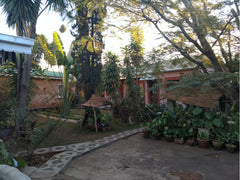
Hotel Mirandav Hotel Mirandav Hotel Mirandav
At 5 a.m., the alarm rang again so we could start the next leg of our flight.  The flight to Nosy Be was scheduled for 7:30 a.m.  Just as we were about to leave, at 6 a.m., there was a knock on the door.  It was another broker from Antsirabe; her name is Gitte, just like my aunt, and who had taken the bus up to see us before our flight was leaving, not realizing we had an early morning flight.  Jochen didn’t want her to feel bad so he let her unpack her wares right on the bed amidst the packed luggage in the dark.  But we just didn’t have time (or light for that matter). Gitte was really disappointed.  It’s a five hour ride on a crappy taxi bus from Antsirabe. (Luckily we were able to buy some stuff from her at a later point in the trip).
We made it to the airport at around 6:15 a.m., and already there was a long line for “Air Maybe” – the local nickname for Air Madagascar.  Air Madagascar has earned this nickname for its high unreliability.  Maybe it goes somewhere, and maybe not, maybe it flies on time, and maybe not.  For instance, when there’s no fuel or there aren’t enough passengers booked, it doesn’t take off.  Ticket prices are equally unreliable and depend on fuel costs as well as the number of passengers booked – tickets for flights within Madagascar are usually quite expensive, but despite all these disadvantages, it is a far better way to get around than driving long distances on poor and only partially paved roads!
Well, we lucked out.  We weren’t on time or anything – there was not enough personnel to check us in quickly.  But we did leave.  Only not to Nosy Be!  Literally just before takeoff the pilot announced that we were making another stop, just north of Nosy Be on the mainland, at the town of Diego Suarez / Antsiranana (that’s the former French name and the later Malagasy name).  Back in the day this area was considered a hideout for Portuguese pirates.  It doesn’t look very exciting there now though. 
The reason, apparently, for our stop was to drop off some cargo.  Another plane had engine trouble so our plane took its cargo over to Diego.  None of the passengers even raised an eyebrow about the change in plans.  A local Frenchman said to us “c’est normal.”  So we accepted it as normal, enjoyed the view from above, and tried not to be phased by the two hour delay (late takeoff, extra hour on the plane, and a short stay in Diego where we had to all leave the plane only to sit in a tiny arrival hall with nothing in it but chairs, and then get back on).
Aerial Shots of Diego, Madagascar and Nosy Mitsio
Diego from above the Madagascan Islands from Above Nosy Mitsio 
At the airport we were met by our driver for the stay, Ando’s cousin Gael who’s father owns the Toyota Jeep we had rented, and who had made the entire two day trip by car.  Gael had decided to use the occasion to visit some friends of his who live on the island.  The original plan had been for Gael to pick us up at the end of the stay in Nosy Be, but he’s a fun companion and we were glad to have the car.  Gael turned 30 this year, he is well educated by Madagascan standards with a degree in computer science, he’s funny, very curious about things and and enjoys driving Jochen around during his gem buying tours.  I had already met Gael on my last trip, and we had a lot of interesting discussions comparing our lives.
Gael and Yvonne
Selfie of Gael and I in Lokobe Park
The Island, as best as I can describe it, is a small slice of paradise.  I had never been anywhere so tranquil and peaceful.  From my reading, I ascertained that Nosy Be has over 40,000 inhabitants but it doesn’t feel at all crowded.  And according to Gael’s observations, it has more white people than anywhere else in Madagascar in one place.  I should qualify this remark: by my standards there were very few white people here, perhaps 1 in 100.  Nosy Be probably also has the largest number of rich people in Madagascar, with perhaps the exception of Tana.  The rich on Nosy Be are mostly French tourists I presume, but at our hotel – the Vanila Hotel and Spa - there were people from all over: Belgium, the Netherlands, Croatia, and a group of rich Malagasy.  Generally the hotel did not seem very occupied for this August, which is not only vacation time all over the world, but winter in Madagascar with very mild days (85-90 degrees, not humid, about 70 at night).  The hotel itself was fantastic: rooms were large and airy and equipped with AC and flat screen tv’s (an absolute rarity in Madagascar); the mattress made of memory foam and the food, which was largely French with some local influences, very good (think French brasserie with an Asian flair).  The prawns and shrimp had very unique taste, nothing like the Thai stuff we usually get in the US, and the desserts (sadly for my waistline) were absolutely excellent.  Every Saturday there is a big buffet with local Malagasy food, i.e. roasted red snapper and coconut chicken curry.  And banana dessert wrapped in banana leaves, in addition to cheesecake, fresh fruits and crème caramel.  For breakfast, lunch and dinner, you could order fresh pressed juices, tuck into a nice size buffet and get fresh made omelettes and French pastries. 
Images of the Vanila Hotel and Spa in Nosy Be
Our dining area in the Vanila Hotel Delicious Food The View from Vanila hotel Vanila Hotel Vanila Hotel Vanila Hotel Vanila Hotel
But for me, so far, the highlight of this trip was an entirely unexpected one: I learned scuba diving!  I came here expecting to do some snorkeling but Jochen convinced me to try the sport with him.  Nosy Be is well known for its coral reefs located just off shore, boasting a wide variety of marine life.  It turned out that there was a diving school right next door, run by a French marine biologist and his wife, Alain Benoit and Nathalie.  They used to live in the Comores but according to Alain, who was our diving teacher for the duration, the coral reefs there are dying from pollution and so they relocated.  Alain is also an excellent photographer by trade (see his photos here)
Unfortunately the money Alain earned through photography and writing was not sufficient, which is one reason why they founded the Sakalov Diving School.  The couple also operates an Air BnB and they offer other excursions to familiarize travelers with the local flora and fauna.  Alain related to us that he had co-authored an article about one of the coral reefs near Nosy-Be, explaining the extinction it faces and how to help prevent it, yet nobody seemed interested in publishing it.  My own feeling is that magazines all over the world are flooded with articles about how we are managing to kill the planet.
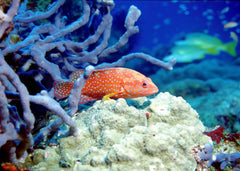
Nosy Be Marine Life Nosy Be Marine Life
But let’s get back to the more uplifting (or perhaps downlifting) subject of diving.  I was actually a bit scared to be dependent upon a tube for breathing.  You have to first get used to breathing through your mouth, and the sound of the regulator was very loud and unnerving to me.  Add to that the thought that your “breathing tube” could easily pop out of your mouth if you don’t remember it’s vital importance while staring at colorful fish.  But we didn’t dive very deep and there was no decompression needed – so if you panic you can just swim back up. In addition to that, I bit on my mouthpiece quite hard, so much so that I was concerned about leaving toothmarks. 
Yvonne Diving near Nosy Sakatia
Me diving
Our first dive took us to an exploratory six meters, the second to about 12 – a fact that I was blissfully unaware of until Alain told us at the end of the day.  On day two we went down to 15 meters, and we saw a baby seahorse nesting in the wall of one of the reefs.  On the final day I got my diving certificate which meant, of course, that I had to go to a diving depth of 18 meters, but not for very long. 
I didn’t find it very hard to dive, but it was a little tricky to regulate your buoyancy, and my ears didn’t like the water pressure so I had to go down very slowly (imagine going up and down in an elevator very fast, you have to swallow hard or hold your nose and breathe out hard to “pop your ears”.  Before each dive we got to practice some safety procedures, most of which would not likely be needed on these kinds of dives, but I appreciated them just the same.  It felt quite weird taking my mouth tube out under water, letting it go and then finding it again and putting it back – or swimming over to Jochen and grabbing his backup regulator to simulate a regulator or air failure on my part.  For getting a certificate, all these exercises are required.  Ugh. 
Weirdly enough, I never panicked during any of the dives, somehow I thought at first I’d want to go back up but then I got distracted by all those “fishes” and coral, sea cucumbers, star fish, lion fish and I don’t know what else – or yes a mantis shrimp, a very colorful animal.  Some of the star fish and corals literally seemed like they “glow in the dark.”  It’s a funny experience because even though you easily see it in photos online, you can’t imagine how colorful it is “down there.”  And how surreal the entire experience is.  In the end, I am very glad I did this and hope to do it again to see what else is hiding down there.
Gael, who had never been on a boat (and had only once been to a beach before, a year or so ago together with Jochen and his sister) came with us on our first day, and he was so delighted by the experience that we decided to sponsor a dive for him on the second day.  Gael didn’t know how to swim but he bravely jumped into the shallower waters with some flippers borrowed from Nathalie.  He told us later that when he saw Jochen and me paddling around in the water he thought to himself” “this can’t be that hard.”  Nathalie explained that you don’t need to know how to swim in order to dive.  There are just restrictions about the amount of time you can stay under (20 minutes) and how deep you can go (I believe it’s around 3 meters but it might be a bit more).  Gael absolutely loved it – the experience of a lifetime he said.  He even got a little diving baptism certificate! 
On a sidenote: diving in Nosy Be is very cheap, about $85 for a day which includes two dives with the required rest in between and which lasts about 5 hours in total.  The certificate, with the test at the end and a diving log book cost me $405.
The second highlight of our Nosy Be trip was a visit to Lemuria, a little natural park on the South East side of the island.  The park houses over 25 different species of lemurs.  They are so cute – I wanted to take one with me.  The lemurs are tamed by park rangers.  New arrivals are fenced in at first until they get used to humans.  Jochen and I got to feed the lemurs with banana smeared on our open palms.  One cannot pet them however.  Apparently they might bite if you touch their tails because that’s their “rudder” and very important to their ability to climb and jump.
Our guide, a very exuberant young Malgash who was super excited to practice German, talked through just about all of my recordings which would otherwise have a very idyllic background of rustling trees and “chatting” lemurs.  Next year they will have some big cruise ships arriving.  Hopefully they don’t destroy everything.
Helle Ville, Nosy Be
The Streets in Helle Ville Nosy Be

In my next blog, read about my travels to the gem capital of Madagascar, Antsirabe…

Tuesday, July 3, 2018

Africa Revisited - A New Trip

I can't believe it came upon me so fast.  This coming Monday I am leaving on my second trip to Africa.  I will be revisiting some of the places of last time and adding a couple new ones.  And of course, I will be looking for gems!
My trip starts in Newark Airport via United, with a one-day layover in Amsterdam on the 10th.  My Kenya Airways flight to Nairobi doesn't leave until 8 p.m., so I get to spend the day in the international terminal.  Luckily Schiphol airport has a funky "hourly hotel" called Yotel, where you can sleep in a little 20 square foot cabin for a few hours.  
My travel companion, as last time, will be Jochen Hintze from Jentsch Mineralien.  Jochen is a well connected Africa veteran - his first trip to Africa was about 50 years ago when he hitchhiked to Morocco as a teenager.  Jochen has traveled almost the entire African continent and has crossed the Sahara desert six times so I feel safe in his hands.
Jochen is flying in from Germany so we are going to meet on the flight to Nairobi - assuming his flight from Hannover is on time!  After another five hour layover in Nairobi on the 11th, we get on another plane to Antananarivo Madagascar.  And after YET another layover of about a day, which we will be spending at the same hotel as last time, a well protected simple little complex just outside of town, we will attempt to take Air Madagascar to the island of Nosy Be 
Attempt?  Yes.  Go to google and search for Air Madagascar reviews.  You'll see what I'm talking about. Air Madagascar is the only airline in Madagascar and sometimes it flies, sometimes not.  When there's no fuel, that is.  Or some other issue that you will never find out about. 
Read some reviews below:
"WORST AIRLINE! BUT one does not have a choice to use Air Madagascar when travelling around Madagascar. Among the locals, the airline company has been nicknamed Air Maybe..." 2 star review "The thing is, if you want to fly from Tana to Nosy Comba, there are not so much other options than flying with air Madagascar. The short flights are very expensive because they have the (corrupt) alone right to fly on some routes. They just do what they want and take their time...." 2 star review
The flight to the island Nosy Be is only an hour, but if you go by car and take the ferry you need two days. Nosy Be has a number of "luxury" hotels as well as standard hotels starting at $10 an hour, going up to about $200.  We are going the "luxury" route which is still way less money than a good hotel in the Carribean.  The Vanila Spa hotel costs about $150 a night.  The website looks stunning to my somewhat simpler tastes so I can't wait to see what I will really think when I get to this nearly "off the grid" location.  (Try booking a flight to Nosy be through a site like Travelocity - Air Madagascar doesn't even exist on there).  
Assuming we will make it to Nosy Be, we will stay there about four days and then get picked up by our friends, Irene (Andou) and her relative Gael with his father's vehicle, on Sunday, take the ferry back to Madagascar proper, and continue on a 2 day drive down to the Green park hotel in Antsirabe.  We will spend a few days there looking at gems and if it goes as it did last time, sellers will line up for us early in the morning and stay until sundown, or sleep in the street or a very cheap hotel (our hotel is on the expensive side for the area, about $15 a night - but very safe and very pretty).  
Here's a video from our previous stay in Antsirabe, 2 years ago.
On Sunday the 23rd we head to back to Antanarivo and from there to Nairobi where I get to see Doreen Kawira and her little baby son who will be one year old this summer.  I sponsored Doreen's college education and I met her for the first time 2 years ago.  Now I help her raise her son (she's a single mom, a state of affairs not very unusual in Africa, sadly).  Doreen also works full time at the University of Nairobi and with the help of Cecile Raley Designs and the money we have raised, it will stay that way and she can afford the nanny every month, who costs about $100 (25% of her salary).  Donations for Doreen, by the way, are very welcome. GoFundMe Campaign gf.me/u/jmg7u7
I will stay with Doreen in her apartment for one day and then we are off to Arusha, Tanzania via Precision Air (don't trust the name lol).  We stay in Arusha another 9 days or so, this time at the Mount Meru Hotel, and we plan a 5 day trip to an area called Kongwa, to look for some rare crystals that I know nothing about.  We will be joined there by a German friend of Jochens.  
If all goes safely, I will be back on a plane to Amsterdam on August 1st, and arrive in Newark on the 2nd after another 1 day stay in Amsterdam.  I plan to do some gem shopping in Arusha as well, mostly with Jaimeen's (Prima Gems) uncle as well as our Greek friend Reno who owns a shop there.  Perhaps I will also buy from the locals, this part is always the big adventure and you never know what you're gonna get.  
I will try to keep you posted throughout the trip, but mostly through small tidbits of information - the internet in most places in Africa is very slow so uploading anything but text is very difficult.  But I will try, and I will most certainly try to return home in one piece!
Please read some of my previous blog entries about Africa here: 

Padparadscha Sapphire – What’s the Story?

Every since Britain’s Princess Eugenie has been sporting a Padparadscha sapphire engagement ring valued at over $130,000, these lotus flower colored beauties have been all the rage.  Industry prices have actually risen as a result.  In terms of color, purists claim that a Padparadscha should combine peach-pink and orange tones, ideally mixed evenly (no color zones), and have light to medium saturation. But exactly how that looks is a point of contention.  The ideal comparison is the Lotus flower which it is named after.  Given the huge variation in both color and saturation of actual lotus flowers, it might be fair to say that this reference is more romantic than it is helpful.
Originally “pads” were mined primarily in Sri Lanka, and this is why “purists” still consider only a specimen with the famed Ceylon origin to be a true Padparadscha. Nowadays, however, gems from other regions with the same color characteristics, for instance from Madagascar or Tanzania, can be deemed a “pad” as well. Some gem dealers will refer to those as “African Padparadscha” but one should not rely on the nomenclature being exact. In any case, it is still true that a Padparadscha sapphire from Sri Lanka will command a premium in price, even if the color quality is the same as a comparable stone from Africa. Whether this is justified or not, the take-home message from this is: if a seller is asking an additional premium for the Ceylon origin of a Padparadscha sapphire, one should only pay the extra if the alleged origin is backed up by an origin report of a reputable lab (GIA, AGL, ...). 
 Traditionally only an unheated sapphire is eligible to be considered a “pad” but that has since changed s well.  Heating may turn an originally only very faintly peachy colored sapphire into a “pad.”  This should not command a premium in terms of price, however.  As to the nomenclature (is it a pad or not), I would probably stay away from the term, to be on the safe side.

GIA has a very interesting article on the historical development and currently use definitions of the term Padparadscha sapphire, which you can look at here: https://www.gia.edu/doc/Padparadscha-What-s-in-a-Name.pdf
According to the report, written by Robert Cownsingshield, no reliable laboratory criteria can be established to standardize the term Padparadscha – at least not one that all labs would agree on.  However that said, a color description can be given that will be used as a comparison base for color.  Here’s what Cownsingshield says about that:
It is GIA's opinion that this color range should be limited to light to medium tones of pinkish orange to orange-pink hues. Lacking delicacy, the dark brownish orange or even medium brownish orange tones of corundum from East Africa would not qualify under this definition. Deep orangy red sapphires, likewise, would not qualify as fitting the term padparadscha.
This definition is best applied by comparing to what the lab considers samples of the right color.  Unfortunately, some laboratories are much stricter in their application than others.  The strictest US lab is probably AGL at present. 
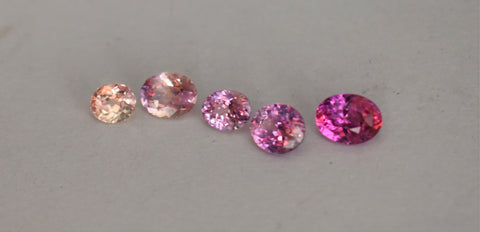
Candidates for the Padparadscha Label from our Collection - All Sri Lanka Origin, the rightmost stone is heated.
1.03 Ct. Sri Lankan Sapphire, 6.4 x 5.7mm, no heat Link here
1.56 Ct. Sri Lankan Sapphire, 7.5 x 5.7mm, heated, labeled "Pad" despite heat. 
 Oval Padparadscha Sapphire, Unheated, 6.67 x 5.36mm. Link here 
Now, it would be expensive both for sellers and buyers alike to have every single possibly qualifying sapphire evaluated by AGL.  So it is often left to gem dealers to decide how to classify their purchases, which is why it is so important for a buyer to find a reliable and also knowledgeable source for their sapphires when it comes to the less valuable pieces (probably at a price over 1K, a declaration of “pad” should probably be verified by AGL.  My own source, as many of you know, is Dudley Blauwet, who has extensive industry experience and sources all his sapphires directly.  Here’s what Dudley has to say about the way he distinguishes a pad from a peach pink sapphire: 

Thursday, May 24, 2018

Emeralds Revisited – New Arrivals, New Origins and A Word about Treatment

I haven’t talked about emeralds for some time and with the Las Vegas Gem Show coming up I should do so, as I plan to focus a little more on this somewhat neglected stock item of mine.  You will see more of the May birthstone listed this June - belated as is somewhat typical of me when it comes to birthdays.
So, let’s start with origins.
Colombia: my absolute favorite, always.  They have the grassiest green color of all the greens, not minty, ranging from light to dark greens, with the medium warmish tones being the nicest.  The lighter colors (often just termed “green beryl”) are more affordable but also need to be cleaner than the darker or they don’t look good.  Supplies in Colombia, from what I understand, are actually pretty good, but well in the hands of the Colombian government and gems are being trickled out to keep the market tight.  My source for these is Vinod Kotahwala, as previously disclosed, an AGTA member and wholesaler who has had connections to Colombia since the 1960s and his supplies are steady. 

Light Green Colombian Emerald
Afghanistan: these have a very bright and happy green, very open color and don’t come in darker tones as far as I know.  I can get these in small sizes only -  those supplies are hard to get and they are very expensive at more than $1000/ct for even very small stuff.  The good news is that I know a supplier who has a small amount of untreated ones – Dudley Blauwet.  They come in small rounds and, some princess cuts.  
Afghanistan Emerald Princess Cut
Zambia: Zambian emeralds have more of a minty green tone and they are not as warm as Colombian emeralds.  They are also a little cheaper.  I saw a really well cut parcel of lighter round stones this week that I was eyeing for a custom project which has since fizzled.  It was going to involve Paraiba, yum.  I have photos here of the project with lighter and darker Colombian emeralds.  I could purchase some of these if anyone’s interested; sizes ranged from 4-5mm, prices were $700/carat.  However, these are more heavily oiled (this is as far as I go with treatment).

Zambian Emeralds
Brazil: these are my least favorite in color because they are darker green and the inclusions are often darker piques as opposed to the whispy white feathers in Colombian material. However, these have the most typical emerald color seen on the commercial market.  When I first started my Etsy business in 2009, clients on the internet were less informed than they are now and many didn’t want the Colombian color because it didn’t look like emerald, although fortunately, that’s changed now.  Generally, I don’t buy Brazilian material but I certainly can upon request.  It is cheaper than Colombian by about 1/3.
Treatment: there are two treatments on the market for cut stones that are employed to various degrees - Oil and Opticon.
Oil: traditionally Cedarwood oil was used, now it is often baby oil.  Baby oil is a petroleum product and is therefore synthetic (sorry little babies) so that’s why sometimes lab reports are coming out as saying that emeralds have synthetic or modern treatment. For an acceptable treatment – in my opinion – the oil should not contain dye, and it should be lightly used – an AGL classification of “faint” or “insignificant” is ideal in my opinion.  If I do go with a heavier use of oil I will disclose this and you’ll see either “lightly oiled” or “heavily oiled” in my description.  The Zambian emeralds I saw had heavier oil.  As to which oil is used, that is not something I can easily discern.  Light oil is often used for safe storage as well, and almost all emeralds will show at least some residue.  The most prized emeralds in terms of value should show minimal oil treatment in a lab report.
Opticon: this is a plastic polymer resin that is injected into the gem.  It is permanent, unlike oil, but it can yellow with age.  I never buy opticon treated emeralds, because I try to avoid treatment whenever possible.  But it’s very common, it’s always disclosed (at least with AGTA members where it’s the rule) and if you are looking at any emeralds where you are not sure just ask. 
Here’s a link to emerald treatments from IGS (International Gem Society) I thought was pretty good: https://www.gemsociety.org/article/just-ask-jeff-are-all-emeralds-treated-and-what-is-your-opinion/
For a more technical discussion, go to GIA for this article: https://www.gia.edu/gems-gemology/winter-1999-classifying-emerald-clarity-mcclure
Naturally, we currently stock some emeralds in the shop.
We have a lovely pair here
and some jewelry here
and here
And what about the little red sister of emerald, Bixbite?  Stay tuned for listings and social media during our upcoming SALE.

Thursday, May 10, 2018

LAS VEGAS – A New Trip, New Adventure, Last Chance to Snag Our Loaner Gems

It’s that time again!  In a little less than 3 weeks I’m leaving on my trip to the AGTA and JCK Shows in Las Vegas for more gem sourcing.  As always, I am happy to take pre-orders for gems so please email us if you are interested!
What's New this Year: 
I’ve set up an appointment with Sergey, my Russian demantoid connection, who will be exhibiting at JCK. He’s bringing more smaller sizes of demantoids for me this time, especially 2mm and 2.5mm, and I’ve also requested some in the 4mm range as that seems to be what most of what you guys are interested in.  But I’m also switching out larger pieces I had on memo.
Same with Dudley Blauwet, my contact for Ceylon sapphire and Burma spinel.  Expect some fresh inventory there, and please do tell me what you are interested in so I know what to source.  Kornerupines are not likely to be refreshed, I’m going to have to make do with what I have here as there’s no new material on the market.  Last time I checked with Steve from New Era Gems in April, all the rough had been sold.  I know one supplier that still has some but I will only get them on request as everyone is holding on to what is left, now that interest in this rare gem has gone up.
Regarding spinels, I still have Vietnamese and Burmese materials that I held back from the last trip and you’ll see these put up on sale starting Memorial Day weekend.
Emeralds: I have neglected those a bit as of late, and plan on stocking up!  There will definitely be Colombian materials, and if I can manage, some of the bright green Afghani gems too!
Tourmaline: A new shipment of Namibian materials has arrived with my supplier already, you will see some of those in the shop soon...
Benitoite: With the renewed interest I am seeing in my shop, I am gunning for more slightly larger pieces as well as more melee sizes.
Red Beryl: Haven’t had those lately but some untreated melee sizes are coming up.
Paraiba: Again, a new shipment is expected and I have an appointment already, but this shipment is very small.  However, I am still holding back some stock acquired earlier.  So for now there is still stuff, just not as much as before. 
Lastly, there’s been an interest in more precision cuts lately, and you will definitely see those in the shop. 
Now, one other thing that’s important.  As you probably know, some of our inventory is on memo – on loan, that is, from other suppliers.  That material gets switched out periodically, suppliers want back what doesn’t sell, and there’s no point in it sitting in my shop.  So what I thought I would do this time is supply you with the list of these for you to decide if you’d like any before they go “back home”.  Gems are on sale till Sunday and then once again starting memorial day.  There will be a flash sale in the meantime on some older inventory, but not on anything on this list.
 
Enjoy and stay tuned on our social media channel for news and videos!

What is Retail and Wholesale Pricing – Really? An Unofficial Opinion

You must have asked yourself this question as well.  What (on earth) does it mean when someone tells you that their pricing is wholesale, or retail for that matter?  Technically, “wholesale” pricing just means the price charged to a wholesaler (from a manufacturer, for instance), and “retail” pricing means the price charged to retail clients (for example, from a wholesaler).  But how much is that?
When you consult web resources for various markup formulas, you will see that how much more you should charge is somewhat subjective.  Aside from your production and overhead costs – which can be high if you own a brick and mortar shop - and your expected earnings you also have to look at the competition for your product.  As a result, some companies double their total costs, some companies triple them.  In the wholesale industry, a markup of twice the total cost is a good average.  By contrast, if you are a well established and highly regarded retail outfit, like Cartier or Tiffany’s, you can charge even more than triple – though don’t forget that those companies also offer an exceptional sales experience as well as exceptional and reliable products with a good resale value.  When you are the “iddy biddy” neighborhood store or Etsy seller, your markup has to be lower.  My jewelry markup is about 2.5 times the production cost, not including overheads or what I pay my assistants (so closer to x2 if that’s figured in).  Sometimes it’s less, sometimes a little more.  Luckily, I don’t have a brick and mortar store to maintain, so my overhead costs are lower – and I do pass these savings on to the buyer.  My production costs are higher however since I do small volume and production is in the United States.
How does markup work in the gem trade?  Here’s what I have learned in the past almost 10 years in gem and bead buying. 
Wholesalers, by which I am going to mean gem dealers and members of the trade such as the ones that vend at AGTA, GJX and other gem shows, or those who work via internet and phone only, have less than a double markup on average.  Unless their gems are specialty cut or one of a kind, your average run of the mill stuff is priced closer to 30-50% up, at least for parcels.  For individual gems it can be more since that requires processing (boxing, measuring, making labels, etc).  It’s not necessarily much higher, however.
Shot of our friends @primagems at the AGTA Wholesale Show in Vegas. Photo taken from Ganoksin Blog 
Retailers, by contrast, have to figure in more customer service such as photos, internet listings, as well as one on one service.  And since they are more likely to sell one stone at a time, they have to figure those costs in for each stone, not for a parcel or larger amount.  Most of my buyers purchase one stone at a time, a pair, or a few small stones, from my shop – they never buy parcels.  That means that I need to process gems by the piece (pretty much), doing measurements and photos for every single stone.  At a wholesale show, when I buy from parcels, I do this work as the buyer, not the seller, and I can also buy (and often do) a bunch of gems from the same parcel, which are then weighed and priced together.  That is more work for me, but less work for the seller, hence the lower markup. 
In short, the difference between wholesale and retail has more to do with the quantity of gems purchased and the labor provided for that quantity.  It is less a matter of formula – even less of a matter of whether or not a buyer has tax ID.  So when I get a query for a “wholesale” price from a jeweler who wants to get one stone under $100, I am far less likely to provide a discount than I would be for a loyal retail client who has spent thousands in my shop but who is not a wholesaler or jeweler.  By the same token, if a retail buyer travels overseas to a gem mining location but intends to only buy a couple of gems , and will only make one purchase, that individual is just as unlikely to get a wholesale price overseas as they would be here.  In fact, they are more likely to be ripped off due to inexperience and due to the fact that many less developed countries have no buyer protection.
Prices for gems are also strongly determined by supply and demand.  Real estate is the best example for a comparison.  The same house, brick for brick, or plank by plank, can cost $50,000 in location A and $500,000 in location B, where the value of the parts is insignificant as a factor in the price difference.  Rather, it is that nobody wants to live in location A and everybody wants to live in location B.  And when supply of housing is not unlimited (it seldom is), prices go up.  In order to determine if one pays too much for a house, or in order to determine what an asking price should be, one studies not the house in isolation but the house compared to other houses like it in the same market.
A fun illustration showing the wholesale (large quantity) vs. retail (small quantity) dynamics 
It is the same in the gem industry.  For some gems, supply really is nearly unlimited (i.e. Brazilian amethyst, white topaz).  In those areas prices might just be determined by labor and other overhead costs.  For any gem where supply is not unlimited but there is a demand – so exempting rare gems that nobody wants to buy – the price very much depends on how many similar gems there are and how these are priced.  In short, gem dealers study the competition for their gems and will price according to what the market will bear.  Often that is not as much as one hopes, but at times, it is also rather shockingly high.  Cobalt spinel is a case in point.  For some rare gems, there is just sufficient demand but almost no supply that the price is just about only a matter between what the seller wants and what the buyer will pay.  Large Benitoite is a good example.
Cobalt Spinel from our Etsy shop
Also, prices can fluctuate when an area is mined out but demand is still high (i.e. Mahenge spinel, Mahenge Malaya garnet).  Or prices can jump up fast when demand goes up and then level out when it is discovered that supply is not that bad (this is often the case with sapphire).  Sometimes prices start out low, then demand increases suddenly and the prices jump drastically, then the market is saturated and prices drop back down (I believe that Grandidierite is an example – I am going to verify this on my next trip to Africa).  Sometimes there are government restrictions, civil unrest,  a change of government etc, and all this will affect pricing, which can end up being quite volatile when we are looking at small amounts.  Current examples are a recent shift in government in Tanzania, export issues in Mogok (affecting ruby and spinel) and export problems with Russia (affecting demantoid).
What should you take away from this?  When you shop, study prices on the internet, as best you can, look at gems in person at gem shows or wherever opportunity presents itself, but also work with someone you trust – we all have to do that, not just you as retail buyers but also us in wholesale because you can’t always test everything, and large amounts of money and product have to change hands safely.  In the final analysis however, for me it is easiest to work with an educated customer for a smooth and easy transaction.  “The more you know…” as they say on TV.

Thursday, April 5, 2018

Sapphire Treatments: What Matters and What Doesn’t  (By Yvonne Raley and Inken Krause)

Every month I give sapphires to my lab to certify that a sapphire is unheated, which is essential for my business, and important to my customers especially when they buy more expensive gems.  But determining that a sapphire is heated is not as easy as one might think.
First of all, what is the purpose of heating a sapphire?  Heating can improve the clarity of a gem, remove zoning, and intensify color.  With high enough temperatures (about 1700 degrees Celsius) you can also melt the silky inclusions in a sapphire.  When sapphires are cut, the friction created by the cutting wheel subjects the sapphire to some heat already (though in most cases, at that point the sapphire has already been heated) but this is rarely if ever detectable in a lab.
How do you determine heat treatment?  The first test to apply is to look at the inclusions of the sapphire under 10x magnification.  In the simplest case you see silky inclusions and fine dusty inclusions.  If those look undisturbed – read: not melted – then you can assume it is not heated.  This takes some practice of course, but in principle anyone can learn to do this (having a darkfield loupe helps because it provides nice lighting from the back). Feathers and jellyfish-like inclusions are also good indicators, it is only a bit more difficult to judge whether those are undisturbed. For a neat search engine of typical sapphire inclusions, go here: http://www.ruby-sapphire.com/ftir-intrigue.htm
According to Lotus, "in this sapphire from Sri Lanka, evidence of high temperature heat treatment can be found in this moiré-patterned fingerprint. The once-lovely lacy pattern of liquid droplets is now besmirched by circular “explosions,” where the pressure from heating caused ruptures in the icroscopic negative crystals,..." (Photographed by Richard Hughes)Hughes, R.W., Manorotkul, W. et al. (2017) Ruby & Sapphire: A Gemologist's Guide. Bangkok, Lotus Publishing, 816 pp.; RWHL*.
However, this method is insufficient if the original gem is too clean to have enough inclusions in the first place: not every sapphire has enough inclusions and you need those to make your determination.  
A loupe clean gem therefore requires further testing.  A common second tool is a spectral analysis.  Heating a sapphire at high temperatures removes water from it.  A spectral graph will show the water content as a peak, and if this peak is lower, this is interpreted as the water having been eliminated by heat.  (https://assets.thermofisher.com/TFS-Assets/CAD/Application-Notes/D10280~.pdf)
There is a human factor here, however, as the strictness of interpretation here may vary from lab to lab.  In most if not all reputable labs, several people will look at the same gem and only if all conclude that they do not think they see evidence of heat will the gem pass as unheated.  GIA and Gubelin are examples of labs that always have 2 gemologists assess a gemstone 100% independently from each other, before examination results are compared and discussed, before potentially seeking advice from additional colleagues; at those two laboratories, the examining gemologists also do not know the client's identity.
Now, let me turn back to the original question, does it matter if a sapphire is heated or not?  Generally, 99% of sapphires on the market are heated, and heat treatment is standard.  According to AGTA standards, however, this must be disclosed on the invoice – in part because it can and usually does affect prices.  Heated sapphires can be up to 30% cheaper than unheated ones.  Sapphires that do not need heat treatment are much rarer than sapphires that do – or rather, sapphires that can be improved with heat treatment are the most common. 
In terms of integrity or safety for setting, however, it doesn’t matter that a gem is heated.  The treatment is permanent, durable, and does not otherwise affect the gem. (Inken and I actually differ a little on this assessment but I think this is the most common view).
As to our own shop, we try to carry mostly unheated gems, to which we have very good access.  Cecile Raley Designs specializes in the unusual gem – not the run of the mill stuff – so it makes sense for us to seek out unheated sapphires whenever possible.
Before closing let me add a quick note here about beryllium heated gems (industry calls this “Be-heat” and according to newer standards, this must be disclosed during a sale): this type of treatment requires heat treatment with beryllium, which reduces the blue tones in a sapphire, therefore it is used on yellow, orange or padparadscha like colors, but not on blues or pinks.  To detect beryllium, a 10x loupe is usually also sufficient since Be-heat leaves characteristic inclusions that are not like the natural inclusions of a sapphire – they are described as “little blue halos” in industry. 
Beryllium Heated Sapphire
Here’s a quick link to a very interesting article on a synthetic Padparadscha sapphire: http://www.lotusgemology.com/index.php/library/articles/327-padparadscha-or-pretender-an-unusual-pink-orange-sapphire
(Inken Krause sells antique jewelry at https://www.einhoerning-jewelry.com.  She specializes in unheated ruby and sapphire.)