Thursday, August 16, 2018

Travels to Antsirabe and Local Gem Buying (Part II)

After a 4:30 a.m. morning rise (for which neither of our alarms rang but Jochen appeared to have an internal clock), we made our way to the ferry terminal for the 6 a.m. ferry to the mainland town of Anify.  The ferry was big enough for exactly two cars, and it went as fast as a turtle.  So it took us two hours to reach Anify which was perhaps a distance of 10km.  But it allowed for a beautiful morning view of the sunrise and a nice nap on the backseat of the 4-wheel Toyota with the “tuk tuk” of the ferry engine and the slight waves lulling me to sleep.  Upon arrival we bought some (non Dunkin) donuts, freshly made from rice flour and soaked in sugar syrup.  Beats Dunkin any day – not that anyone over here had ever heard of Dunkin Donuts, or any other chain for that matter, including McDonald’s. So lovely...
Sunrise ferry ride to Anify, Madagascar
Here in Madagascar, street food is available in abundance.  Not everyone here cooks for themselves because it’s quite a bit of work to start a charcoal fire, mix fresh dough and cut and wash vegetables at 5 a.m. Refrigerators are a rarity in Madagascar and so is running water.  This is why just before sunrise, when the day begins, people cook rice and meats, make their rice cakes in shallow pans, fry sweet donuts and vegetable or meat pakoras, which they offer on the street in little booths, together with bananas and fresh cut salads of cucumber, cabbage, tomato and carrot.
The first part of our treck took about ten hours, first leading tropical forest with cocoa and ylang-ylang plants, then through open areas past half dried up rivers (since it’s winter here and dry season).  Just after dark at around 7 p.m. we reached our stop for the night, a tiny town called "Ambordromamy."  Gael stopped on the side of the street and asked a local about a hotel for the Vasahy, the whites.  After chatting with the local for a bit, he arrived at two options for where to stay.  One was more of a hotel meant for Vasahy travelers, the other more of a spot for Malagasy.  We were advised however to stay at the latter.  The reason: there are Dahalo, a bandid tribe, in the countryside and when whites stay in the nice(r) hotel sometimes one of their lookouts makes a cell phone call when they leave to organize an armed highway robbery.  It is especially dangerous when you leave before sunrise.  So we heeded the advice and stayed in the not so nice place (but I think the nicer place wouldn’t have been much nicer).  And we didn’t leave before sunrise either.
The Streets and our Hotel in Ambordromamy Madagascar
Ambordromamy Ambordromamy Ambordromamy Hotel
Once at the hotel, the owner proudly showed us that he had availability of a shower across the yard (one shower for the entire guest house which had perhaps five or six rooms).  There was “kind of” a shower – a narrow room with a sink and a pipe leading up a wall, a fixture at the end of a pipe and a lever to turn on the water.  When I tried it, however, it didn’t work.  A closer look revealed a blue plastic barrel next to the shower with a little bucket in it and a sign in French which said something like “one barrel per person only."  Once my brain had fired up and I had absorbed what a "shower" would therefore entail, I was also able to reason that the water would not be hot.  It was wet, that is all.  So I skipped the shower.  The toilet “stall” was across the yard also.  Another barrel next to the seat indicated the flushing method.  Lighting was provided by the lantern in my back pack.  The door was to be barricaded with a broom, the high gate was locked at night.  Gael slept in the car to protect the luggage.  Well, it was a short night anyway, sleep assured with a beer and a couple of shots of whisky from the bottle secured in Duty-free at Nairobi.  At daybreak around 6 a.m., we had nice filling street food breakfast (banana fried in sweet dough, fresh rice cakes, nescafe with sweetened condensed milk since regular milk doesn’t last).  I took a long and restful morning nap in the back of the car once we hit the road.
Breakfast in Ambordromamy
Ambordromamy Breakfast
The first part of the drive ahead of us was about five hours, back to the capital Tana, so we could stop at the hotel Mirandav, where the rest of our luggage had been stowed as a courtesy of the owner, who has known Jochen for many years. 
The drive slowly lead uphill through a more mountainous region and into more dry lands.  At one point during the drive, I saw Jochen throw his plastic water bottle out of the window and went “tsk” to chastise him for littering. I should have known better than to make that accusation.  What I hadn’t fully processed was that just seconds before, a little boy who saw Jochen drinking the water called out to him “rembourser” – reuse.  So Jochen tossed him the bottle.  In the poor countryside, plastic bottles are of great value.  They can be refilled with water from the local wells, they can be used as funnels, who knows what else.  They are especially valuable when they still have a cap.  After that realization, we tossed all our empty bottles out the window; of which there were many because we were advised not to drink the local water.  Since there are little villages all along the single lane, the “highway,” you always see people walking along on the side, either on the paved road, or in the red dirt.  They pick up anything you toss.  It is the perfect recycling (in fact I did not see a single garbage dump anywhere here).  But it is also a sign of the immense poverty that exists in Madagascar.  Most people are barefoot, many have ripped clothes, you see people pushing bikes so old and rusty that they are only good for carrying water bottles or jugs, and you see many many women balancing huge loads of various stuff on their head, walking for miles and miles every day bringing things back from town or from the fields.  Kids on the road often pointed to us, calling out “Vasahy” – white person.  While there were some cars on the road, and many trucks, most do not have white people in them.
North-East Madagascar
We reached Tana just a little bit before noon and stopped again at “Chez Maman” for pork chops and duck, excellently spiced grilled vegetables, and madeleines, all again for under $10 for three of us.  Food is quite impressive in Madagascar, and very fresh.  You only need to worry about things like fish or mayonnaise sitting in the sun too long, or shrimp hanging out on the boat before being delivered.  So that’s why you best eat things well cooked and cooked right before consumption.  I had many fresh salads in Madagascar however, they just looked too appetizing.  And many of the open kitchens work hard to keep things clean and well washed, which belies the dusty and sometimes dirty looking context.  Pots and pans are old because they cost money, and they get black from the charcoal cooking.  Most cups and plates are made from aluminum.  You only see glassware in restaurants for Vasahy.
After picking up our luggage, we started our drive to the final destination of Antsirabe, the city of gem trade and the stop for us for five nights.  Other than the fact that we got slowed down trying to pass dozens of large trucks and taxi-bus’ filled to the brim with people and luggage piled on their roofs, we traveled with just one incident to report.  There was seemingly dead or injured body lying in the street, partially covered by tarp, and bringing traffic on the opposite side to a dead halt. He was illuminated by the headlights of the truck trying to get past.  Nobody appeared to get out and help.  We drove past slowly.  Gael explained that since it was after dark, it might be a trap so nobody wants to risk stopping.  Plus there’s not really any police or ambulance to call.  This reminded me of a story Jochen once related to me: many years ago, on one of his car trips through Africa, Jochen gave a ride to a young women in labor who was clearly in distress.  He dropped her at a hospital a couple hours away.  Without his help, the woman may have died.  Out in the middle of nowhere, help to the injured is not an available convenience.
Houses and a Rice Terrace North of Antsirabe
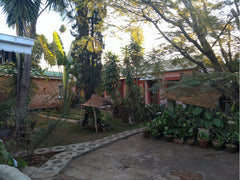
We finally arrived at the Green Park Hotel in Antsirabe a little after 7 p.m. only to find out that our rooms were not ready because either Jochen, or the owner of the hotel, or Ando had confused the dates.  So we were given other huts (each room at Green Park is actually a little brick hut), smaller than the ones booked, and though they have running water, it was cold on that day.  The water is warmed by the sun on the roof and it had been an overcast day – or maybe the hot water was just out for the day.  I didn’t brace the shower until the next morning, and it was the fastest shower ever! 
Green Park Hotel and a Pousse Pousse Outside the Hotel
Green Park Hotel, Madagascar Green Park Hotel, Madagascar Green Park Hotel, Madagascar
We started buying gems almost immediately the next morning after breakfast.  Ando had organized wooden table and some chairs, right outside the hotel on a meadow.  Brokers were already waiting in a kind of line, chatting with one another, then unpacking their wares on the table once it was their turn.
I was shown quite a bit of interesting material.  I haggled over a small lot of 6mm cushion mandarin garnets from Mahaiza for quite a bit.  The initial price offered, which is always “a discuter”, was very high in my opinion.  Since I didn’t have too much equipment with me, I was careful in my choice.  But bright orange garnets are a fairly safe buy, they are unlikely to be anything else.  I also purchased two small parcels of color change garnets, a little bit of rhodolite garnet and two matched pairs of sanidine (a Feldspar), a bigger lot blue and teal blue sapphires between .8 and 2 carats from Diego and Ambatondrazaka, as well as a little bit of pink tourmaline (rounds only).  I eye balled some green tourmaline but found it muddy in color, nothing special.  I was actually shown a lot of tourmaline but nothing really stood out.  Since I try to do a little bit of business with each broker and not everyone shows you useful stuff, I bought just a very small bit.
Grandidiarite, one of the 10 rarest minerals on earth, turned out to be widely available because there was a big find a few months or year ago.  I guess it won’t make that list anymore in the near future, given how much there is.  The price had dropped accordingly and as it sometimes goes in this trade, those who bought at the high got caught with their pants down, including our friend Ando (a sad story that needs to be covered in the next blog).  Grandidierite is just not pretty enough to fetch high prices except for rarity, even the nicer blue colors.  And having made the mistake before of buying what I thought was grandidiarite which turned out to be muddy aqua, I only got two cabochons which I can test at home – and of which I am fairly sure they are what they are supposed to be (update: both cabochons have since been tested and are indeed grandidiarite).  I also risked small funds on two tiny local emeralds which will need to be tested.  We saw a beautiful piece of faceted bottle glass which someone tried to sell for about $800 as an emerald.  I kind of knew it was fake just looking at it, the microscope did the rest.  (I saw a bigger piece around a carat which I didn’t think is fake but the initial asking price was fairly high and I just wasn’t going to risk it). 
Gem Buying in Antsirabe
Gem buying in Antisirabe, Madagascar Gem buying in Antisirabe, Madagascar
I also examined a pretty ruby oval with bubbles under magnification which indicated it was glass filled.  I did get a couple of tiny pieces of ruby that looked more promising (but too small to test on location), but I didn’t spend much just to be on the safe side.
There was one lot of peach pink supposedly Malaya garnet and some rather similar looking zircon – a gem with a peachy yellowish tint (the ones in Tanzania are more peachy, here most Zircon is more yellow).  I bought some of both for telling apart back at home, the lines of people to show us things were long and it was very important to us to give everyone a chance because you never know how long they travelled.  Also, the gem trade in Madagascar is in it’s infancy (or maybe “childhood”) compared to Arusha.  While minerals have been available here to buy for some decades, it’s the huge sapphire finds of the past few years that have put it on the map, and the other discoveries are just following.  The difficult travel conditions, and the lack of easily available large funds are slowing the development.  The law forbids non-Malagasy to enter mining regions, the lack of security makes it unadvisable.  Some locations can only be accessed with a 2-5 day foot march, which few non-locals are willing to subject themselves to.
Gem buying in Antisirabe, Madagascar Gem buying in Antisirabe, Madagascar
The gem brokers in Madagascar are an interesting bunch.  They are 90% female, and they borrow their wares from various “proprietaries.” They come armed with a price list (though they usually have an excellent memory for numbers and don’t need it), then start negotiating with a high asking price or ask you to make an initial offer for discussion.  No price is fixed, ever.  The brokers live off the commission so the higher the prices we pay, the better for them.  Whenever my idea of price and theirs was just too far apart, I would explain that middle price is impossible.  My exception for that were stones from Maria or Ando, whom I want to support.  In their case, I would to figure out an honest price but slightly on the higher side.  I would also try to explain what my clients like or what I can sell, but that often fell on deaf ears because the need to make money simply has priority.  There is an urgent need here to earn some sort of a living and for these small brokers there isn’t a big clientele, which is why I sometimes overpaid.  The downside to that is that money ran out faster.  All deals are cash based, credit cards don’t exist except in the expensive hotels and even there they prefer the credit card just to hold the reservation (even at the Vanila spa, which was $150 a night, we ended up paying cash). 
Once everyone is through and first choices are made, the women return the gems they borrowed and get others from different people or from their supplies.  Often the result is that you see the same stuff presented by different brokers.  But I have a good memory too.  Not always for prices, but I rarely forget a gem that I have seen before.
More about gem buying next time...
Below are some of the gems I brought back from Madagascar and that will soon be in the shop.  I have set up a section on Etsy for Africa Gems, all of which will be discounted durig the sale.
Unheated Sapphires (Tested)
Mandarin Garnet
Chrysoberyl
Color Change Garnet, Strong Change but not pictured
Sphene
Sanidine, a Feldspar
Grandidierite Cabochons (Tested)

Thursday, August 9, 2018

Madagascar – A New Trip, New Experiences, New Gems (Part I)

The first destination on my most recent trip to Madagascar was the Island of Nosy Be, slightly to the northwest of Madagascar and very close to the coast.  Before starting my gem buying, I allowed myself a few relaxing days under palm trees.  On my eight-hour night flight from Amsterdam to Nairobi I met up with my travel buddy Jochen Hintze from Jentsch Minerals.  We had so much to catch up on during the flight that I missed out on a bit of sleep.  Luckily the Business Class Lounge in Nairobi has some couches, where I ended up crashing for three and a half of our six-hour stopover (it was supposed to be just five hours but “that is Africa” as you hear many Africans say). 
We arrived in Antananarivo (called “Tana”), the capital of Madagascar, on the following day, Wednesday at 4 p.m.  Tana is by far the largest city in Madagascar.  It lies in the central plateau, about 1500 meters above sea level and has a very mild climate.  As you fly over the 3000 mile island from the West, you will see hundreds of miles of a nearly uninhabited red mountainous region – deforested in the 1500 years since Indo-Malayans first populated the island.  Your landing approach takes you over the more lush region of the central highlands with many rice paddies and rivers turned red from the earth surrounding it.

Aerial Shots of The Red Island, Madagascar
Madagascar from the air The Red Island from above

As soon as we got past the temperature and health check for yellow fever, completed our visa application and made it past the police stop, we saw Ando, Jochen’s longtime broker friend, and her daughter Maria, waiving to us from the queue.  After many welcoming hugs, we took a taxi straight to hotel Mirandav, a small and private hotel not far from the airport.  At the hotel, we were greeted by another familiar face, Mamavelo, one of the brokers from Antsirabe and part of Ando’s extensive family.  Mamavelo had taken the local taxi-bus up to Tana to get the very first opportunity to show goods to Jochen, and Ando and Maria had brought some stuff for me – time is always too short and all prices have to be individually negotiated.  Ando does a great job announcing our arrival to dozens of dealers, letting them know what we are interested in and arranging the meetings.  So we spent our first two hours fresh off the plane looking at gems at a table in front of my room, shaded by palm trees; just until past nightfall at 6 p.m., when even the battery operated lantern I brought didn’t yield enough information any more.  I saw several new sapphire parcels of blue-green, blue and pink shades, some nice rich dark but included aqua, a parcel of Malaya garnet ovals, as well as sphene, chrysoberyl and a lot of demantoid for me to mull over.  I was too tired to make any decisions but I set aside what I liked for Ando to talk to the “proprietaries” about more realistic prices than the first quotes, which are traditionally way too high.

Reunion with Ando Antoniania, our Broker
Happy Reunion with Ando Happy Reunion with Ando
For dinner, we went to a restaurant for Tana locals – Chez Maman - and where we were indeed the only white faces.  I had some excellent salads, beef tongue with French fries, and the local beer, THB – Three Horses Beer.  For the four of us, dinner and drinks came to just under $10.  I tried to take some video, it was funny sitting at such a noisy street with cars honking at each other, buyers and sellers of who knows what arguing, tables tightly packed, and feeling completely out of place, just not in a bad way. 
After we got back to the Mirandav and finished rearranging our suitcases so that some of them could stay at the hotel (the local airline doesn’t allow 2 pieces of luggage so one had to stay behind), I was out like a light.

Hotel Mirandav, Ivato (Near Antanarivo)
Hotel Mirandav Hotel Mirandav Hotel Mirandav
At 5 a.m., the alarm rang again so we could start the next leg of our flight.  The flight to Nosy Be was scheduled for 7:30 a.m.  Just as we were about to leave, at 6 a.m., there was a knock on the door.  It was another broker from Antsirabe; her name is Gitte, just like my aunt, and who had taken the bus up to see us before our flight was leaving, not realizing we had an early morning flight.  Jochen didn’t want her to feel bad so he let her unpack her wares right on the bed amidst the packed luggage in the dark.  But we just didn’t have time (or light for that matter). Gitte was really disappointed.  It’s a five hour ride on a crappy taxi bus from Antsirabe. (Luckily we were able to buy some stuff from her at a later point in the trip).
We made it to the airport at around 6:15 a.m., and already there was a long line for “Air Maybe” – the local nickname for Air Madagascar.  Air Madagascar has earned this nickname for its high unreliability.  Maybe it goes somewhere, and maybe not, maybe it flies on time, and maybe not.  For instance, when there’s no fuel or there aren’t enough passengers booked, it doesn’t take off.  Ticket prices are equally unreliable and depend on fuel costs as well as the number of passengers booked – tickets for flights within Madagascar are usually quite expensive, but despite all these disadvantages, it is a far better way to get around than driving long distances on poor and only partially paved roads!
Well, we lucked out.  We weren’t on time or anything – there was not enough personnel to check us in quickly.  But we did leave.  Only not to Nosy Be!  Literally just before takeoff the pilot announced that we were making another stop, just north of Nosy Be on the mainland, at the town of Diego Suarez / Antsiranana (that’s the former French name and the later Malagasy name).  Back in the day this area was considered a hideout for Portuguese pirates.  It doesn’t look very exciting there now though. 
The reason, apparently, for our stop was to drop off some cargo.  Another plane had engine trouble so our plane took its cargo over to Diego.  None of the passengers even raised an eyebrow about the change in plans.  A local Frenchman said to us “c’est normal.”  So we accepted it as normal, enjoyed the view from above, and tried not to be phased by the two hour delay (late takeoff, extra hour on the plane, and a short stay in Diego where we had to all leave the plane only to sit in a tiny arrival hall with nothing in it but chairs, and then get back on).
Aerial Shots of Diego, Madagascar and Nosy Mitsio
Diego from above the Madagascan Islands from Above Nosy Mitsio 
At the airport we were met by our driver for the stay, Ando’s cousin Gael who’s father owns the Toyota Jeep we had rented, and who had made the entire two day trip by car.  Gael had decided to use the occasion to visit some friends of his who live on the island.  The original plan had been for Gael to pick us up at the end of the stay in Nosy Be, but he’s a fun companion and we were glad to have the car.  Gael turned 30 this year, he is well educated by Madagascan standards with a degree in computer science, he’s funny, very curious about things and and enjoys driving Jochen around during his gem buying tours.  I had already met Gael on my last trip, and we had a lot of interesting discussions comparing our lives.
Gael and Yvonne
Selfie of Gael and I in Lokobe Park
The Island, as best as I can describe it, is a small slice of paradise.  I had never been anywhere so tranquil and peaceful.  From my reading, I ascertained that Nosy Be has over 40,000 inhabitants but it doesn’t feel at all crowded.  And according to Gael’s observations, it has more white people than anywhere else in Madagascar in one place.  I should qualify this remark: by my standards there were very few white people here, perhaps 1 in 100.  Nosy Be probably also has the largest number of rich people in Madagascar, with perhaps the exception of Tana.  The rich on Nosy Be are mostly French tourists I presume, but at our hotel – the Vanila Hotel and Spa - there were people from all over: Belgium, the Netherlands, Croatia, and a group of rich Malagasy.  Generally the hotel did not seem very occupied for this August, which is not only vacation time all over the world, but winter in Madagascar with very mild days (85-90 degrees, not humid, about 70 at night).  The hotel itself was fantastic: rooms were large and airy and equipped with AC and flat screen tv’s (an absolute rarity in Madagascar); the mattress made of memory foam and the food, which was largely French with some local influences, very good (think French brasserie with an Asian flair).  The prawns and shrimp had very unique taste, nothing like the Thai stuff we usually get in the US, and the desserts (sadly for my waistline) were absolutely excellent.  Every Saturday there is a big buffet with local Malagasy food, i.e. roasted red snapper and coconut chicken curry.  And banana dessert wrapped in banana leaves, in addition to cheesecake, fresh fruits and crème caramel.  For breakfast, lunch and dinner, you could order fresh pressed juices, tuck into a nice size buffet and get fresh made omelettes and French pastries. 
Images of the Vanila Hotel and Spa in Nosy Be
Our dining area in the Vanila Hotel Delicious Food The View from Vanila hotel Vanila Hotel Vanila Hotel Vanila Hotel Vanila Hotel
But for me, so far, the highlight of this trip was an entirely unexpected one: I learned scuba diving!  I came here expecting to do some snorkeling but Jochen convinced me to try the sport with him.  Nosy Be is well known for its coral reefs located just off shore, boasting a wide variety of marine life.  It turned out that there was a diving school right next door, run by a French marine biologist and his wife, Alain Benoit and Nathalie.  They used to live in the Comores but according to Alain, who was our diving teacher for the duration, the coral reefs there are dying from pollution and so they relocated.  Alain is also an excellent photographer by trade (see his photos here)
Unfortunately the money Alain earned through photography and writing was not sufficient, which is one reason why they founded the Sakalov Diving School.  The couple also operates an Air BnB and they offer other excursions to familiarize travelers with the local flora and fauna.  Alain related to us that he had co-authored an article about one of the coral reefs near Nosy-Be, explaining the extinction it faces and how to help prevent it, yet nobody seemed interested in publishing it.  My own feeling is that magazines all over the world are flooded with articles about how we are managing to kill the planet.
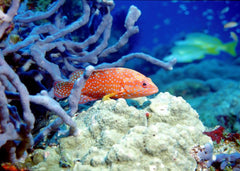
Nosy Be Marine Life Nosy Be Marine Life
But let’s get back to the more uplifting (or perhaps downlifting) subject of diving.  I was actually a bit scared to be dependent upon a tube for breathing.  You have to first get used to breathing through your mouth, and the sound of the regulator was very loud and unnerving to me.  Add to that the thought that your “breathing tube” could easily pop out of your mouth if you don’t remember it’s vital importance while staring at colorful fish.  But we didn’t dive very deep and there was no decompression needed – so if you panic you can just swim back up. In addition to that, I bit on my mouthpiece quite hard, so much so that I was concerned about leaving toothmarks. 
Yvonne Diving near Nosy Sakatia
Me diving
Our first dive took us to an exploratory six meters, the second to about 12 – a fact that I was blissfully unaware of until Alain told us at the end of the day.  On day two we went down to 15 meters, and we saw a baby seahorse nesting in the wall of one of the reefs.  On the final day I got my diving certificate which meant, of course, that I had to go to a diving depth of 18 meters, but not for very long. 
I didn’t find it very hard to dive, but it was a little tricky to regulate your buoyancy, and my ears didn’t like the water pressure so I had to go down very slowly (imagine going up and down in an elevator very fast, you have to swallow hard or hold your nose and breathe out hard to “pop your ears”.  Before each dive we got to practice some safety procedures, most of which would not likely be needed on these kinds of dives, but I appreciated them just the same.  It felt quite weird taking my mouth tube out under water, letting it go and then finding it again and putting it back – or swimming over to Jochen and grabbing his backup regulator to simulate a regulator or air failure on my part.  For getting a certificate, all these exercises are required.  Ugh. 
Weirdly enough, I never panicked during any of the dives, somehow I thought at first I’d want to go back up but then I got distracted by all those “fishes” and coral, sea cucumbers, star fish, lion fish and I don’t know what else – or yes a mantis shrimp, a very colorful animal.  Some of the star fish and corals literally seemed like they “glow in the dark.”  It’s a funny experience because even though you easily see it in photos online, you can’t imagine how colorful it is “down there.”  And how surreal the entire experience is.  In the end, I am very glad I did this and hope to do it again to see what else is hiding down there.
Gael, who had never been on a boat (and had only once been to a beach before, a year or so ago together with Jochen and his sister) came with us on our first day, and he was so delighted by the experience that we decided to sponsor a dive for him on the second day.  Gael didn’t know how to swim but he bravely jumped into the shallower waters with some flippers borrowed from Nathalie.  He told us later that when he saw Jochen and me paddling around in the water he thought to himself” “this can’t be that hard.”  Nathalie explained that you don’t need to know how to swim in order to dive.  There are just restrictions about the amount of time you can stay under (20 minutes) and how deep you can go (I believe it’s around 3 meters but it might be a bit more).  Gael absolutely loved it – the experience of a lifetime he said.  He even got a little diving baptism certificate! 
On a sidenote: diving in Nosy Be is very cheap, about $85 for a day which includes two dives with the required rest in between and which lasts about 5 hours in total.  The certificate, with the test at the end and a diving log book cost me $405.
The second highlight of our Nosy Be trip was a visit to Lemuria, a little natural park on the South East side of the island.  The park houses over 25 different species of lemurs.  They are so cute – I wanted to take one with me.  The lemurs are tamed by park rangers.  New arrivals are fenced in at first until they get used to humans.  Jochen and I got to feed the lemurs with banana smeared on our open palms.  One cannot pet them however.  Apparently they might bite if you touch their tails because that’s their “rudder” and very important to their ability to climb and jump.
Our guide, a very exuberant young Malgash who was super excited to practice German, talked through just about all of my recordings which would otherwise have a very idyllic background of rustling trees and “chatting” lemurs.  Next year they will have some big cruise ships arriving.  Hopefully they don’t destroy everything.
Helle Ville, Nosy Be
The Streets in Helle Ville Nosy Be

In my next blog, read about my travels to the gem capital of Madagascar, Antsirabe…

Tuesday, July 3, 2018

Africa Revisited - A New Trip

I can't believe it came upon me so fast.  This coming Monday I am leaving on my second trip to Africa.  I will be revisiting some of the places of last time and adding a couple new ones.  And of course, I will be looking for gems!
My trip starts in Newark Airport via United, with a one-day layover in Amsterdam on the 10th.  My Kenya Airways flight to Nairobi doesn't leave until 8 p.m., so I get to spend the day in the international terminal.  Luckily Schiphol airport has a funky "hourly hotel" called Yotel, where you can sleep in a little 20 square foot cabin for a few hours.  
My travel companion, as last time, will be Jochen Hintze from Jentsch Mineralien.  Jochen is a well connected Africa veteran - his first trip to Africa was about 50 years ago when he hitchhiked to Morocco as a teenager.  Jochen has traveled almost the entire African continent and has crossed the Sahara desert six times so I feel safe in his hands.
Jochen is flying in from Germany so we are going to meet on the flight to Nairobi - assuming his flight from Hannover is on time!  After another five hour layover in Nairobi on the 11th, we get on another plane to Antananarivo Madagascar.  And after YET another layover of about a day, which we will be spending at the same hotel as last time, a well protected simple little complex just outside of town, we will attempt to take Air Madagascar to the island of Nosy Be.  
Attempt?  Yes.  Go to google and search for Air Madagascar reviews.  You'll see what I'm talking about. Air Madagascar is the only airline in Madagascar and sometimes it flies, sometimes not.  When there's no fuel, that is.  Or some other issue that you will never find out about. 
Read some reviews below:
"WORST AIRLINE! BUT one does not have a choice to use Air Madagascar when travelling around Madagascar. Among the locals, the airline company has been nicknamed Air Maybe..." 2 star review "The thing is, if you want to fly from Tana to Nosy Comba, there are not so much other options than flying with air Madagascar. The short flights are very expensive because they have the (corrupt) alone right to fly on some routes. They just do what they want and take their time...." 2 star review
The flight to the island Nosy Be is only an hour, but if you go by car and take the ferry you need two days. Nosy Be has a number of "luxury" hotels as well as standard hotels starting at $10 an hour, going up to about $200.  We are going the "luxury" route which is still way less money than a good hotel in the Carribean.  The Vanila Spa hotel costs about $150 a night.  The website looks stunning to my somewhat simpler tastes so I can't wait to see what I will really think when I get to this nearly "off the grid" location.  (Try booking a flight to Nosy be through a site like Travelocity - Air Madagascar doesn't even exist on there).  
Assuming we will make it to Nosy Be, we will stay there about four days and then get picked up by our friends, Irene (Andou) and her relative Gael with his father's vehicle, on Sunday, take the ferry back to Madagascar proper, and continue on a 2 day drive down to the Green park hotel in Antsirabe.  We will spend a few days there looking at gems and if it goes as it did last time, sellers will line up for us early in the morning and stay until sundown, or sleep in the street or a very cheap hotel (our hotel is on the expensive side for the area, about $15 a night - but very safe and very pretty).  
Here's a video from our previous stay in Antsirabe, 2 years ago.
On Sunday the 23rd we head to back to Antanarivo and from there to Nairobi where I get to see Doreen Kawira and her little baby son who will be one year old this summer.  I sponsored Doreen's college education and I met her for the first time 2 years ago.  Now I help her raise her son (she's a single mom, a state of affairs not very unusual in Africa, sadly).  Doreen also works full time at the University of Nairobi and with the help of Cecile Raley Designs and the money we have raised, it will stay that way and she can afford the nanny every month, who costs about $100 (25% of her salary).  Donations for Doreen, by the way, are very welcome. GoFundMe Campaign gf.me/u/jmg7u7
I will stay with Doreen in her apartment for one day and then we are off to Arusha, Tanzania via Precision Air (don't trust the name lol).  We stay in Arusha another 9 days or so, this time at the Mount Meru Hotel, and we plan a 5 day trip to an area called Kongwa, to look for some rare crystals that I know nothing about.  We will be joined there by a German friend of Jochens.  
If all goes safely, I will be back on a plane to Amsterdam on August 1st, and arrive in Newark on the 2nd after another 1 day stay in Amsterdam.  I plan to do some gem shopping in Arusha as well, mostly with Jaimeen's (Prima Gems) uncle as well as our Greek friend Reno who owns a shop there.  Perhaps I will also buy from the locals, this part is always the big adventure and you never know what you're gonna get.  
I will try to keep you posted throughout the trip, but mostly through small tidbits of information - the internet in most places in Africa is very slow so uploading anything but text is very difficult.  But I will try, and I will most certainly try to return home in one piece!
Please read some of my previous blog entries about Africa here: 

Padparadscha Sapphire – What’s the Story?

Every since Britain’s Princess Eugenie has been sporting a Padparadscha sapphire engagement ring valued at over $130,000, these lotus flower colored beauties have been all the rage.  Industry prices have actually risen as a result.  In terms of color, purists claim that a Padparadscha should combine peach-pink and orange tones, ideally mixed evenly (no color zones), and have light to medium saturation. But exactly how that looks is a point of contention.  The ideal comparison is the Lotus flower which it is named after.  Given the huge variation in both color and saturation of actual lotus flowers, it might be fair to say that this reference is more romantic than it is helpful.
Originally “pads” were mined primarily in Sri Lanka, and this is why “purists” still consider only a specimen with the famed Ceylon origin to be a true Padparadscha. Nowadays, however, gems from other regions with the same color characteristics, for instance from Madagascar or Tanzania, can be deemed a “pad” as well. Some gem dealers will refer to those as “African Padparadscha” but one should not rely on the nomenclature being exact. In any case, it is still true that a Padparadscha sapphire from Sri Lanka will command a premium in price, even if the color quality is the same as a comparable stone from Africa. Whether this is justified or not, the take-home message from this is: if a seller is asking an additional premium for the Ceylon origin of a Padparadscha sapphire, one should only pay the extra if the alleged origin is backed up by an origin report of a reputable lab (GIA, AGL, ...). 
 Traditionally only an unheated sapphire is eligible to be considered a “pad” but that has since changed s well.  Heating may turn an originally only very faintly peachy colored sapphire into a “pad.”  This should not command a premium in terms of price, however.  As to the nomenclature (is it a pad or not), I would probably stay away from the term, to be on the safe side.

GIA has a very interesting article on the historical development and currently use definitions of the term Padparadscha sapphire, which you can look at here: https://www.gia.edu/doc/Padparadscha-What-s-in-a-Name.pdf
According to the report, written by Robert Cownsingshield, no reliable laboratory criteria can be established to standardize the term Padparadscha – at least not one that all labs would agree on.  However that said, a color description can be given that will be used as a comparison base for color.  Here’s what Cownsingshield says about that:
It is GIA's opinion that this color range should be limited to light to medium tones of pinkish orange to orange-pink hues. Lacking delicacy, the dark brownish orange or even medium brownish orange tones of corundum from East Africa would not qualify under this definition. Deep orangy red sapphires, likewise, would not qualify as fitting the term padparadscha.
This definition is best applied by comparing to what the lab considers samples of the right color.  Unfortunately, some laboratories are much stricter in their application than others.  The strictest US lab is probably AGL at present. 
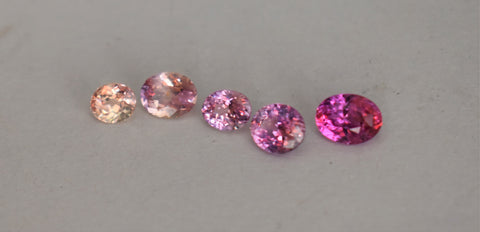
Candidates for the Padparadscha Label from our Collection - All Sri Lanka Origin, the rightmost stone is heated.
1.03 Ct. Sri Lankan Sapphire, 6.4 x 5.7mm, no heat Link here
1.56 Ct. Sri Lankan Sapphire, 7.5 x 5.7mm, heated, labeled "Pad" despite heat. 
 Oval Padparadscha Sapphire, Unheated, 6.67 x 5.36mm. Link here 
Now, it would be expensive both for sellers and buyers alike to have every single possibly qualifying sapphire evaluated by AGL.  So it is often left to gem dealers to decide how to classify their purchases, which is why it is so important for a buyer to find a reliable and also knowledgeable source for their sapphires when it comes to the less valuable pieces (probably at a price over 1K, a declaration of “pad” should probably be verified by AGL.  My own source, as many of you know, is Dudley Blauwet, who has extensive industry experience and sources all his sapphires directly.  Here’s what Dudley has to say about the way he distinguishes a pad from a peach pink sapphire: