This blog is dedicated to the pursuit of everything jewelry and gems. As a jewelry designer with lots of connections to artisans and gem dealers in New York, I love to fill you in on the latest gem imports and ways to make pretty pieces.
Do you realize that, as a retail business, I am already getting holiday advice email from our industry? Etsy, Manta, and even FedEx are sending around fact sheets on how to prepare for holiday business, or how to boost it. For my own part I’ve never had a ton of it, probably because most of you are shopping for yourselves. So maybe then I need to think differently – i.e. propose some ways in which you can get others to find you the perfect gift from my shop, either with a gift card or with starting early by planning a custom project to wear on Christmas or New Year's.
When I think of treating myself with jewelry, my own first thought is not a ring or a pendant but earrings. I have more earrings than anything else in my personal collection. I wear a Diamond pendant all the time, and rotate between 4 or 5 rings, the rest are earrings. Dangly earrings mostly, though I occasionally wear a kite with a Diamond in my second hole. I should probably branch out to a single Hauyne or a small square Burma Spinel!
Custom earrings can be an expensive item in my shop since you are making two of everything. On the other hand, there are some fun ways of reducingcost:
Use interchangeable leverbacks, which come in silver, white gold and yellow gold.
Use Diamond huggies or plain gold hoops instead of leverbacks.
Dangle a gem from a short chain behind a post.
Make one component at a time, i.e. a pear gemstone dangle first, then have another component lazered on top at a different point. In fact I often change my earrings around by adding another part or switching from leverbacks to posts.
Here are some ways in which I have made my own earring collection more varied:
In these Red Mahenge Spinel, Burma Spinel and Diamond Earrings I used the leverback itself as part of the design and added the Victorian flower component as part of the mechanism.
In these Purple Garnet, Color Change Garnet and Zircon earrings I used my favorite oval leverbacks, my trillium connector part but no channel wire. Rather, I used a five-prong pear setting which provides a lot of light for the center gem. The basket is really low set on these and it's strongly tapered so there's no interference in the back. These come in oval also and in emerald cut.
These 6mm Tanzanite cushions are set with tips up and down as danglies, and I soldered a tiny round Diamond on the bottom for extra interest. These are among my everyday favorites. My four prong floral settings are perfect for this design.
In These Vietnamese Spinel and Paraiba Drops I used Purple Tanzanites in Pearl Cups as the top post instead of leverbacks.
I rarely use yellow gold but these colors called for it. Peachy Mahenge Spinel and Chrysoberyl in channel wire - for the Mahenge Spinel I used an 8 prong pearl setting which is fairly low set. It comes in round only, 14 kt yellow and white gold.
Here's another variation on the dangly - Seafoam Green Tourmaline baguettes with handmade prong settings that run almost no interference with the gem. Directly soldered on top are Purple Garnets in low set bezels, and dangling above my prize: two 4x3mm oval Paraiba Tourmalines. I made a matching necklace for this.
And finally, my most prized set, Red Mahenge Spinel, Pink Burmese Spinel, and oodles of Diamonds set in my Penelope style. With Diamond leverbacks (available upon request). Who could resist?
And here, finally, are some inspirations for custom creations for some of you:
Red Garnet, Mahenge Spinel and Mandarin Garnet:
Burma Spinel and Paraiba with a Chain Component
Aquamarine and Yellow Sapphire, the Aqua setting is hand fabricated
So this is going to be a longer story, and it starts a few billion years ago. As my geologist friends tell me, when you have a flat plateau and there’s a hill on it, you have two possible explanations. Either there’s a young volcano on the plateau – where the word “young” has to be taken within a certain context - or there’s very hard rock underneath, rock that refused to erode over the last few million years. In either case, if you are a geologist, this is interesting. Fast forward to the late 1950s when a few British geologists found this interesting as well and decided to prospect one such hill: Mautia hill in southern Tanzania. Said geologists blew holes into the hill and took samples. The dumps created by the excavation were clearly visible via satellite – or rather, the satellite images show blotchy impressions indicating possible talc schist. The geologists wrote some articles about the minerals. Initially they thought they found something called glaucophane, but later this was identified as a new mineral called yoderite.
Mautia Hill
These old articles caught the interest of Jochen's friend Gunnar Faerber, a burly East German carpenter turned geologist who has a business selling rare minerals. Gunnar proposed to Jochen to make an expedition to prospect the hill, and that was the story behind this trip, which I got to join.
Driving to Kongwa
We started towards Kongwa early morning together with Gunnar’s son Eric, Moustache – nicknamed because of his mustache but whose actual name is Wilson, and of course the driver, Benuel, in a minivan borrowed from Benuel’s family. The closest “actual town” near Mautia hill is “Kongwa,” located about 50 miles southeast of the capital of Tanzania, Dodoma. So Dodoma was our first destination, and “praise the Lord” the road to Dodoma was paved two years ago. So there was no “Tanzania massage” as Moustache tends to put it – the shiatsu on your behind which starts to really hurt after about 15 minutes on a dirt road when your lower back tends to be fed up.
Baobab Landscape
Sadly, while the road is paved, it is a single lane highway (one lane in each direction) and you can only go 100 km/hr, so about 70 mph, if that. And since in Africa towns are built right near the highway for better access to bus transportation, you have to slow down to 35 mph every few miles. We also got stopped for speeding (about 5 miles over the limit), the fine was about $12, a lot of money for a Tanzanian (he’s been reimbursed by me since). There were police stops every few miles, sometimes they would wave us through, sometimes we had to stop. Sometimes they’d ask for your license, sometimes they’d want to know where you are going. There were new speed bumps absolutely everywhere in the towns. Maybe the government is trying to make money, or maybe they are just trying to make the roads safer now that there are more roads. Many chickens and probably not just chickens have lost their lives now that one can drive faster – on a dirt road car accidents are just about impossible because you can’t go fast enough. Unless you can’t navigate them and end up in a ditch. This is why we always have a local driver.
Our drive took us past the turn to Manyara national park just south of the escarpment where the continent is drifting apart due to tectonic plate movement (no worries, it’s a slow process), past the Tarangire national park and then slowly turning south to Dodoma. The first part of the drive took us through flat land, then through a lush forested mountainous region with banana plantations and wild growing rice, and finally through 100 miles of wide open land with baobab trees. Since it was winter, the baobabs didn’t have leaves, which made the area look very deserted.
By about 4 p.m. we finally got to Dodoma; we turned west to the (also paved) road towards Dar Al Salaam for another 75 minutes, then headed south towards Kongwa. That road turned out to be partly paved as well, with much construction still under way. In fact it was kind of funny seeing gas stations along the way and then a few miles of dirt road, then paved road again with gas stations. I wondered how they managed to get the gas to those gas stations, not to mention the building materials to put it there in the first place.
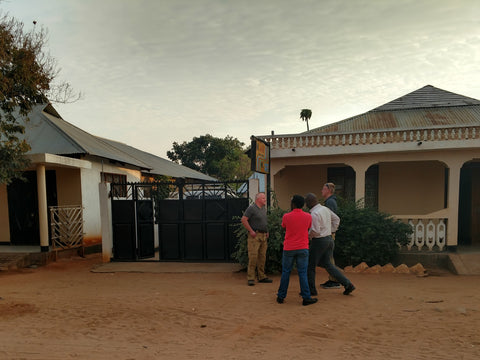
Kongwa Guest House
Near Kongwa
The town of Kongwa turned out to be a very sorry looking place, there were no hotels and just one small guest house for local travelers. There were no restaurants either, just some huts where we could buy water, beer, white bread and cookies. Luckily, next to the guest house there was a kind of “kitchen,” manned by Muslim women who cooked the traditional Swahili food. Dinner cost $2 a person, on offer that night was rice and ugali (a mush made from white corn), banana in sauce with meat, red beans, a spinach kind of thing and cooked okra. We picked up a case of beer only to find out that we could not drink it there – Muslim rule. “Hakuna matata” – no problem. We behaved.
While we were eating, Moustache tried to find out if there was any local person in charge of the area. We had been strongly advised not to do any kind of digging for minerals on our own. Someone told us there were arrests made recently. Tanzanian prison is nothing fun, even U.S. prisons are a luxury hotel in comparison. Jochen related the story of once being inside a police station and seeing prisoners beaten bloody, lying on the floor only semi-conscious. “Prisoners don’t receive food in the prisons,” he said, “they have to be fed by their families or try to get food through a prison mate.” So we decided to just go and look and not take anything, and also to enlist the company of a local who knew the local laws.
After dinner, it was time to turn in for the night in our guest house. “Guest house” is a name given by the locals for places to stay for the locals. Not really for Wazungu – white people – or at least not for this Mzungu (singular for white person)! There were a total of five rooms, one of which was already taken by another traveler. One room went to Gunnar, one to Eric (16 – had to have his own room!), one to Moustache and Benuel to share, which left one room for Jochen and I. Each room had one full size bed. Ugh. The rooms were tiny, electric was turned on only for us, one naked lightbulb in each room equipped with a glaringly white light energy saver lightbulb. Running water was promised but never turned on. There was a bathroom in each room, but only the size of a toilet (3x6 feet) with the “toilet” at the end of it – a hole in the ground with a “tread” on either side, and no shower. In lieu of the running water, there was a plastic tub full of water with a little bucket for flushing or washing. The floors were bare but tiled, in the corner a table and an old TV, a mosquito net over the bed, two small pillows, one blanket. I asked for another pillow: “Amna” – don’t have. The most common word in Tanzania. This is also a typical response when you order from a menu in a restaurant. A second blanket? Another “amna.”
Well, having two beers on the porch before helped. And the shot of whiskey. I was out like a light. Apparently, I stole the blanket during the night and wrapped myself in it 360 degrees, forcing Jochen to put his jeans back on because he was cold. Sorry Jochen.
At 7 a.m. there was a loud knock on the door. It was Gunnar, fully dressed, ready to go. Totally hot to get to our hill, right now! But: we were supposed to wait for tea which meant waiting for the fire to be hot. And for some chapati, a pancake made from corn flour. (Tasty actually.) And we had to wait for “the guy” as Moustache called him, the local in charge, who was supposed to come with us. Someone from the local tribe, the Gogo. So Gunnar had to wait.
Gunnar Raring to Go
Eric Not so Much
Well the guy from the Gogo was a no show, and Gunnar grew increasingly impatient, so we decided “hell with it” and go to our hill without a local guide. Meanwhile, enough time had passed by for the fire to get hot so we could enjoy the chai and chapati, together with a package of toast. Eggs? Marmalade? “Amna.”
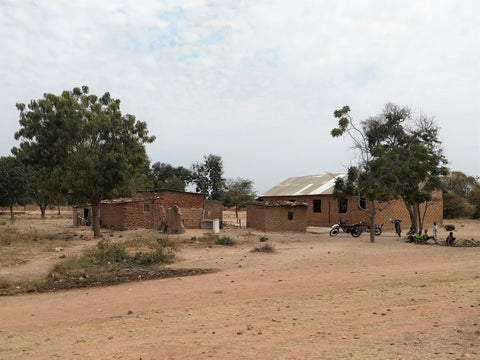
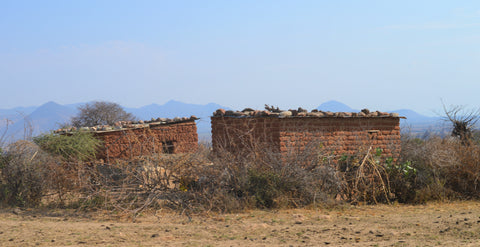
So off we went at about 8 a.m. Gunnar’s GPS, it turned out, was malfunctioning but we had the satellite printouts and my phone was loading satellite maps as well. So we figured out which dirt road it was, drove down that road for about 10 miles, then found another dirt road toward Mautia hill. The road wound past several villages of 5-6 clay huts each, some zebu cows, children herding goats, and we gathered a lot of stares on behalf of the Gogo tribe. The roads we took were meant for carts, not cars (once when we got lost we were able to see our own tracks from earlier in the day to find our way). We can only speculate when the last car had passed through that area, if ever there was one. The surrounding area was quite beautiful, lots of open space with baobab trees, juicy red earth, dried up sunflower and maize fields. Mountains in the distance, and views over a vast and far landscape.
After another half hour or so we finally reached one side of the hill. The van barely made it up the road, we thought once or twice that we had to get out of the vehicle so it could manage the next ditch but Benuel was used to that kind of driving. At the bottom of the hill, where the white dirt clearly indicated the previous digging, we parked. We changed into working clothes – shoes that cover the ankles for stability, thick jeans or any other pants that don’t rip easily, head cover for sun, hammer, chisel. The area was totally deserted, all we saw were some shepherds in the far distance, but once we climbed up a little and then descended into the pits, we were not visible to anyone.
At the bottom of Mautia Hill
Mautia Hill
Maybe it was due to the lack of local interest in us – the arrival of Wazungu in a village normally makes cell phones ring across the entire region – or maybe it was due to the fact that there was nobody near Mautia hill when we were digging; in any case, less than a few minutes into our supposed “looking only” expedition, Gunnar and Jochen got the better of themselves and started collecting rocks. First they filled ziplock bags, then the ziplock bags wandered into sandbags, bag after bag. The bottom of the hill took us past deposits of talc schist with deposits of quartz, kyanite and the expected yoderite or what looked like it, dark violet crystals on black host rock. After further prospecting, they also found quartz colored by piemontite.
After a couple hours of prospecting, and a nice nap on the back seat of the car on my part, Gunnar and Jochen seemed satisfied with their discoveries and we headed back. On the way, we noticed more white piles of rock on the other side of the path, indicating another pit. But it was too late in the day to explore it. We were tired, hungry and full of dirt and sand. Given the satellite image, we believed ourselves to be near a tarmac road so once we got down from the hill, we instructed Benuel not to turn in the direction of Kongwa. We also thought it better not to be seen back in town with all of our bags of rocks.
Gunnar and Jochen Prospecting
Well, things didn’t go as planned. Moustache had expected us to return to Kongwa and had consequently left his and Benuel’s bags in the guest house. Initially we had expected the same as we didn’t think that the prospecting would go this quickly, but we had nonetheless packed our bags in the morning and put them into the back. The guest house had also been reserved, dinner ordered, and we didn’t have the phone number of the owner. So – we had to risk going back.
Piemontite
Thankfully, back in Kongwa things went smoothly. Nobody seemed to be interested in finding out why we were there. There were no officials, no police, just a disappointed guest house owner because we cancelled our reservation. We did pay for Moustache’s and Benuels room (the damage: $6.50), had some food at the neighboring kitchen (more rice, beans, ugali, etc.) and democratically decided to return to Dodoma to look for more comfortable accommodations. I have to say “democratically”, not “mutually” because Jochen was against, Gunnar, Eric and I were for returning to Dodoma. Jochen’s idea turned out to be the better one. As is typical for democratic systems, the “masses” don’t always know what’s best. The drive back to Dodoma took us almost 2 hours with traffic, as we got stuck behind a lot of trucks on the way. The first hotel we stopped at, probably the best in Dodoma, was not accommodating – they didn’t have any rooms left. We had no choice but to look for another. As a result, we got lost in Dodoma while I was desperately trying to download hotel options with crappy internet. We finally ended up at the New Dodoma hotel at $65 a night with breakfast, fairly tiny and run down rooms but there was fast wifi, a pretty courtyard, regular toilets and showers with warm water!
Dodoma Hotel
While the warm shower was certainly worth it for me, two precious hours had been lost. And since we had considered going to the Winza region the next day, which is much closer to Kongwa than Dodoma, two more hours would be lost going back the next day. The other disadvantage: staying in Kongwa, or near Winza in Mpwapwa, would have meant that Moustache could have spread the word among local brokers that some Wazungu were in the region who wanted to buy stuff. The arrival of Wazungu wanting to make purchases usually spreads like wildfire, but not necessarily at a fast pace. Arriving closer to lunch, by contrast, meant we would not enough time to spread the word and not enough time go get good minerals.
So, after a dinner of chicken, tomato and pepper salad (Jochen ordered tomato salad and I ordered Katchumber but we both got the same thing), grilled goat and “chipsy” (French Fries), and some locally produced wine we hatched a plan B: head to Winza to at least investigate a little and then return to Mautia hill and prospect the second pit if there was time. Plan B also didn’t go as planned, this time it was my fault because I sat up front to navigate and missed the turnoff. In my defense, we were all engaged in a slightly heated discussion about the value of a short stop in Mwpapwa and I wasn’t paying attention. So the decision kind of made itself because after we finished arguing we had already reached the turnoff to Kongwa. So that’s where we went (luckily as it turns out). First we spent another hour at the already investigated pit, during which Jochen explored the top and collected 80 pounds of stuff to analyze, while Gunnar explored yellow orangy glimmer with a pink colored mineral (Jochen thinks it’s biotite, Gunnar says it isn’t) and green kyanite in quartz, probably colored by chromium as opposed to iron manganate.
The rest of the afternoon was spent at the second pit. This pit turned out to be quite a bit larger than the first, with oodles of the quartz piemontite of varying shades of peach, pink, and burgundy and quartz containing a black mysterious mineral. I wandered around shooting some video and promptly got stuck in a bush full of burr. It took considerable time removing those sticky little buggers. In general, I found the prospecting somewhat challenging. There are bushes armed with nearly two inch pointy pins that can punch a tire (and did punch ours as we found out the next day). And other bushes aptly termed “wait a little” (subiri kidogo) in Swahili because once you get stuck, the more you pull, the more you get caught. The rocks in the pit were so full of talc that you couldn’t get a proper hold with your boots and were constantly in danger of slithering down into the pit 10 feet below. I opted out of too much climbing in the area and as the guys worked their way along the side wall of the pit, instead I walked the longer way through the bush and a dried up sunflower field to the other side.
Eventually I got fed up with trekking through fields and climbing rocks. I went back to the car where Eric was watching a movie in the back seat and Benuel was resting under a tree, occasionally talking to friends on the phone. (Some things are the same everywhere.) I took out my laptop and started writing. Just as we were starting to think it should be time to return, Moustache emerged from the rocks and passed on the message that we were to drive around the pit to the other side so that Gunnar’s sand bags could be carried downhill, not uphill. According to the satellite, there was another path on that side.
Click below for second video of us prospecting Mautia Hill
Satellites can be incorrect sometimes. Like this time. There was no road, at least not all the way. Benuel braved a sunflower field and then we gave up. He got out of the car and walked the rest of the way. Jochen, who had joined us already, stayed behind with Eric and me, and after what seemed like half an hour, Benuel emerged with a heavy bag, followed by Moustache and Gunnar with two more bags each. We packed up the trunk and headed back, all the while musing over the now pressing question about how to get all this back to Arusha once the bags were joined by our luggage, and then the even more pressing question of what to do after that.
After passing through the closest village, we turned right instead of heading back to Kongwa because the day before we had seen trucks driving in the distance at a good speed, so we surmised a tarmac road somewhere back there which should accelerate the journey. And tarmac there was, not more than 2 miles away from the hill: the very tarmac road from which we had turned off miles earlier to take the much more arduous road through Kongwa. Duh.
By sundown we had reached our hotel. Again, we were full of dust and dirt. We showered and headed for dinner. I ordered “Indian” food, which turned out to be another misnomer. Don’t get me wrong, it was excellent. Lamb, or rather, mutton, in a kind of sauce with mixed vegetables and salad. It just wasn’t Indian. Two kittens came to request part of the meal, they were probably the best kept kittens in the region, living outside in comfortable climate, protected from the wilderness by the courtyard, and fed daily by tourists.
The next and final morning in the not so impressive capital of Tanzania presented us with another challenge. Getting the van loaded. The challenge was two faced. Getting everything and all of us into the van, and unloading and reloading minerals right in front of the hotel guard. A small amount of “posho” (pocket money) did the trick and the guard watched us load with a big smile on his face.
We were off to an early start back to Arusha, or so we thought. For the first time while driving us in the entire week, Benuel got lost. All of a sudden the paved road ended and we were on a dirt road instead of the highway. We were lost for a good 30 minutes – Benuel acted like he was taking a shortcut but it wasn’t very long before I figured out that he had engaged in what prejudice clearly identifies as male behavior: getting lost, not admitting it and not asking for the way. I blew my stack. “That PISSES me off,” I said rather loudly in a serious “don’t xxxx with me” voice. Everyone in the car got nice and quiet. I pulled out my cell, checked google maps, found the blue dot, and Eric typed in Arusha. Seconds later, the friendly American lady who lives inside my phone told us where to go. Moustache and Benuel were impressed, the rest of us relieved. We found our way, found a gas station, and found a puncture in the tire, caused by the previously mentioned long thorn. One of the thorns that Benuel so carefully tried to avoid when we picked up Gunnar on the other side of the hill. But Africans know what to do about that sort of thing. The tire got plugged – from the outside, not the inside. And it worked.
So, and hour later, we were back on the road to Arusha. On our 7 hour trip, we consumed copious amounts of Ndizi, banana, one of the few things you can get everywhere on the road. The peels were to go out the window but not in town as I figured out after Moustache screamed “no” when I almost tossed the banana peels in front of a policeman who was planted to stop suspicious characters. Generally the trip proved uneventful. We asked Benuel not to speed because we didn’t think getting stopped and getting the car searched was such a hot idea. The highlight of the trip in reverse was two guys on a motorcycle with two live goats in between them. The highlight was short, but admittedly extremely amusing to us Wazungu.
It's a WHAT?
On Monday, the problems of transport was being resolved. As we found out through, well, someone, goods are leaving Tanzania constantly. For instance, Longido is located just 20 miles away from the Kenyan border… People have to survive. Business is slower than usual because via this classified venue (that we tried to know as little as possible about), not as much can be achieved but stuff appears to be happening behind closed doors on a daily basis. Everyone seemed to know it, too.
Monday afternoon was spent in part at Moustache’s house. His wife cooked Swahili food for us – chicken (kuku), chipsy (Fries – very popular here), salad. According to custom, a bowl and a small pitcher were handed around for us to wash our hands before eating. Most Masai eat with their hands. We were all given forks (not a knife though) but we decided that eating chicken and fries with a fork was more cumbersome than helpful.
Moustache's House
Moustache’s house was surprisingly nice given what else I had seen. It had running water, indoor plumbing (albeit the “squat down” kind), a dining and living area with a small fridge, a kind of kitchen (very small) and two bedrooms. Like most accommodations for locals, it was located on an unpaved road, or perhaps path, because it was so narrow the car couldn’t drive all the way. The unpaved roads are not well kept in the areas of the less wealthy, so the ride is extremely bumpy. The house was located amidst banana trees however, with a small brook nearby, and it was quite peaceful there. Jochen and Gunnar were sorting through their rocks from Mautia hill, and I was talking to Moustache about his daughter’s future. She just turned 19 and got into college in Dar es Salaam. Tuition is going to be $1000 a year, which is far too steep for the family. So I am going to try to find her some sponsors.
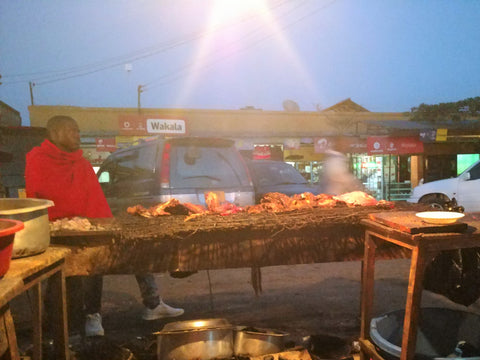
Our goodbye dinner was an invitation by Moustache and two of his broker friends to the local Barbecue area - where the Masai eat we were told – for BBQ goat (nyama choma). Down another dirt road we went at the outskirts of town, all the white people in the car wondering if we were going to want to eat this food. But at the end of the rather longish and again bumpy drive we reached a street full of smoke, one open charcoal barbecue next to another, piled with meat, bananas and potatoes – but mostly meat. Behind the barbecue stands there were raw goat legs and ribs lined up on butcher’s hooks dangling from wire. Behind that, plastic chairs and tables. The meat was served cut up on large tin plates that were set in the center of the table, and with a red dipping sauce. There were no individual plates, no utensils, no napkins. We were offered the customary bowl to wash our hands, and then we got to dig in. We consumed 4 large piles of extremely tender and juicy goat until our bellies were bursting. Moustache prevented me from eating salad because he was worried it wasn’t properly washed, but the meat, chipsy and bananas were all well cooked through so we were told not to worry.
BBQ in Arusha
The last and final challenge of our trip home, aside from the arduous trip itself (flight from Arusha to Nairobi, Nairobi to Amsterdam, overnight layover, then Amsterdam to Newark), was to get our gem “tins” from customs. This required a boarding pass, so we had to check in, then go to customs for pickup, repack our suitcases, and then back out of customs and again to check in to check the luggage. This slightly unusual maneuver requires a bit of posho and the customs official wasn’t sufficiently happy with the amount offered (25 Euro), but he didn’t pull any of the usual stunts: i.e. – “we don’t have the key to the room where it’s stored,” “nobody is in the office right now,” “there’s a typo somewhere,” etc. My business class ticket to Nairobi was downgraded in the computer to coach, nobody knew why, and nobody knew how to change it, but it didn’t matter for the 45 minute hopper flight past Kilimanjaro across the border. “This is Africa.”
Our next destination after Madagascar was Nairobi, Kenya, where I planned a long overdue reunion with my friend Doreen. Doreen Kawira is the niece of a Franciscan sister whom I met during my teaching days at Felician University. Sr. Francesca, as she was called, was born in Meru Kenya and belonged to the Nazareth Sisters of Annunciation congregation. She was sent to study at Felician through her sister institution in Kenya. She took one of my classes and we quickly made friends. When she graduated, Sr. Francesca confided in me that when she came to the United States, she had hoped to find a sponsor for her nieces Doreen and Purity to go to secretarial school. She wanted her nieces to learn a trade, like typing and letter writing, and have the opportunity to practice on a computer – which was far too expensive for the family to purchase. The Franciscan sisters at Felician College were not very interested in this, and neither were any lay Franciscans in the community. So my department decided to sponsor her nieces, and with combined forces we paid for Doreen’s and Purity’s secretarial school. Over time I became personal friends with Doreen via email and Facebook, and Doreen eventually told me her dreams for a bachelor’s degree, something she could of course never afford to pay for with her secretarial job (and college loans don’t really exist in Kenya). I decided, not having kids of my own and therefore no college bills, that this is how I could pay it forward.
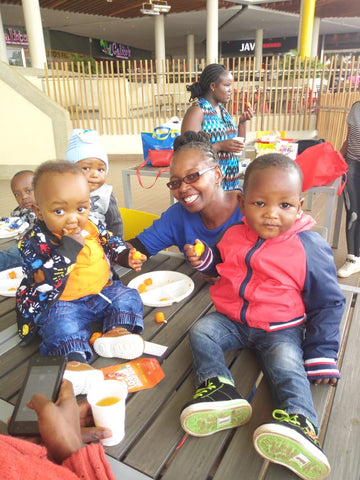
Doreen and Immanuel (left)
Doreen completed her bachelor’s degree in 2016 and that year, I met her in person for the first time. Now Doreen is the mother of a little boy called Immanuel whom she is raising on her own (yes, childcare or parental responsibility laws are not really known in Kenya). I really wanted to meet little Immanuel, and of course I wanted to see Doreen again.
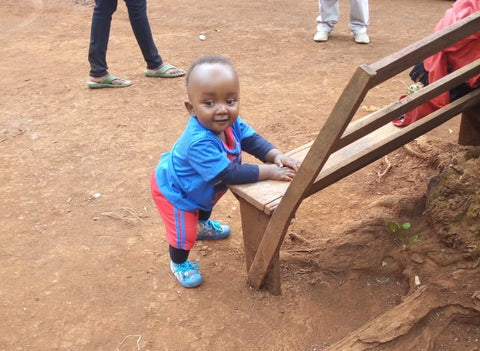
Little Immanuel Playing
Doreen now works for Mount Kenya University in Nairobi (the largest private university in Kenya), and she lives in a small apartment about an hour’s bus ride away during rush hour. She works from 9 to 6 p.m so she’s hired a live in nanny with whom she shares the living room (her apartment is about 200 square feet). She and Immanuel share the bedroom. Water is turned on twice a week, so the rest of the time, they have to store it for washing and such. With paying for the nanny and food, there’s not much left for anything else. So I had bought some children’s clothes for Immanuel, and a colorful box of plastic cubes to play with. Almost the entire family came to see me, including Sr. Francesca as well as Purity whom I had never met before. They had cooked a big meal for us: a banana potato mash, rice, chicken stew, chicken soup, and vegetables.
It was a pity for me, because something I ate on the plane didn’t agree with me and I barely managed a bite. I almost threw up on the plane (one of the worst things I can imagine at least as far as throwing up is concerned, which isn’t high on my list!). Maybe it was something I ate before but in any case, I felt like crap. I ate a little bit even though I shouldn’t have and got even sicker. By the time it was 11 I was practically passing out and Doreen found us a local hotel for us to go to, and her next door neighbor who drives a taxi for a living took us there.
The drive to the hotel near the University of Nairobi took us past a number of brightly lit billboards selling luxury items that very few people could afford (like beauty products, makeup, even cars). I found this strange because here in America, you wouldn’t advertise to such a small social group – it makes much more sense to pitch to the middle class. So who buys those beauty products and those cars other than a select few I asked myself? For most, these billboards must just represent a life that they can scarcely imagine. Even Doreen remarked that riding in an airplane was something they regarded as only being for the rich. She said they’d point to the sky and go “that’s how rich people travel.”
The hotel was another example of an unimaginable life to most Kenyans. By our standards, the hotel was slightly above a motel 6 with a hotel entrance, but it was located inside a walled complex with a guard, guardhouse and gate. The price was $100 a night, which was a reduced rate that Doreen was able to get us through her connection to the university. Even by US standards, this wasn’t so cheap, but for Doreen it would represent a week’s pay.
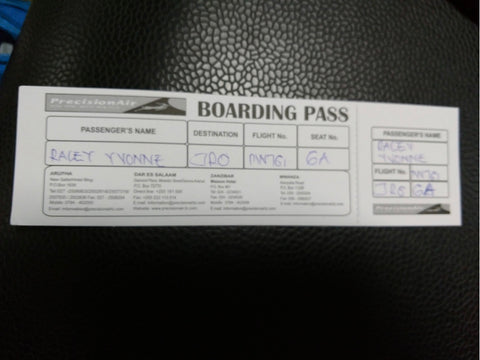
At 4:30 a.m. we got up to make the flight to Entebbe Uganda (layover) and then Kia (Arusha, Tanzania). I was totally dead in the morning, with not enough sleep and a sick tummy. The cab driver ended up over charging us (asked for $100 USD for the two rides the day before and the ride to the airport). But I was too sick to argue. I slept in the lounge on two ottomans, I slept through the first plane ride (where I almost got sick again), I slept in the airport at Entebbe which is newly built (very small) but where they still couldn’t print boarding passes (we got handwritten ones). I slept through the next flight as well. Then I felt better. After another long wait for business visas and a long discussion at the custom’s office where we needed to have our Madagascar gems held due to export restrictions in Tanzania (a catastrophe at the moment about which I will talk later), we finally got picked up by our arranged ride to the Mount Meru hotel. We reached the hotel in 30 minutes, I went straight to bed and crashed for 12 hrs....
Handwritten Boarding Pass
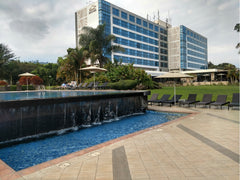
Images of Mount Meru Hotel in Arusha
Current Trade Issues
On the first full day in Arusha, we had morning coffee with some of the master dealers to get caught up on the current export situation, which has changed drastically since last year. In July of 2017, the new mining act was established, which made all exports of rough gemstone material illegal. The act was not signed until November of 2017, so when Jochen was here last fall he was still able to export. The new mining act supposedly excludes all mineral specimens (because they are not facet rough) but apparently the government does not have sufficiently educated staff to tell the difference. They have hired professors of geology but these lack the practical experience, and while the mining office lab has asked the help of several of the more educated gem dealers, they have not offered to pay. Hence, they have not received their much needed education.
And what is the reason for such strong restrictions? Apparently Thailand exports over 4 times as much Tanzanite as Tanzania, which indicates that mineral rough is exported and cut elsewhere – and elsewhere is also where most of the profit is made. The Tanzanian government hopes to have the gems cut in Tanzania so that it can increase its own profit margin.
And profit margin there is: First, there is the revenue gained by hiring cutters and employing local workers, but second, faceted stones fetch more money than rough stones, even if one figures the loss of the weight after cutting into the comparison.
The problem is, however, that there are not enough cutters available in Tanzania to cut everything. One master dealer explained to us that he is cutting 60% fewer gems than before (mind you this particular master dealer has 11 cutters all of which are Sri Lankan, not Tanzanian – most cutters aren’t local and it takes years to become a good cutter). This particular master dealer said that this is still enough revenue for him, but he has also stopped buying new material, and this creates a problem for the miners and smaller brokers. Many of the local miners, who tend to profit the least in any case, have stopped trying to find new materials (and have also therefore stopped making money). Overall it is estimated that the gem trade is down by 90%. As a result, many small brokers and the miners are in financial trouble, and so are the families they support. Jochen and I actually sent some money to our broker back in April because he could not feed his family. His daughter, who just finished high school, wants to attend University but he does not know how to help her. University is $1000 a year, and that is probably 5x a monthly salary for him. I’m hoping that I can find them a sponsor, as I have sponsored Doreen.
Given the new mining act the government loses revenue of course, they make far more money from tourism, so for now, despite many meetings between the master dealers and the president, the government is holding steadfast and nobody knows when the situation will change. The hope is it will change soon but the election cycle is 5 years and most presidents are elected twice, which puts the time frame for change at 7 years from now. One person we spoke to is thinking of closing down, two others are thinking of relocating to Kenya, which would simply deprive the Tanzanian government of the gem trade revenue on a permanent basis.
From what the master dealers told us, – the main sources of Tanzanian Tsavorite, the Mererani mines (also pronounced “Merelani”) now have a wall built around them which is guarded by the Tanzanian army who controls every person and package going out. Tanzanite block C, the largest producing area of Tanzanite, is closed. Block A is inactive anyway (it has been for some time), and B and D are for small scale mining, yielding smaller production.
Generally however, from what I have observed, the current government, and perhaps the previous, are doing a lot for the country. Many of the main roads are getting paved, thus making transportation much easier. Arusha now has 10 traffic lights, up from 3 from my last trip, and in Dordoma, the capital, new buildings are springing up everywhere. So from my outside perspective, it is not all bad, but as is the case with most governments, not everything may be entirely thought through. Since the lack of infrastructure is one of the main reasons why African countries have such trouble improving revenue and participating in international trade, building roads should bring a lot of changes to the country. The Arusha airport is still in need of an overhaul, but the roads are helping a great deal. If you saw some of the unpaved streets over here which are barely good enough for an ox cart, it is easy to understand why essentials like water, food, and gasoline cannot easily be brought to the villages.
More about Tanzania, the Longido mines, and my own purchases in my next blog!
Here are some of my ruby purchases! The Small Oval and Pear Shape are AGL Certified already.
As promised, let me tell you about the gems I saw, or didn't see, in Tanzania: on my second day, I spent rather a lot of time inside the little gem and jewelry shop owned by one of the few Tanzania retailers, a Greek immigrant named "Reno", born in Kenya. The shop is right inside the Mount Meru hotel. After sipping some excellent Greek coffee in his office and discussing current politics and Trade issues with Reno, his daughter Despina showed me their entire stock, where I was allowed to pick at wholesale prices.
As you know, I am by now more seasoned at buying gems, and I no longer jump at anything unusual at first sight. Nevertheless, the old ruby stock Reno had in his trays peaqued my interest. There were mainly cabochons, but also several faceted pieces that I loved. The cabochons were certified unheated by Despina's lab in Arusha, and so were the faceted gems. By the time this blog entry appears, I have already had AGL recertify two of the cabochons, and I am waiting on the rest. Getting (certified) unheated ruby material these days is tough going, and the Kenya material that I got is pretty rare.
John Saul Ruby
In General, from what Reno told me, not many people right now are acquiring new stock, Reno included. But that makes it equally interesting. I saw a few super strongly saturated Mandarin garnets, of which I bought two (one is since sold), but I passed on unheated pink and purple Tanzanite. All of it is also older material, and maybe I should have bought it, but I thought the ruby was still more unusual. I also sourced a small parcel of unheated sapphires, a peach colored one as well as purples and a pink purple, all of which have the liner silk so typical of material from the Mozambique belt (most likely they are from Garba Tula Kenya). I also got a pair of Mahenge spinel that is super saturated that I am quite happy with. My export was facilitated via Bimal, the uncle of Jaimeen Shaw, owner of Prima Gems USA. Bimal had us over for some amazing Cardamon tea and cookies, he still ships a lot to the US but only larger goods, not gemstone melee. And he stocks almost nothing. Like everyone else, he's waiting for the situation to either improve or fall apart entirely.
Kenya Sapphire
Faceted Ruby
While selecting my gems, I chatted with Despina, who provided another perspective on life in Tanzania. Born in Kenya to Reno and his Greek wife whose name I don’t know, she led a childhood of luxury for Africa. She went to a Greek school, got a college education, and speaks fluent Swahili, English and Greek. But she never felt like Africa was her home. Despina hopes to go back to Greece where she spent almost two decades of her adult life. Back in Tanzania now for 4 years, she says she would leave tomorrow, “as I am” she said. Just with the clothes on her back and her little 8 year old daughter Emma. “I want to live somewhere where my windows do not have to have bars, she said.” “Where I can go anywhere, and just walk, not have to drive, not have to worry about security.” And Kenya is now worse than Tanzania she said, especially Nairobi. It used to be the other way around when she was young. She feels European, not African, and of course Greece is one of the most beautiful places on earth, so I couldn't blame her. And as much as I enjoy the visits, I could not live in Tanzania either. The “rich” (consider it the upper middle class in the US and Europe), live in protected compounds, and white people have difficulty moving about freely because they stand a higher chance of being robbed. They belong to no tribe and thus have no tribal protection. I look at Tanzania and I see the United States' future, hopefully a far away future, where there is virtually no real middle class, just poor, very poor and well off, with the latter being the top of the pyramid and in need of protection because of the scarcity of resources. Some day we will have scarcity of resources as well, if we keep multiplying as we have. The middle class is already getting squeezed and I do not forsee it getting better. But I digress….
Ruby Zoisite and Expedition to Longido
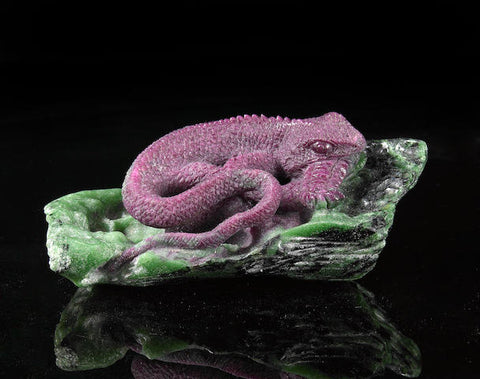
On our second day in Arusha, we focused on ruby, in particular, ruby in zoisite, not for cutting but for carving. Jochen had a request from a German buyer for several hundred kilograms so he had to see what’s around and make a deal for material to be held here until hopefully the export of specimen rough including this ruby zoisite will resume. He had one offer from one of the Master Dealers - Tony Frisby, aka the “doctor” because he has a Ph.D. to look at something at Tony’s property. Tony, a white Kenyan in his 60s with short shaven hair and a mumble, has been dealing in Tanzania for decades. We took a cab to hi son's house in Arusha to look at large lumps of ruby in a huge pile in the yard. Tony now resides in Arusha downtown with his “young wife” as he explained – this is his 9th one. Tony converted to Muslim so he could marry more than one. He’s divorced from some, not others. Interesting character.
Jochen got a pretty low price for the ruby – possibly because of the export problems. But he decided to pursue one more lead in Mundarara (not far away from the town of Longido) about an hour north-west of Arusha. So we headed there, we were driven by one of the guys interested in making the deal. I found that in Tanzania it was often very unclear who actually owns the material or who is negotiating for it (or if more than one person owns stuff).
Longido Region
Mundarara
We turned off the tarmac road (the paved road) just past Longido onto a dirt road which we followed for about another hour (25 miles or so) to the actual place where the ruby zoisite was mined – Mundarara. Jochen noticed that in the years since he’s last been here, there had been a lot of change for the better: a lot of nicer houses had been built – brick houses with actual roofs, larger in size – and the mining area itself was closed off properly. There were a lot of new buildings and many of the original huts were empty. Of course it was still on an unpaved dirt road and from our perspective it looked extremely poor, but it wasn't what it was for the people a few years ago. So the money that was made from selling the ruby was actually going back to the town itself which was extremely nice to see! Anything and everything was being sifted through, old pits close and new ones open at a high pace.
For Jochen to make a transaction with anyone here, we first had to make ourselves known to the person in charge, possibly the chief of the area. We drove to the end of town and Moustache our broker, a Masai who was well known among the locals for his connections to dealers in Arusha, figured out who we need to clear our presence with. As we waited, consuming copious bananas and fresh pineapple, several people pointed at my cell phone to be photographed. I did that not realizing they were hoping for money. Duh. I had no Tanzanian shillings on me so I couldn’t pay but the issue wasn’t pressed. This was a good thing. I felt kind of guilty. Generally though we were asked not to take photos until we talked to the person in charge. The mining areas are fiercely protected. I took some secret video though with my cell phone.
After some time, possibly close to an hour, of waiting around, a guy appeared, shook hands with us and said everything was all good and we could proceed. So we went to a property where the ruby was piled up (imagine a construction site about 30x10 feet) and Jochen stomped around on it looking at various pieces. He decided it was good enough and so negotiations could commence. No actual trade was facilitated at the time however.