Friday, December 30, 2011

Merry Christmas to ME

Sometimes, you have to think of yourself.  After a very successful Etsy December, and a busy sale still running, I finally took time out to buy myself a Christmas gift.  And then I got another one for free!  I figured I’d share because I know at least some of you have asked me what I would keep for myself. 

I have three rules when it comes to buying gems for me:
1.      I have to love love love the stone: I see a lot of stones every week.  More than most gemdealers, because I get around more, and I don’t specialize in a particular region, or particular stones.  So if the stone does not absolutely blow me away, I won’t keep it.

2.      It has to have a high resale value: I’m not made of money, and I don’t really allow myself expensive gemstone treats.  What stops me is this: could I buy a new refrigerator for this stone?  Fix the roof?  Then what on earth am I doing buying that gem.  In short, what I buy has to be something I could sell for the same or more if I need cash.

3.      I have to actually be able to wear the gem.  Many collectors buy stones just to look at them (and of course some stones are too valuable or too fragile to set).  I’m not one of them.  My stones have to be wearable, durable, and look pretty on me (be strongly colored, vibrant and match my skintone).  I’m not wearing gems to show them off, I simply want to enjoy seeing them.
So, what gems do I own? 
Sapphires: that’s what I love the most.  I have some Burma studs, Burma pear shaped dangly earrings, a Ceylon that I wear every day, a smaller one for a pendant and I kept a pair of the Ceylon old miners that I had on Etsy in December.  I also have a pink sapphire, a 4mm round Burmese (nice saturated color).
Ruby: I only have one, a Burmese 4mm round.  And some earrings (3mm danglies on hoops).  It’s just not my color.  I will set the ruby as a stacker one day, in yellow gold.
Emeralds: I have a few of those, all Columbian, all from D. I have a pendant, earrings, and a couple of rings.  Brazilian emeralds are not my thing, they’re too dark.
I don’t have much else.  Some aqua, some of the cushion Burma spinels I sell, and a pair of old mine pink tourmalines.  I also love green tourmaline, but it ends up getting upstaged by emerald and tsavorite, so for some reason I never keep it in the end.  Tsavorites I love but I don’t actually own any (yet).
And what is my Christmas present?  A beautiful, 1.7 carat, cushion cut Mahenge spinel.  In November, I had a trillion piece set in yellow 14K for a customer – my metal of choice – and I was just floored by how it came out.  So yesterday, I had to see the East Africa dealer to memo out more of the stuff (if you noticed I sold all of the Mahenges in the last few days).  For fun, he showed me a few pieces that were in the 10-15 carat range, costing in the neighborhood of $100,000 and more.  But I wasn’t planning on taking out a second mortgage.  J
Then I played around with the 1-2 carat parcels, and the piece in the photo jumped out.  It will fit perfectly into a yellow gold emerald cut bezel I already have, and will make a very prominent ring.   I can’t wait! 
My Mahenge Spinel
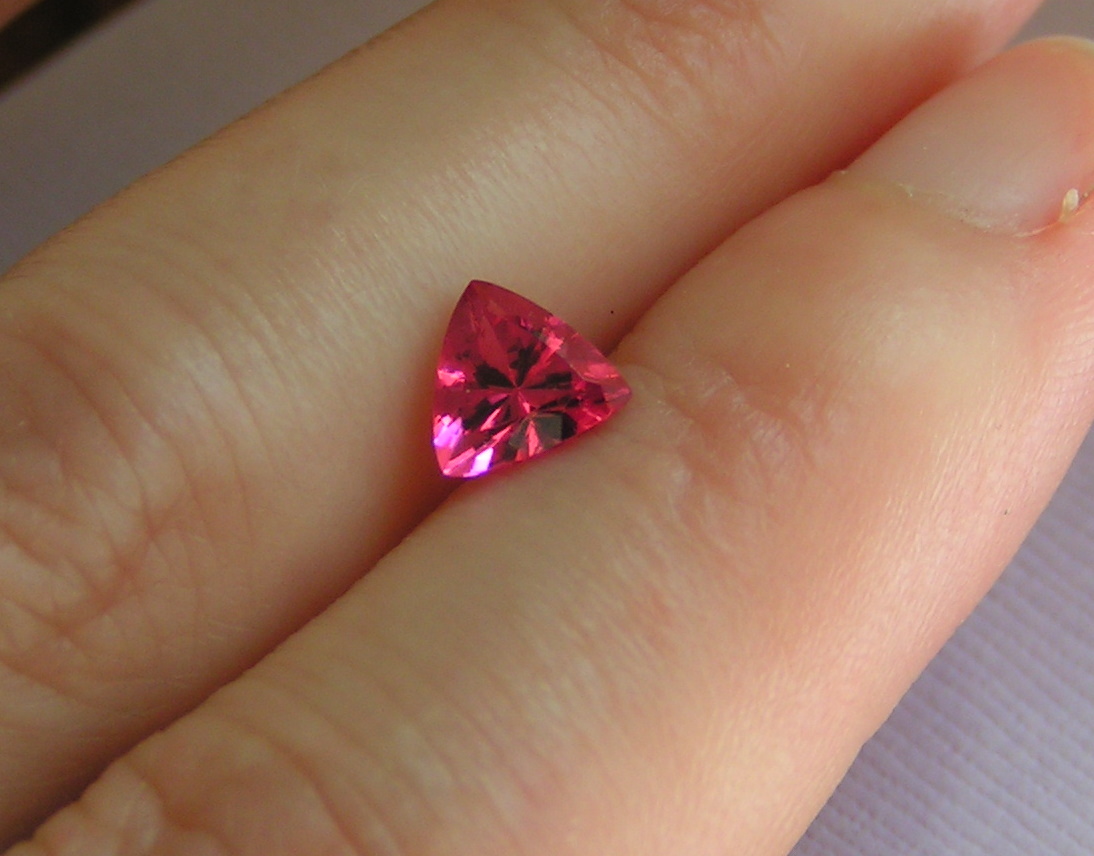
And when I got ready to pay my – over $1000 – tab (I also bought some Chrysoberyls and smaller Mahenges), J. the dealer, had added a little gem jar to my bag.  With some gorgeous Tanzanian Rubellite garnet.  And what garnets those are!  They actually have a slight color change effect, more purple in daylight and more wine color in evening light.  This garnet actually looks almost better in evening light, which is the exact opposite of what one is used to.  Larger rubellites can also get expensive, and this piece has exquisite cutting.  I will prong set the largest one, I just don’t know what it will be exactly.  Probably a pendant.  Thanks J.
Tanzanian Garnet


Mahenge Spinel and Tanzanian Garnet

Sunday, December 4, 2011

The other Tanzanite

Last December I pooh-poohed Tanzanite as a bad investment.  I guess I always say what I think, even if it hurts my own business...  But Tanzanite really is tricky.  Relatively new on the market (since 1967 or something), it has gotten seriously pushed by the large conglomerates that own most of the mines in Tanzania.  That’s why it now is a December birthstone, by the way.  Meanwhile, the material is overpriced, soft, and scares the living daylights out of setters.  In a ring, it won’t last long on your hand if you wear it every day.  If prong set, it should be for special occasions, or at least not be worn when you are doing heavy duty work.  Pendants and earrings are safe, rings should be bezeled but not hammer set because unless it is squaky clean it will most likely shatter the stone.  Hammersetting a gem is like taking a mini sledge hammer to a fragile object, and any minor inclusion can get busted wide open.

So then what kind of Tanzanite could I possibly recommend?  If you’re willing to stick to pendants and earrings, or a non-everyday ring (which you’ll take off when you do heavy lifting, possibly also when you sleep or take a shower), or an oval or round piece that’s safely bezeled, then I think you should buy Tanzanite that’s not been heated.

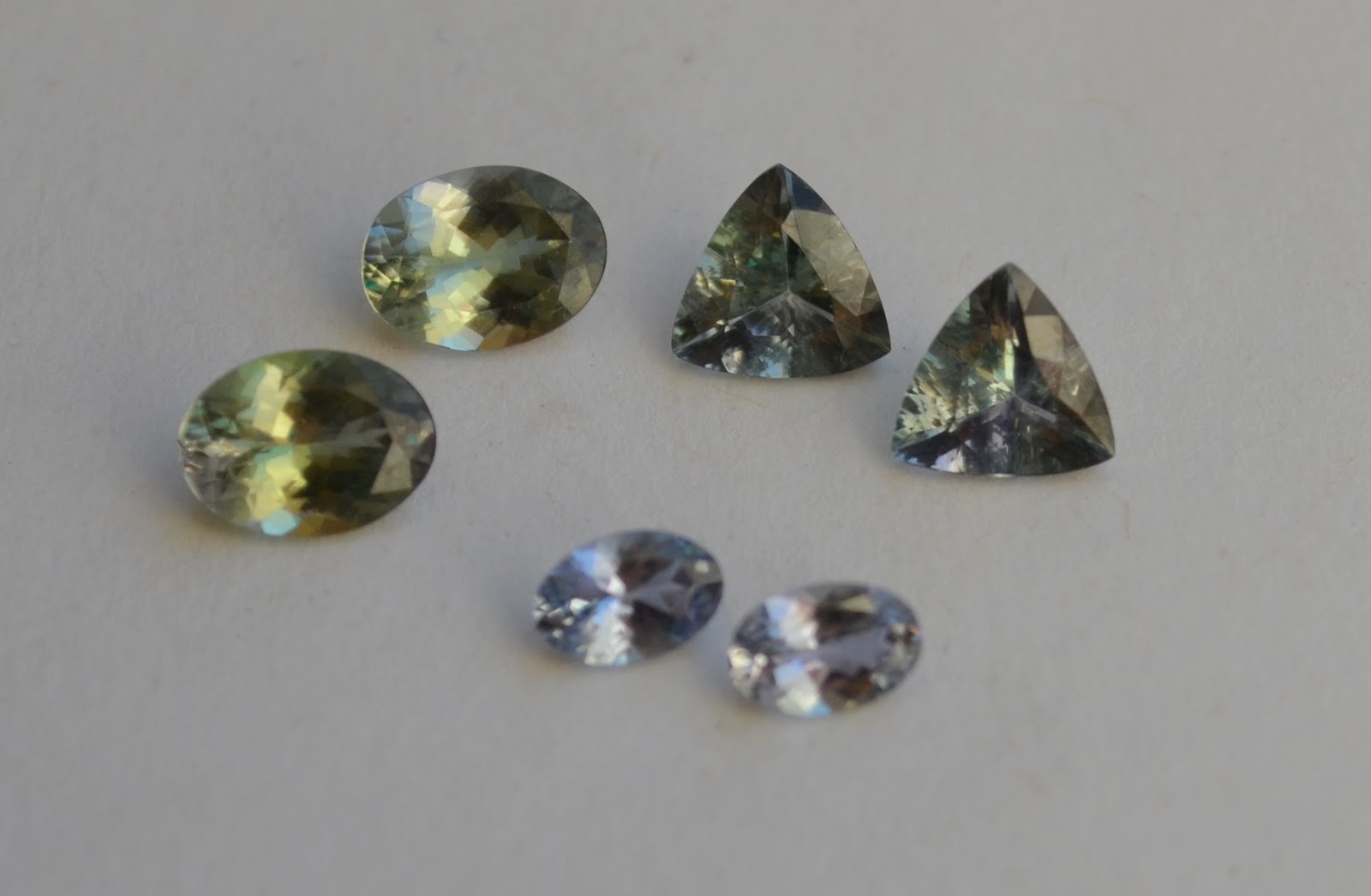
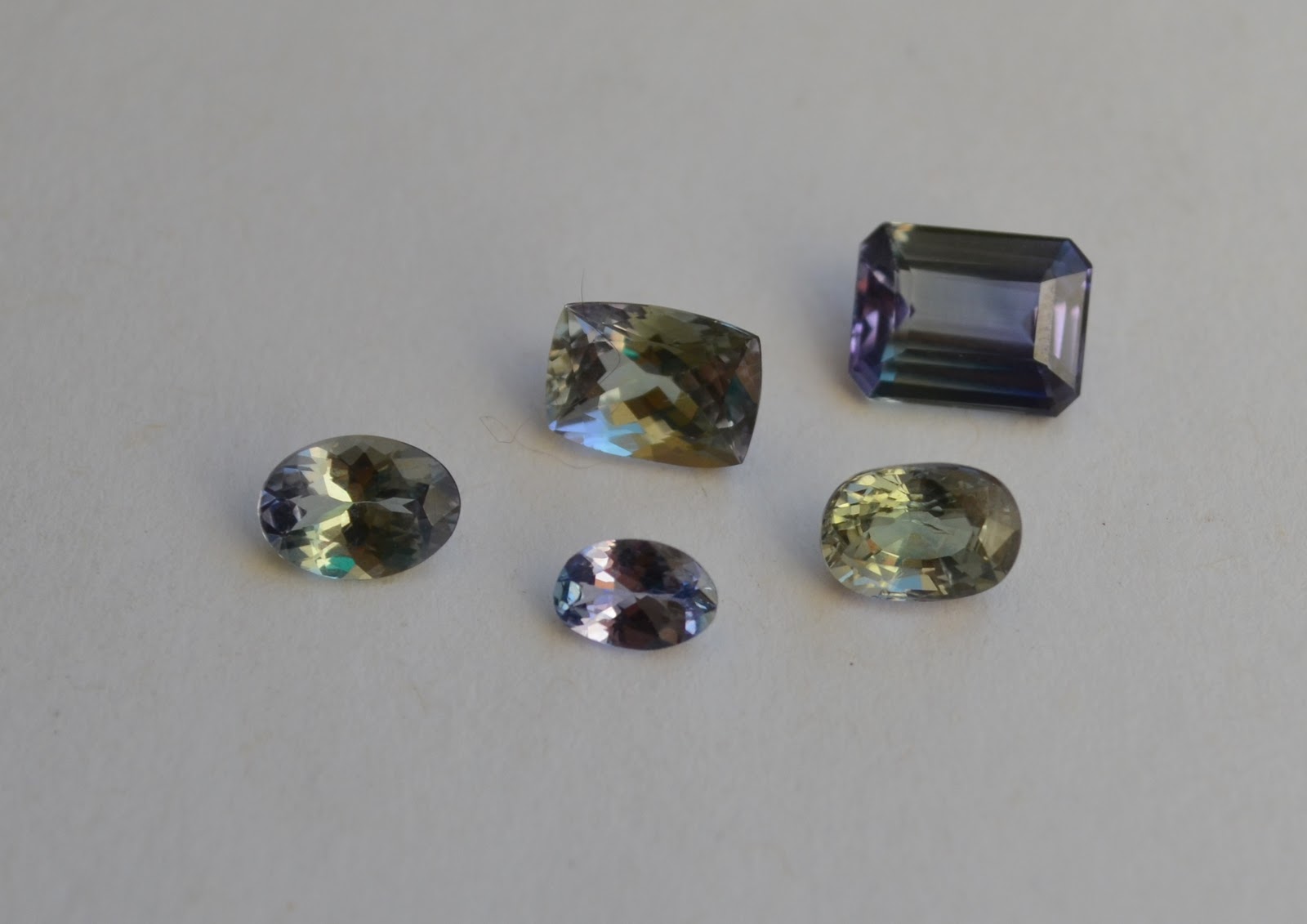
Somewhere between 2% and 5% of the Tanzanite currently mined comes out of the ground a nice minty to olivy green with purple flashes around the sides or back.  Some smaller pieces also come out a light purple.  Since Tanzanite is always very clean and sparkly, so it can look gorgeous against silver or white gold.  The other 95% are better off heated, the material is light brown or yellow and not that attractive.  Every once in a blue moon, they still find fully rich purple Tanzanite in the ground as well, but most of it has at least a green tinge to it, and even that’s rare.  So for unheated Tanzanite, what you will get is green and light purple.

And these 2-5% greenies are hard to find!  In part, because many gem sellers don’t even think about not heating their material.  Just last week, I chatted with another gem dealer about Tanzanite and he said he had some nice huge pieces but they were still green and had to be sent for heating.  When I suggested he sell them the way they are he was totally surprised.  Unheated Tanzanite is for a niche market, not mass market, it takes a bit of looking to find it, and it is available only in small quantities.  What that sums up to is: the right stone for me.  And I have been buying it.  Some photos below. 


3 Matched Pairs

Unheated Tanzanite Parcel .5 - 2.2 Cts


The smallest piece in the first picture is about to go into a ring, the one on the right is on my website in the gem section. 

The smallest matched pair in the pair section (about .8 carats combined) will be set as dangly earrings.  The rest are up for grabs for now.  Each pair is about 2 carats.

Saturday, November 12, 2011

Casting

Questions about casting are starting to come up more often, as I am increasingly moving toward custom orders these days.  So let me dispel the mystery.

When you cast something, you replicate it, you make a copy so to speak, in any metal the casting service offers.  Mine offers just about every metal on the planet, including anti-tarnish (argentium) silver and bronze, and they are green certified, meaning they only use recycled metals.
When you take your model to casting, you can go two ways: one, you can have a mold made.  With a mold, the liquid silicone or rubber fully encloses your model, taking a three dimensional impression, and adding a little “canal” that the metal flows into.  Once it is hardened, the mold is sliced in half and your model is removed.  For instance, I made my little silver frame pendant from sterling wire first, which I soldered onto sterling plate.  Then I took that in to have a mold made.  A mold for a small item like that is about $15.

Silicone Ring Mold for Flower Ring
Your other option is to go “straight to casting” without a mold.  This is cheaper (about $4 for a small item not counting the metal), but it only works when your object will liquefy or burn out during the process.  That means you can use wax or organic material (or plastic, actually).  For my melted rings, I use wax and go straight to casting.  For some of the plain rings, I have also bought finished wax models online and then had them cast.  I use mostly wax sheeting, it’s easiest to work with, but I also have wax bezel wire (with a step inside that forms the seat).  But making a bezel with wax bezel wire is very hard to do, the wax softens and melts in your hand, and the bezel comes out thick and globby.  It’s much better to make a bezel in silver.  Some model makers who are very good, use hard wax and file it down to make a perfect shape (like a conic bezel for instance), or they use a special drill to create a seat for a stone that fits exactly.  I’m nowhere near good enough for either.
In organic material, you can use leaves, twigs, patterned paper and insects for instance.  But if the pieces are too thing, like leaves, you have to add wax sheeting in the back first, or lots of clear nail polish on both sides.  With my twig rings, I first had a few twigs cast in silver and then I played around with them.  The ones I liked the best I shaped into rings, soldered them shut, and then went back to casting, this time having a mold made.  Each casting costs a labor fee ($3.00 – 4.00 for my small stuff), plus the cost of the metal, which is recalculated daily based on market prices.

One thing to watch out for when you make a casting, is the 3-5% shrinkage of the final product, which can be a lot when you need an exact fit for a stone.
Also, when you get the finished product, it’s not actually finished.  You have to cut the sprue and file down the metal.  The sprue is the little piece of canal left after casting – where the silver flowed into the mold (the casting service clips it down but not all the way because they don’t want to ruin your piece).  Then you have to tumble your piece to shine it up again, or you have to polish it.  Otherwise it looks totally matte.
All in all, I love the casting process, and I can see that many etsy shops clearly use it.  All my stacking rings are castings – Imagine how many times I’d be making them by hand, it would be crazy.  My twig jewelry is cast also, and my wax rings are too although I don’t have molds for those (I just make each one from scratch). 

Fresh Castings of Wax Rings, Sterling Silver

Wednesday, October 26, 2011

Topaz: Worth Having?

Topaz is one of the birthstones of November, aside from Citrine.  But it has kind of gotten a bad rep in the gem world.  Most of it is deserved, too.   Next to the quartz varieties, white topaz is pretty much the most readily available gemstone material in the world.  It comes in large clumps, with wholesale per carat prices starting as low as 99 cents.  Beware of the trade name “smoky topaz” which refers to smoky quartz and is a different mineral entirely.

Virtually all topaz, except the colorless, or white, variety, is treated in some way.  Swiss and sky blue topaz are heat treated, London Blue topaz is irradiated, all the mystic varieties and pink topaz are surface coated.  The names are now largely trade names, signifying how the topaz has been treated to achieve that particular color.  The markup of up to $8.00 wholesale per carat for London Blue is largely due to the cost of the treatment, and to nice cutting jobs.  If you ask a gem seller if Swiss or Sky blue topaz is treated, he or she will probably laugh at you because you’ve just evidenced that you don’t know anything about gems.
Why London Blue topaz is sought after by jewelry fans is a mystery to the jewelry industry.  But perhaps it’s just a result of great marketing.  The color is very nice, too.  I don’t carry it, though.
Natural Topaz Necklace
So is there any topaz that’s worth something? Yes.  It’s called “Precious Topaz.”  I know of three kinds:  natural (brown) topaz, natural pink topaz, and imperial topaz.  All three occur naturally, and all three are much more rare than white.  Natural brown topaz is a tad brownish in color.  I knew someone who had a parcel last year.  I still have one stone from it (in the necklace below), and now he parcel is gone and no material like it has surfaced again on my horizon.  Natural topaz is not that expensive though.
Natural pink topaz is baby pink in color (darker pinks are extremely rare).  I see natural pink topaz on occasion.  Imperial topaz is orange to salmon or peachy color, with the more orange valued below the peachy tone.  I’ve seen pink and imperial topaz sold for up to $100 per carat on 47th Street for the smaller stuff (below half a carat).  At that price, of course the material should be sparkly clean and free from inclusions.  The peachy tone is the most expensive, after that the pinks, then the more orange stuff.  Some of the large stuff can actually trade way above that.
Natural Pink and Imperial Topaz
To my knowledge, there’s no particular pedigree when it comes to origin of precious topaz.  The largest producing mines are in Brazil, and that’s where most precious topaz has been found, but topaz comes from many other places as well: Nigeria, Russia, the U.S., Sri Lanka, Myanmar, Pakistan and Mexico, to name a few.
I own only a little bit of precious topaz, just the ones in the pictures above.  The two matching baguettes are now set as earrings, the other two pieces are up for grabs if you are interested.  I haven’t priced them but they don’t weigh more than half a carat I think.  I got the pink round in Germany from a cutter who was “cleaning out.”  When I saw the piece I was already aware that the trading price was higher than what his tag indicated, so I snatched it.  The rectangular cushion and the tourmaline cuts are from my friend D., who has a very tiny parcel.  There’s no other cushion cut, though.

Monday, October 10, 2011

Bargaining: When and When Not

It happens mostly at craft shows, though sometimes on Etsy as well.  “Can you do a little better than that?” or “Will you have any sales coming up soon?” are some polite attempts at getting me to come down from a price that didn’t work in a sufficient markup for a discount in the first place. 

I also see it when I shop for gems on 47th street, though the bargaining techniques of experienced gem brokers are considerably less underhanded: “Two hundred a carat?  For this stuff?  That’s not worth a quarter of the amount.”  And then the dealers argue loudly with one another over quality and price, waving cash around by way of indicating buyer interest and wetting the seller’s appetite; putting the cash away again and acting offended at a high per carat price, making a lowball offer in turn, or trying to stare each other down in silence.  The seller will claim he has another offer, the buyer will claim he doesn’t really need the stuff.  And round it goes, sometimes for just a few minutes, sometimes off and on for half a day, until someone walks away in a huff or a deal is quickly executed before either party changes their mind.
Should you bargain for a lower price?  Before you decide, consider the context you are in. 
Are you buying handmade jewelry?  Perhaps you should not bargain, unless you can really be sure the item is overpriced.  Most small time crafters tend to undervalue their work and don’t charge enough for their time.  Don’t compare to prices for items hand made in China or India.  We can’t compete with cheap labor.
Are you buying supplies?  Gold and silver have fairly fixed prices, so don’t bother bargaining.  With gems and beads, prices fluctuate, and much depends on what the seller paid for his wares, which you may not know.  Bargain only when you know what you are doing!  Can you get this bead elsewhere at a lower price?  Then you might say so.  Beads are fairly easy to judge.  But gems are another story, and most buyers are not in a position to make a good judgment call.  Keep in mind also that an experienced gem seller will “make you” as an amateur within minutes, and then he may jack up his price.  If you are not a repeat customer, if you are “retail” (buying for your own use), the dealer has no reason to disclose his wholesale pricing to you, because he will ruin it for his regulars: jewelers and designers who need room for markup to pay for their business.
I don’t bargain very often, even though I own a business and even though I am a repeat buyer.  And I never put down anyone’s wares.  It’s distasteful, and unless I really know what I should pay for a gem of this exact quality and size, I may just make myself look like a fool.  Not all prices are inflated, and bargaining when you shouldn’t is a good way to ruin future business with someone. 
But sometimes I do think a price should be lower.  Then I try another angle.  First of all, I take my time.  If I’m at a show, I will look around first, get an idea of what’s there and what the prices are, then I tell the dealers that I will be back.  (Most know that that’s not a promise.)   If I come back, I may spend quite a while at the dealer’s booth, sifting through the parcel and louping everything.  Sometimes I get a lower offer just by doing that.  I may say I’m not sure and I’m thinking about it and I am considering my budget or whether or not I think I can sell the finished jewelry at a price that works for my business.  I never directly ask for a lower price, and I never claim the asking price is not fair or too high.  I may look at my wallet and check my change, indicating I am interested in a deal.  If I get a price that’s too high I may say it’s just out of the range of what I can afford.  I may also indicate if I am interested in future business.  Sometimes I honestly say that I want to buy more, but have to do it in small batches.  The seller may not believe me, in which case I may just buy one piece but then show up again a few days later, looking at the same parcel.  I say the same thing again as I buy another piece.  If that still doesn’t work I may not come back.  But I may have left my card, and sometimes I get a phone call.
Lastly, I try to get a sense of the seller.  I ask myself what kind of car they might drive, or where and how they might live.  If I get a sense that they are raking it in, I will drive a harder bargain.   But if it becomes clear to me that they are struggling to make ends meet, I may very well pay full asking price.  I don’t like to feel cheated by a greedy customer.  And I bet others feel the same.

Monday, September 26, 2011

Addicted to Spinel

You must have wondered: how much more spinel can she list on her Etsy site?  Well, instead you should ask: how much spinel does she buy?  A lot, apparently.  I’m addicted to the stuff.

Spinel is its own mineral, but it is often found together with corundum – sapphire and ruby in other words.  Spinel comes from Sri Lanka (Ceylon), Myanmar (Burma), but also Vietnam and Cambodia, Madagascar, Nigeria, Tanzania and Thailand, to name a few.  The spinel I’ve dealt with has been from Sri Lanka, Myanmar, Vietnam and recently, Tanzania.  I’ve not seen other origins on the market.
I like spinel because it is very sparkly and because right now, there are no known treatments or enhancements for it, so it is not that tricky to buy.  Spinel is a fairly sturdy stone with a hardness of 8, and it always totally natural. (There is synthetic spinel, of course, but I’m not talking about that.)

Spinel comes in red, pink, purple, blue, and sometimes orange, yellow and green.  The value is determined more or less in that order as well, though there are exceptions, depending on origin.  There’s also black spinel, but what is sold under that name can also be garnet, and sometimes even black onyx. 

Red spinel used to be confused with ruby but if you’ve ever seen red spinel, this is hard to believe.  Most ruby nowadays is more pinkish, and usually more included.  Spinel is very crisp and clean.  Word has it that there used to be rubies like that, but they are now exceptionally rare.
Red Spinel, Diamond and 14K Gold Ring - Custom Order
The rarity factor: yes, spinel is rarer than corundum, and some people think it is therefore more valuable.  Well, value is determined by demand, and there’s much less demand for spinel because it is less known and not used in the mass jewelry market.  So the cat chases its own tail: because it is rare, spinel can’t be commercialized, and because of that, it costs less.

I think spinel will probably never be as costly as sapphire, but it will also retain its value.  Some say it might move slightly ahead of inflation.  But right now all gemstones are ahead of inflation because many people are looking to invest in something other than stocks.  So as gold and silver go up, diamonds go up, and then colored stones go up.

So what’s the most valuable spinel?  Probably Burmese red, if it’s clean and large enough (1 carat at least).  I’ve never seen any that size.  Some websites offer Burmese reds at over 1 carat, but they’re lightly included and darker color.

The next most valuable spinel is the neon pink stuff from the Mehenge mines in Tanzania.  That material is really really bright.  Mahenge spinel has an absolutely phenomenal color, it’s almost fake looking.  It is also rare, and it already trades at high prices.  I only know one dealer that carries it.
Mehenge Spinel Currently on my Site

Sri Lankan stones, which are mostly pink, purple and blue, definitely cost much less (about 80% less on average) than Burmese or Tanzanian.  They come in bigger sizes, though, and are equally clean. 

 There’s one other very important factor to consider when you buy spinel.  You must look for “open color”:  a red stone, for instance, should be bright and sparkly, it should pop out at you.  It should not look like garnet.  In other words, you are avoiding what is sometimes called “grey mask”.  This doesn’t make the stone look grey exactly, but as any graphic or interior designer will tell you, adding grey subdues a color.  So a stone with grey mask has less presence, it looks a little lifeless.  When I browsed the web for this blog entry, I came upon a site where you can see the grey mask in some of the purple and blue stones: http://awesomegems.com/spinel.html.  I think you’ll see it clearly.
Ceylon Spinel Ring

Wednesday, September 7, 2011

Can You Live off Etsy?

Everyone in my craft group has an Etsy shop, one is even an Etsy co-founder.  Some have been in the Indie craft scene for over a decade.  But everyone is a hobbyist.  At one of our recent meetings, someone asked if you could actually make a living with an Etsy shop.  There are no studies on this, so we all took our best guess: unlikely.

I could not stop thinking about this.  I have an active shop, but I don’t think that the number of sales a shop has necessarily determines your income.  You can have a lot of sales, and still not make any money.  You might be putting way too much time and material into the shop without calculating the required return.  So let’s talk about that.
Let’s start by asking how much money you want to make.  $50,000 before taxes, working 40 hrs a week, would not be an unreasonable figure.  Here in NJ, you can’t raise a family on that, but you can make a single living.  And I want to look at the possibility of making a living, not “contributing to family income.”  (If this figure sounds too high or too low for you, just make a mental adjustment.)

Divided by 50 weeks of working and taking 2 weeks off for vacation, this means that you have to make $500 each week.  How much is that in sales revenue?  I’m going to say $2000.  Here’s how I did the math for this:
Income                                                             $500 / 25%
Materials                                                          $600 / 30%
Fees (Etsy, Paypal, Listing Fees)                 $140 / 7%
Equipment, Tools, Packaging, Printing     $200 / 10%
Overhead (Electric, Internet)                       $100 / 5%
Wasted and extra materials                          $100 / 5%
Breakage, botched designs and orders       $100 / 5%
Growing inventory and materials                $200 / 10%         


That’s 97%, with 3% wiggle room.  I am here falsely assuming that you sell ALL the items you list.  I am also assuming that you already have a running Etsy shop with a good number of listings.  This is not a startup calculation.
How many items do you need to sell to make this?  If your average item is $50, then that’s 40 items.

Anecdote: I recently ordered a dress on Etsy for $88.  I am not a taylor, but friends estimated it took about 3 hrs to make that dress.  Can the seller make 20 dresses in one week?  No because that’s 60 hours just spent dressmaking.  Her dresses are seriously underpriced.
But let’s say it takes you an average of 1 hour to make an item and your average item costs $50.  That means you need to make 40 items in any given week.  Can you do that?  I doubt it.  Why?  Because we’ve only taken account of the time spent making the item.  But that’s hardly all that’s involved.  What else takes time?

1.      Photos (for 40 new listings, that’s 200 pictures minimum).
2.      Writing up 40 listing descriptions.
[Observation: if you make 40 different items, you will kill yourself just taking photos and making listings.]

3.      Other internet time: convos, blogging, promoting …
4.      Packing and shipping (for international orders, trips to the post  Office).
5.      Shopping for supplies.
6.      Bookkeeping, working out pricing for custom orders etc.
Would it be fair to say that items 1-6 will fill up to half your week already?  Then you can make only 20 items and your math is way off.  You need be faster or you need to double your prices. 

Somebody said this to me once: if you want to make money selling crafts, remember that you will spend up to 60% of your time selling, and 40% of your time making stuff.  Seems right, doesn’t it?
If these observations have you pondering, or worse, have you worried, do this: next week, keep a log of all your time spent, sorted by the categories above.  Better, do it for a month because no two weeks are the same.  If the math doesn’t add up for you, you need to rethink your shop.