Saturday, February 25, 2012

The Story of a Sapphire

Sapphires seem to have disappeared from the face of the earth.  Literally – because we can’t get very far below it.  This is true of Ceylon in particular, and Burma is pretty much long gone.  African material you can get, Thai also, but not Ceylon.  The good stuff goes at exorbitant prices, and unheated stones have almost vanished.  Meanwhile, I have a small waiting list of people who are interested in one of these non-existent gems.

For months now, I’ve been waiting for Mohammed – I only know his first name – to come back from Sri Lanka.  He’s the guy from whom I’ve got my last unheated parcel this past summer.  It sold out within a month.  Presumably, one day when he has enough material to sell, he will just turn up on the street, and I’ll know the same day because someone’s bound to call me.  Last time I happened to be there the day he arrived, and I got first pick at a good price because Mohammed still had Jetlag (and I had cash).

But in the meantime, I have to look elsewhere.  Here’s one story of minor contortions.  My friend Anya, whose research skills in all things sapphire (and Russian literature) are unparalleled, dug up a seller somewhere in England who had a trillion cut, maybe Burma, maybe Ceylon, low heat only, 1 carat, very good price.  She bought it.  (Yes, there was return policy!)  And the stone, when it arrived, looked legit.  And stunningly beautiful.  So I wanted one, too, and contacted the guy.  He had one more, he said.  It came from a parcel of uncut rough that he had dug up in Thailand some years before, and had cut only recently.  The parcel itself was of mixed origin, no pedigree (meaning no further info was available).  That’s the sort of thing you only buy when you know what you’re doing, or when it’s dirt cheap.

Anyway, this stone was a cushion, 1.07 ct, nice and clean he said.  The picture he sent was fuzzy, but the price was good.  I figured, what the hell, accepted the paypal invoice – which my email system flagged as a potential risk, haha – and got my stone about 10 days later.  It was so beautiful I almost couldn’t believe it was real.  So before I even showed it around on the street, I took it to the lab.  Just in case I was had, I didn’t want to have to admit that to any of my friends. 

But the stone was good.  Everyone in the lab admired it.  Low heat only, just like the seller said, possibly just from the cutting wheel, which is unavoidable.  It might be Burma, if not then Ceylon.  Because that is, very broadly speaking, the same region (before the plates moved and all that).  How is origin judged?  Unless you go to GIA and pay an arm and a leg, you don’t get an origin on your gem card.  It’s an estimate based on color, nature of the inclusions, and the presence of zoning.  This is not an exact science, except that you can rule certain things out.

The lab guys also gave me the current estimated retail value, which is a list average based on overall quality (he decided it was “fine”, but shied away from “extra fine”), color (blue, not purple or pink for instance), size (over 1 carat but under 2), and origin (Ceylon and Burma have their own lists, everything else gets lumped together).  $1900!  Whew.  The list they use, called “The Gem Guide,” is technically a wholesale list, it represents the national average of loose stones of that kind sold in the past year or so; for retail you are allowed to add up to 30% to the price on the list.  And if you’re a jewelry store, or you’re Tiffany’s, you can do whatever you want in terms of overcharging the customer.

Armed with my card, I then showed the stone to two gem dealers I am friends with.  One always has an opinion: heat only from the wheel (which means no heat), Ceylon, not Burma, but an amazing stone.  Street price is about $1000.  The other dealer is always cautious: more likely Ceylon because there are so few Burma, no view on heat.  No view on pricing, because it depends on whether or not you are in a financial emergency: if you need money immediately then the price goes down drastically.

So then what is the final story of my gem?  For now, only the stone itself “knows”.  Even GIA, when not sure, will simply take a vote on origin.  If 10 guys see the stone, and 7 say it’s Ceylon, then it’s Ceylon. 

Right now my baby is with a guy who has a $50,000 machine which can actually determine origin with accuracy.  I don’t know what it does exactly, but it sounds cool (and when I do find out, I’ll let you know).  I’m anxiously waiting for the person to get back in touch with me….


My Little Sapphire

Sunday, February 12, 2012

How much would it cost in Gold?

This is a common question, but it has a disappointing answer: too much, for the most part.  14K gold is the most common metal used where I shop, and there are endless choices of rings, settings, even a lot of pendants, available.  But at $60-70 per gram wholesale, your average ring costs between $150 and $200, a setting anywhere between $20 and $100 (for an 8x6 heavy cast bezel for instance).

But if you pay attention to weights and market prices, you can get a sense of how to calculate costs ahead of time. 
Price of Gold: right now, gold is at about $1700 per ounce.  What does that mean?  14K gold, the industry standard, is 58% gold.  The rest is silver, nickel, copper or zinc.  So an ounce of 14K costs 1700 x .58 = $986.  One ounce is 30 grams, so divided by 30, one gram costs $32 in terms of the pure gold cost.
However: you have to add in the other alloys, plus labor fees (casting costs and the making of the setting, ring, etc).  When gold was hovering at $1000 per ounce, I paid a little over $30 per gram for settings and wire.  Now I pay around $60.  If I have a finished object that I can take to the casting service myself, rather than buy it at the wholesaler (i.e. my twig ring), then I pay a little less.
When I make customer quotes, I always round up, too, because you have to add in solder, wastage when clipping wire and such, maybe a sprue from casting, etc.  Plus on rare occasion a small or lightweight setting gets fried, or a jump ring has to be replaced.  Those accidents should spread out over my gold orders as a whole.
How much does jewelery weighIf you want to weigh something at home that’s in silver, add 20% for gold weight, because gold is more dense.  But don’t subtract out the stone, those are very light.  5 carats = gram and a standard 6mm round stone weighs only 1ct.
Here’s a sampling of the weights of some of my itms:
1.      My little twig ring, size 7: about 1.2 grams.
2.      Stacking ring, size 6: 1.5 grams.
3.      Size 8 lightly domed ring, 5mm wide: 5 grams.
4.      My 6mm cushion bezel: 1.4 grams.
5.      A 3mm button setting: .3 grams.
6.      1.5 x 1mm flat wire (for a very thin ring): .44g per inch
7.      3 x 1mm flat wire: 1 gram per inch
8.      3 x 1.5mm domed wire: 1.21 grams per inch
How many inches are there in a ring? A size 3 ring requires 2 inches of wire, a size 8 ½ needs 2 ½, so most rings are in between.  If I solder the setting in between I usually buy 2 inches of metal.  Or a tad more since they don’t always clip it evenly, or smush the edge while clipping, so you have to file it down.  You have to add a little on each end, therefore (btw., one inch is 2.5mm). 
Markup: for a standard wholesale markup you double the material cost (and also double the labor).  For retail you double that again so you can pay for the store and the employees.  The wholesale markup accounts for all the other indirect costs, which, in all honestly do add up to double.  I often calculate lower than wholesale, but most of you who are reading this know that anyway.  J
Happy calculating!

Princess Cut Emerald Ring in Gold, 2x1mm flat band

Sunday, January 29, 2012

Why I Don’t Like Setting Customer’s Stones

I often get asked by customers if I would be willing to set their stones.  These days, I mostly turn them down.  And I find that many other Etsyans do the same.  You may find this strange, but for the jeweler, there really are only downsides.

For me, the first set of issues arises because I’ve not actually seen the stone.  I rarely make my own settings, so I have to rely on what’s commercially available.  The customer’s stone may have odd dimensions or prove too deep.  It may have an internal fissure that could open up.  When I buy stones I try to avoid this but sometimes it isn’t until the setter actually sees the gem that I find out it can’t be set.  From pictures alone, there’s no sure way to judge ahead of time that the stone will work.
The next set of issues concerns the gem type.  Some gems are too soft or fragile to work for certain designs.  Even when I own the gem, I rarely agree to do custom jewelry with apatite, kyanite, or Mexican fire opal for instance.  I don’t want to disappoint expectations. 
Also, some stones are hard to replace.  They have unusual shapes or colors, so if they do crack I cannot find anything like it.  If it’s my own stone, then I’ll just use something else in my design.  And if it’s a custom order with my own stone, then the order goes bust (which is sad but not the end of the world).  But if the stone belongs to the customer, not only do I have to cancel the order, I also have to replace the stone out of my own funds.  And what if I can’t?   There’s not even a plan B for that case.
Third, what if a crack or fissure that was present in the stone all along but not noticed becomes more prominent after the stone is set, and the customer claims it was not there before.  This sort of thing is hard to prove.  Sometimes an inclusion becomes bigger from the pressure of setting.  Is this considered a broken stone?  Who will judge? 

In the industry, lost or broken stones are everyone’s worst fear.  The other day, I went to visit my friend the diamond cutter and found him crawling on the floor of his tiny office, combing the every corner with a 1-inch brush, looking for a small pink diamond.  “It’s only worth $50,” he said, “but if I can’t find it then it will be worth a lot more.”  For, a lost or broken stone can suddenly gain sentimental value, or the customer paid a lot more than he should have, or he is just not being truthful, and so now the person who lost or broke it has to pay more than he should.  On 47th, this happens a lot.  (Two days later, the stone was found, by the way, but a lost or broken stone can cost a person their business.)
You see, the main problem is that there’s no insurance – no affordable insurance anyway – for that kind of thing.  Because anyone can claim anything about the value of a stone, including “it belonged to my grandmother,” and then stone is simply irreplaceable even if it’s a fake (I’ve seen this happen, too).  No amount of money will make it right.  Meanwhile, the setter only charges a few dollars for his labor, so he might have to work a day, a week, a month, or a year to try to make up for the loss.  At which point you have to ask yourself why he should have wanted to work with an irreplaceable stone to begin with.
And that, alas, is where I find myself.  I’m not really in this to get rich, I make a little on the side, I enjoy what I do, and that’s it.  I do this for fun.  But I certainly don’t want to lose money, and I don’t want to have to sweat bullets when I take on an order, for fear something could go wrong.  So, no customer’s stones for me.  Nor do I blame anyone else for not wanting to set them.

What, then, is my advice to a customer?  You have a number of options: you can just buy finished jewelry.  You can buy a stone from the person who will make the jewelry for you.  They have to guarantee it (I certainly do), but they will also know what they’re doing, their offer will be at a much lower risk to them.  And the stone won’t have sentimental value – yet.  Lastly, you can go to a more expensive jewelry store, a larger jeweler perhaps, and ask them if they’re willing to guarantee it.  Often even they don’t, and if they do it’s expensive, but it will also lower your risk.  So if a gem is very valuable to you, that’s the best option.

Friday, January 13, 2012

How to Heat a Zircon

My friend Anya and I were buying some stones at a gem dealer friend’s house last weekend.  When we got there, we saw some rosy colored gems on his desk and I asked what they were.  “Zircons”, he said. “I just heated them.”

“Huh?”  I didn’t know heating could be this low tech.  Because we were standing in his home office, and he didn’t have any particular equipment that suggested whatever fancy heating process I was imagining.  So he demonstrated.  Anya took the pix.
But first, a little background: many gems on the market today are heated.  Heating can do a number of things.

1.      Change the color: amethyst can be heated to “turn into” citrine.
2.      Brighten or lighten the color: brown zircons can be turned white.
3.      Deepen the color: light colored Ceylon sapphires can be made cornflower blue.
4.      Melt inclusions: rubies can look cleaner, though not crisper (heating lessens the brilliance).
Gems react to temperatures in various ways.  An aqua can be subjected to low heat to drive away the greens, but when subjected to high heat, it cracks.  Many aquas suffer that fate during the heating process when it isn’t done with care.  Sapphires can be subjected to low and high heat.  But for high heat, they have to be packed in borax, which can seep into the stone and leave trace bubbles (and that’s also how you know a sapphire has been subjected to high heat).  A sapphire subjected to high heat can sometimes be called “glass filled” but that’s not the same as “lead glass filled”.  The latter is done to rubies and is not considered an acceptable form of treatment.  It devalues a gem considerably more than any other form of treatment and should always be disclosed.

In general, gentle heat (low heat) is a more acceptable form of treatment than high heat.  But it isn’t always permanent.  Again it depends on the stone.  When sapphires are heated, the treatment is permanent.  But I’ve seen lemon quartz turn white over time. 

There are also stones that don’t do anything when you heat them.  The garnet family and for now, spinels belong into that family.  I’m very proud of those stones.  J

But let’s get back to “our” zircons.  My gem dealer friend J. (who also sells me the Mahenge spinels, by the way), placed a set of dark brown stones straight onto the burner of his little camping cooker.  Then he turned the heat on low and we sat there and waited.  After a couple of minutes, maybe 3 or 4, no more, the stones started to brighten up.  You could literally see them change color over the next 2-3 minutes.  They turned into a nice rosy pink, and some into more of a champagne color.  J. explained that the effects are not all equal, some stones transform into champagne, some more into pink.  And if you leave them on long enough, they turn white.  But we took the stones off the burner before that.  First, J. turned the burner off, then he placed the stones one by one on a tray to cool them, using his tweezers.  They have to cool down slowly and naturally, otherwise they can crack. 
You can see the results in our pix.  Pretty neat, isn’t it?


Zircons before Heating

Zircons After a Few Minutes


Zircons after Heating

Friday, December 30, 2011

Merry Christmas to ME

Sometimes, you have to think of yourself.  After a very successful Etsy December, and a busy sale still running, I finally took time out to buy myself a Christmas gift.  And then I got another one for free!  I figured I’d share because I know at least some of you have asked me what I would keep for myself. 

I have three rules when it comes to buying gems for me:
1.      I have to love love love the stone: I see a lot of stones every week.  More than most gemdealers, because I get around more, and I don’t specialize in a particular region, or particular stones.  So if the stone does not absolutely blow me away, I won’t keep it.

2.      It has to have a high resale value: I’m not made of money, and I don’t really allow myself expensive gemstone treats.  What stops me is this: could I buy a new refrigerator for this stone?  Fix the roof?  Then what on earth am I doing buying that gem.  In short, what I buy has to be something I could sell for the same or more if I need cash.

3.      I have to actually be able to wear the gem.  Many collectors buy stones just to look at them (and of course some stones are too valuable or too fragile to set).  I’m not one of them.  My stones have to be wearable, durable, and look pretty on me (be strongly colored, vibrant and match my skintone).  I’m not wearing gems to show them off, I simply want to enjoy seeing them.
So, what gems do I own? 
Sapphires: that’s what I love the most.  I have some Burma studs, Burma pear shaped dangly earrings, a Ceylon that I wear every day, a smaller one for a pendant and I kept a pair of the Ceylon old miners that I had on Etsy in December.  I also have a pink sapphire, a 4mm round Burmese (nice saturated color).
Ruby: I only have one, a Burmese 4mm round.  And some earrings (3mm danglies on hoops).  It’s just not my color.  I will set the ruby as a stacker one day, in yellow gold.
Emeralds: I have a few of those, all Columbian, all from D. I have a pendant, earrings, and a couple of rings.  Brazilian emeralds are not my thing, they’re too dark.
I don’t have much else.  Some aqua, some of the cushion Burma spinels I sell, and a pair of old mine pink tourmalines.  I also love green tourmaline, but it ends up getting upstaged by emerald and tsavorite, so for some reason I never keep it in the end.  Tsavorites I love but I don’t actually own any (yet).
And what is my Christmas present?  A beautiful, 1.7 carat, cushion cut Mahenge spinel.  In November, I had a trillion piece set in yellow 14K for a customer – my metal of choice – and I was just floored by how it came out.  So yesterday, I had to see the East Africa dealer to memo out more of the stuff (if you noticed I sold all of the Mahenges in the last few days).  For fun, he showed me a few pieces that were in the 10-15 carat range, costing in the neighborhood of $100,000 and more.  But I wasn’t planning on taking out a second mortgage.  J
Then I played around with the 1-2 carat parcels, and the piece in the photo jumped out.  It will fit perfectly into a yellow gold emerald cut bezel I already have, and will make a very prominent ring.   I can’t wait! 
My Mahenge Spinel
And when I got ready to pay my – over $1000 – tab (I also bought some Chrysoberyls and smaller Mahenges), J. the dealer, had added a little gem jar to my bag.  With some gorgeous Tanzanian Rubellite garnet.  And what garnets those are!  They actually have a slight color change effect, more purple in daylight and more wine color in evening light.  This garnet actually looks almost better in evening light, which is the exact opposite of what one is used to.  Larger rubellites can also get expensive, and this piece has exquisite cutting.  I will prong set the largest one, I just don’t know what it will be exactly.  Probably a pendant.  Thanks J.
Tanzanian Garnet


Mahenge Spinel and Tanzanian Garnet

Sunday, December 4, 2011

The other Tanzanite

Last December I pooh-poohed Tanzanite as a bad investment.  I guess I always say what I think, even if it hurts my own business...  But Tanzanite really is tricky.  Relatively new on the market (since 1967 or something), it has gotten seriously pushed by the large conglomerates that own most of the mines in Tanzania.  That’s why it now is a December birthstone, by the way.  Meanwhile, the material is overpriced, soft, and scares the living daylights out of setters.  In a ring, it won’t last long on your hand if you wear it every day.  If prong set, it should be for special occasions, or at least not be worn when you are doing heavy duty work.  Pendants and earrings are safe, rings should be bezeled but not hammer set because unless it is squaky clean it will most likely shatter the stone.  Hammersetting a gem is like taking a mini sledge hammer to a fragile object, and any minor inclusion can get busted wide open.

So then what kind of Tanzanite could I possibly recommend?  If you’re willing to stick to pendants and earrings, or a non-everyday ring (which you’ll take off when you do heavy lifting, possibly also when you sleep or take a shower), or an oval or round piece that’s safely bezeled, then I think you should buy Tanzanite that’s not been heated.

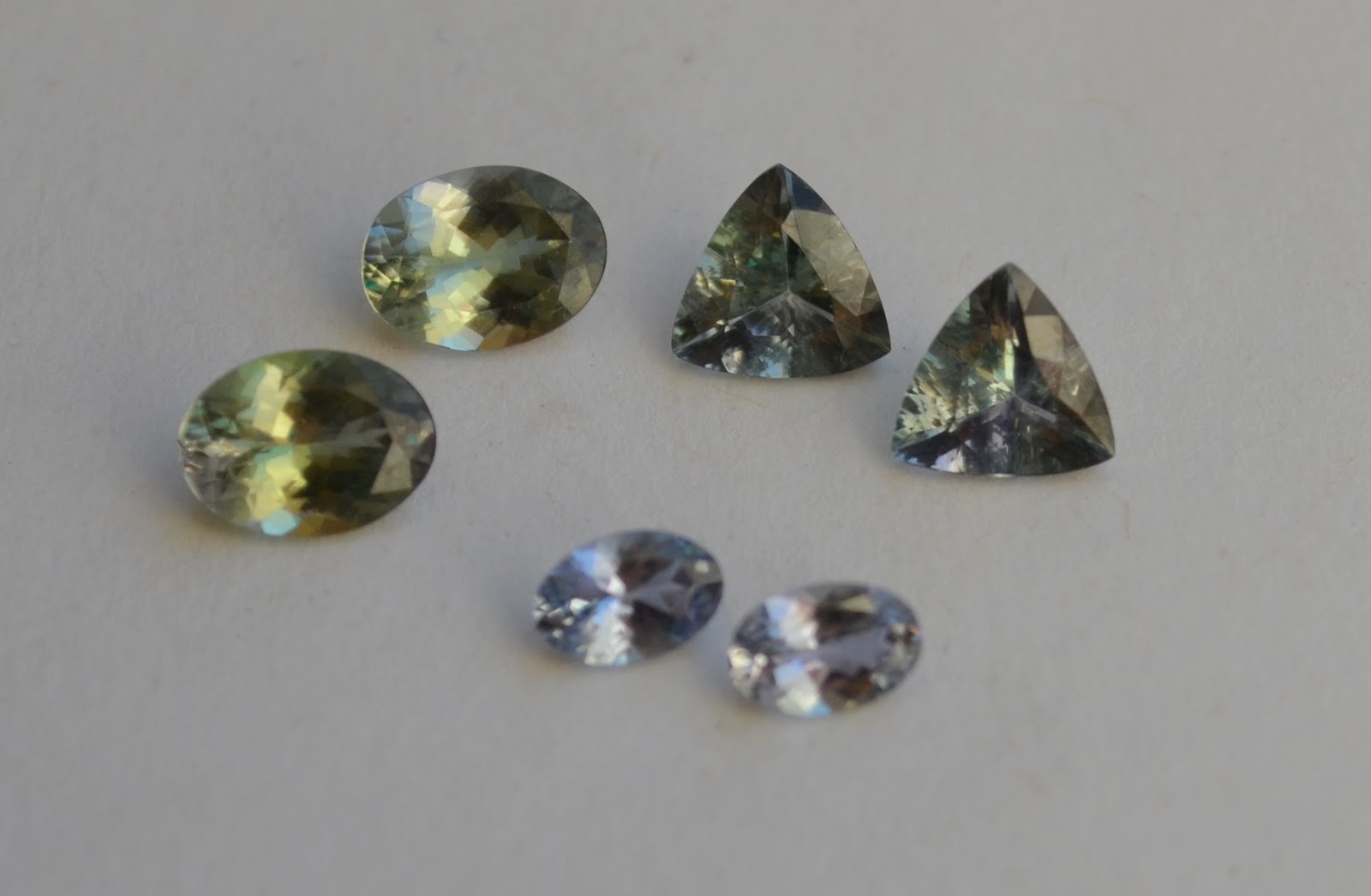
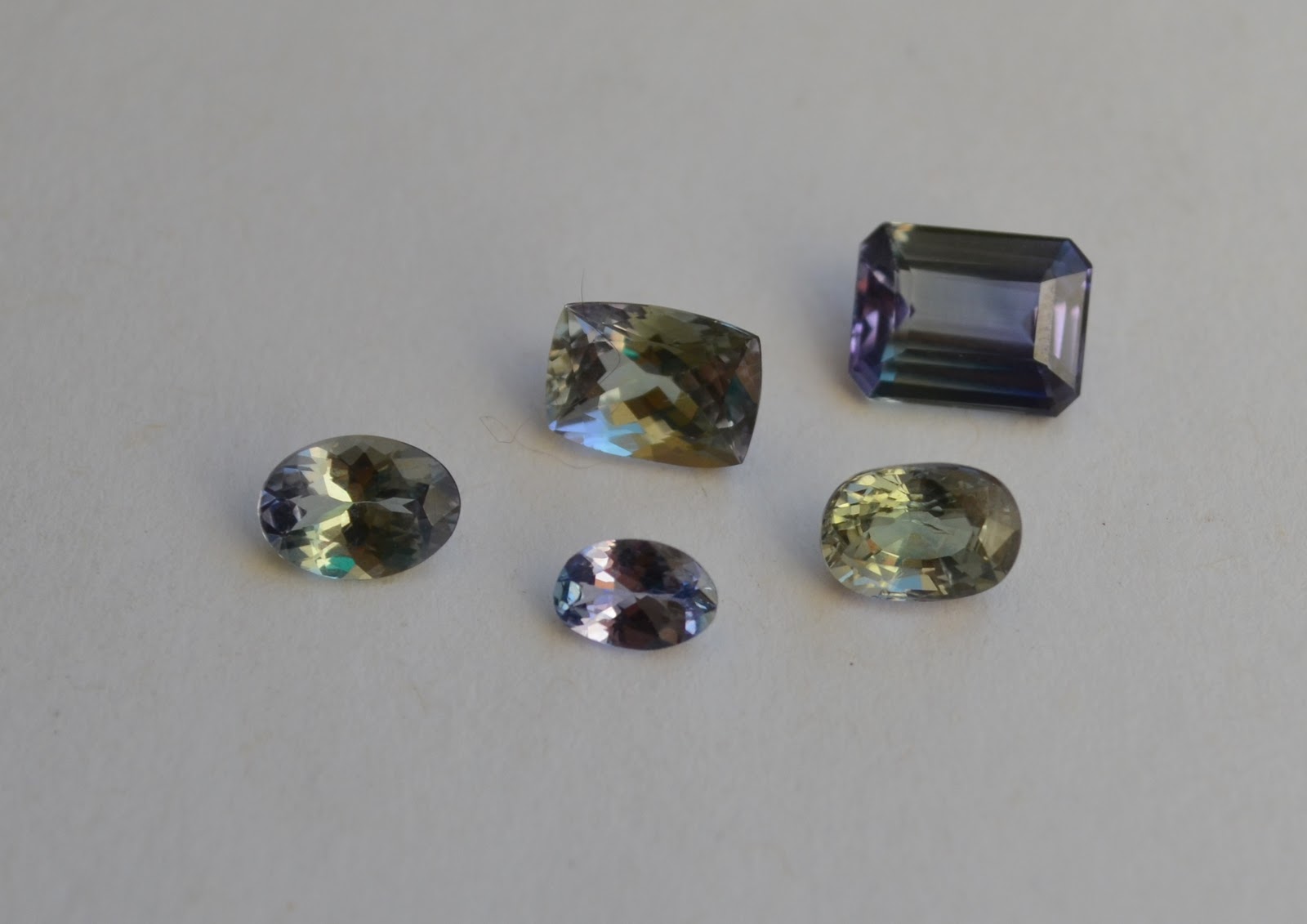
Somewhere between 2% and 5% of the Tanzanite currently mined comes out of the ground a nice minty to olivy green with purple flashes around the sides or back.  Some smaller pieces also come out a light purple.  Since Tanzanite is always very clean and sparkly, so it can look gorgeous against silver or white gold.  The other 95% are better off heated, the material is light brown or yellow and not that attractive.  Every once in a blue moon, they still find fully rich purple Tanzanite in the ground as well, but most of it has at least a green tinge to it, and even that’s rare.  So for unheated Tanzanite, what you will get is green and light purple.

And these 2-5% greenies are hard to find!  In part, because many gem sellers don’t even think about not heating their material.  Just last week, I chatted with another gem dealer about Tanzanite and he said he had some nice huge pieces but they were still green and had to be sent for heating.  When I suggested he sell them the way they are he was totally surprised.  Unheated Tanzanite is for a niche market, not mass market, it takes a bit of looking to find it, and it is available only in small quantities.  What that sums up to is: the right stone for me.  And I have been buying it.  Some photos below. 


3 Matched Pairs

Unheated Tanzanite Parcel .5 - 2.2 Cts


The smallest piece in the first picture is about to go into a ring, the one on the right is on my website in the gem section. 

The smallest matched pair in the pair section (about .8 carats combined) will be set as dangly earrings.  The rest are up for grabs for now.  Each pair is about 2 carats.

Saturday, November 12, 2011

Casting

Questions about casting are starting to come up more often, as I am increasingly moving toward custom orders these days.  So let me dispel the mystery.

When you cast something, you replicate it, you make a copy so to speak, in any metal the casting service offers.  Mine offers just about every metal on the planet, including anti-tarnish (argentium) silver and bronze, and they are green certified, meaning they only use recycled metals.
When you take your model to casting, you can go two ways: one, you can have a mold made.  With a mold, the liquid silicone or rubber fully encloses your model, taking a three dimensional impression, and adding a little “canal” that the metal flows into.  Once it is hardened, the mold is sliced in half and your model is removed.  For instance, I made my little silver frame pendant from sterling wire first, which I soldered onto sterling plate.  Then I took that in to have a mold made.  A mold for a small item like that is about $15.

Silicone Ring Mold for Flower Ring
Your other option is to go “straight to casting” without a mold.  This is cheaper (about $4 for a small item not counting the metal), but it only works when your object will liquefy or burn out during the process.  That means you can use wax or organic material (or plastic, actually).  For my melted rings, I use wax and go straight to casting.  For some of the plain rings, I have also bought finished wax models online and then had them cast.  I use mostly wax sheeting, it’s easiest to work with, but I also have wax bezel wire (with a step inside that forms the seat).  But making a bezel with wax bezel wire is very hard to do, the wax softens and melts in your hand, and the bezel comes out thick and globby.  It’s much better to make a bezel in silver.  Some model makers who are very good, use hard wax and file it down to make a perfect shape (like a conic bezel for instance), or they use a special drill to create a seat for a stone that fits exactly.  I’m nowhere near good enough for either.
In organic material, you can use leaves, twigs, patterned paper and insects for instance.  But if the pieces are too thing, like leaves, you have to add wax sheeting in the back first, or lots of clear nail polish on both sides.  With my twig rings, I first had a few twigs cast in silver and then I played around with them.  The ones I liked the best I shaped into rings, soldered them shut, and then went back to casting, this time having a mold made.  Each casting costs a labor fee ($3.00 – 4.00 for my small stuff), plus the cost of the metal, which is recalculated daily based on market prices.

One thing to watch out for when you make a casting, is the 3-5% shrinkage of the final product, which can be a lot when you need an exact fit for a stone.
Also, when you get the finished product, it’s not actually finished.  You have to cut the sprue and file down the metal.  The sprue is the little piece of canal left after casting – where the silver flowed into the mold (the casting service clips it down but not all the way because they don’t want to ruin your piece).  Then you have to tumble your piece to shine it up again, or you have to polish it.  Otherwise it looks totally matte.
All in all, I love the casting process, and I can see that many etsy shops clearly use it.  All my stacking rings are castings – Imagine how many times I’d be making them by hand, it would be crazy.  My twig jewelry is cast also, and my wax rings are too although I don’t have molds for those (I just make each one from scratch). 

Fresh Castings of Wax Rings, Sterling Silver