This blog is dedicated to the pursuit of everything jewelry and gems. As a jewelry designer with lots of connections to artisans and gem dealers in New York, I love to fill you in on the latest gem imports and ways to make pretty pieces.
Day two in Arusha, Tanzania. The day started with a visit to one of Jochen's suppliers, a long time dealer in gemstone rough and one of the richest men in Arusha, who has also supplied to a few dealers I know here in NY. T. who has to remain nameless for security reasons, is a White African native in his early 60s and, like all the other dealers there, he is totally hooked on what he does. T. showed me a small quantity of cut stones he had in stock, mostly Tanzanite. I still have quite a bit so I didn't buy any. T. explained that the price of Tanzanite was back in the basement again because the market was flooded with gems (in fact most people I know don't even stock Tanzanite, they buy it as they need it and then sell it immediately). Right now the unheated stuff is sought after, which is harder to come by than ever. I was told that another dealer, a Greek man who had also spent most of his life in Tanzania, would have cut stones. He was just down the block so we went there and I got a nice cup of Greek coffee, not the powdered stuff that Tanzanian coffee shops offer, but the real thing. This is interesting by the way: Kenya, Rwanda, and Tanzania, all of which grow coffee, export the good stuff to Europe and the US, with just the garbage remaining for the locals. This is typical I am told because first world countries pay more so you can't actually get good coffee here. It is the same with tea and chocolate.
Most of the stones owned by the Greek gemstone dealer were in his retail shops. He didn't do much wholesale, he said, but what he had in the office was great. I set aside some tourmalines, tsavorites and a pair of spinel, (most of which is already sold), and I was to see the rest of his collection later that week. Prices looked just a tad better than in the US, but I was going to see some gems I didn't have in my collection, like African ruby, so I was interested.
After the visit with the Greek guy, I was put into a taxi and brought over to Jochen's office, where he was waiting for me. It wasn't far but I was so turned around by all the streets looking the same, and frankly a bit intimidated by it all, so a taxi was best.
That day I was shown better quality stuff by the local brokers. It took a few hours to sift through, but I found 3 little spinels, a sapphire cabochon, a faceted sapphire, and a few garnets (purple but from Mahenge, not Mozambique). Generally, lots of goods you see in Arusha don't come from Tanzania as they are imported from other African countries now that Arusha has become the main African gem trading center. You, therefore, have to be more careful - lots of brokers are not very well informed about their goods and again the expectation is that you just know. I am pretty good but I didn't have either a microscope or any other good equipment, so I bought based on what I saw with the loupe only. I can pull out fakes quickly but I can't tell, for instance, if a ruby is glass filled. Now that I've come back I've learned some more tricks that I can apply on the next trip.
Tanzanian Spinel
When we got back to the hotel, Honorine was waiting for us. Honorine is Jochen's friend from Rwanda, who had traveled for 18 hrs on a crowded bus to come see us. A beautiful, humorous and bubbly woman with long braids (all plastic, she told me), she's known Jochen for several years and has brokered some deals for him in Rwanda as well. She's also accompanied Jochen on buying trips to other countries because she speaks several African languages in addition to French and English. Jochen pays for her bus ride and the hotel when she comes. Honorine is about 33 years old, from the Tutsi and lost her parents in the genocide - they were murdered in front of her eyes when she was 11. Before that though, she said, she had a really nice childhood, and she feels that she is who she is now because she was very happy before they died. Honorine's parents were well off because her father worked for the government, although that may have been the reason he was killed. Honorine works as a book keeper now, and her job even paid for her bachelor's degree. As a very outgoing and quick minded person, she has been extremely resourceful, and this is an invaluable survival skill in Africa. Honorine is super helpful in observing the trades, translating some things that are missed, and counting the money. I suck at counting money and if you add to that the problem of trying to understand the currency, this is quite helpful.
The next day, we spent the morning in the office again and then my friend Doreen arrived from Kenya. Doreen is the niece of a good friend of mine, Sr. Francesca Nkima. Francesca is a Kenyan sister who came to study at the college where I was full time professor - Felician College - about 15 years ago. At the time, she told me a lot about her family in Kenya, and how her two nieces really wanted to get an education but could not afford it. So my department sponsored first Purity and then Doreen to go to secretarial school. A few years ago I started sponsoring Doreen for a bachelor's degree by collecting money from my friends and saving what I have left. I don't have kids and I feel I should give back somehow, so I kind of adopted Doreen. Doreen graduated this May, her life dream is a Master's Degree. We'll see, I hope I can get more money for her.
Doreen is in her early thirties, she was introverted at first even though we had "known" each other for over a decade we had never met in person. Doreen had taken the local bus from Nairobi, about a six hr ride. She had never been outside the country before so this was a big deal. I think her rough childhood made her a more cautious person emotionally, but within just a few days, we got very close and shared a lot of moments from our upbringings and past. I found her to be tremendously self disciplined and committed to her goals, as well as highly intelligent and observant of her surroundings. When I commented to Doreen that I liked her dreadlocks, both her and Honorine laughed at me. They said they were jealous of my long, straight hair - "I wonder why God punished African women with this wool" Doreen said, giggling. Her 4 inch long dreads took 2 years to grow.
At the end of the journey, I gave Doreen my old iPad, and of course the money I have collected so far to get her on her way to an MBA or the graduate degree of her choice. Hopefully I can collect more, as I know Doreen saves every penny despite her limited income. Honorine, who loves a bit of luxury, got a Dior soap from my mom, I left half my makeup and creams, and of course some money too. (I came back with very little in my wallet, as you can imagine - but I don't regret a thing!).
On our fourth day in Arusha, I finally had time to meet with the Greek gem dealer again. I took Doreen with me, as well as her boyfriend George, who had come along for the ride. We arranged that I would take a taxi to his shop at the Mount Meru Hotel. Security at these nicer places is tight, so we had to go through a scanner and get our bags checked. Once I got inside I saw why. Aside from Kibo palace, this was one of the nicest places in town. The Greek gem dealer offered for me to stay there at a reduced rate of $150 a night because he was friends with the manager. I declined because I wanted to save my money for Doreen. Also, to be honest, I felt stupid staying in a nice quality hotel when the rest of our crew, Doreen, George, Honorine, and Jochen, were going to remain in much more basic accommodations and I couldn't afford to pay for 3 rooms.
The Greek guy and I got along really well. We swapped trade info about what gems move and which don't while I selected some goods - a John Saul ruby cab, a Longido ruby octagon (both unheated), some tourmaline, some mahenge spinel, a chrysoprase just for fun - at the time of writing, all this material is already sold. He then took us to another one of his shops where I looked at unheated Tanzanite (very rare these days), a purple pear shape and a green octagon (sort of the color of blue green emerald but not quite, a really unusual color). Having run out of cash, we agreed that I'd arrange for payment through a friend's family in Arusha (more about that later). One phone call later and that was taken care of. He didn't seem remotely bothered. In this town and in this business, a lot has to be done on trust. If you have the right connections, you're "in" and nobody gets worried. If you don't, purchasing is difficult.
John Saul Ruby
Longido Ruby
Mahenge Spinel
Doreen's boyfriend George was thrilled to have come along because the Greek dealer had a Mercedes 4 wheel drive, the only one of this particular kind of Mercedes on the East Coast of Africa, he proudly claimed. Not that I would know (I knew it was a Mercedes because it had the star on the front, that was about it), but George had never seen a car like this, certainly he had never ridden in one, so he took lots of selfies after we parked.
Doreen and George
Our trip back took us past the Meru Coffee Lodge, another expensive resort area that is set within coffee plants. There we got to see local glass blowers in action, making beads and glassware for tourists. In the evening, I took everyone to an Ethiopian restaurant in town. For just over $120, the five of us had an amazing dinner including wine, beer, and fresh juice. Doreen posted on FB since this was the first time she had had that kind of food before. I was impressed too I must say. Maybe even more so after lunch in the local canteens - fried chicken, rice or ugali (corn meal) or chipsi (fries) with some tomato, cucumber and cabbage salad. (Though one day I picked a local dish, a kind of beef stew with banana, and that was really good). My stomach had begun to rebel at day two, I think mainly because much of the food in Arusha is fatty and oils are used to fry things over and over, so I'm not sure how old some of the fat is.... My German doctor friend Dagmar later explained that another problem is that your body doesn't know the microbes in that region of the world so it tends to want to expel quickly (much to my detriment). She said that an African who visited America would face the same problem. Plus my body was put through four major world regions in less than a month: Central Europe, an island off the African coast, then Central Africa, plus of course the United States.
Mount Meru Lodge
Glass Blowers
Speaking of food, on another evening, we got to taste the national dish - fresh roasted goat. It roasts all day, and for dinner you buy it by the pound. together with rice, ugali or chipsi, and vegetables. It was simple food but really tasty, except that I was chided by Honorine for not properly chewing the meat off the bone. I was leaving too much meat to be thrown out and that was a no no so I dutifully went over all my bones a second time. It is interesting to note how many habits we rich people have that establish our wealth beyond doubt to others.
Goat - The National Dish
Goat Dinner
More about the rest of my trip and my safari in my next blog entry.
Day two in Arusha, Tanzania. The day started with a visit to one of Jochen's suppliers, a long time dealer in gemstone rough, one of the richest men in Arusha who has also supplied to a few dealers I know here in NY.. T. who has to remain nameless for security reaons, is a White African native in his early 60s and like all the other dealers there, totally hooked on what he does. T. showed me a small quantity of cut stones he had in stock, mostly Tanzanite. I still have quite a bit so I didn't buy any. T. explained that the price of Tanzanite was back in the basement again because the market was flooded with gems (in fact most people I know don't even stock Tanzanite, they buy it as they need it only and then sell it immediately). Right now the unheated stuff is sought after, which is harder to come by than ever. I was told that another dealer, a Greek man who who had also spent most of his life in Tanzania, would have cut stones. He was just down the block so we went there and I got a nice cup of Greek coffee, not the powdered stuff that Tanzanian coffee shops offer, but the real thing. This is interesting by the way: Kenya, Rwanda, and Tanzania, all of which grow coffee, export the good stuff to Europen and the US, with just the garbage remaining for the locals. This is typical I am told (it is the same with cocoa and tea) because first world countries pay more. So you can't actually get good coffee here. It is the same with tea and chocolate.
Most of the stones owned by the Greek gemstone dealer were in his retail shops, he didn't do much wholesale he said, but what he had in the office was great. I set aside some tourmalines and tsavorites and a pair of spinel (most of this stuff is already sold). And I was to see the rest of his collection later that week. Prices looked just a tad bit better than in the US, but I was going to see some gems I didn't have in my collection, like African ruby, so I was interested.
After the visit with the Greek guy, I was put into a taxi and brought over to Jochen's office, who had left earlier to get back to the office. It wasn't far but I was so turned around by all the streets looking the same, and frankly a bit intimiated by it all, so a taxi was best.
This day, I was shown better quality stuff by the local brokers. It took a few hours to sift through stuff, but I found 3 little spinel, a sapphire cabochon, a faceted sapphire, and a few garnets (purple but from Mahenge, not Mozambique). Generally, lots of goods you see in Arusha don't come from Tanzania, they are imported from other African countries now that Arusha has become the main African gem trading center. You therefore have to be more careful - lots of brokers are not very well informed about their goods and again the expectation is that you just know. I am pretty good but I didn't have either a microscope or any other good equipment, so I bought based on what I saw with the loupe only. I can pull out fakes quickly but I can't tell, for instance, if a ruby is glass filled. Now that I've come back I've learned some more tricks that I can apply on the next trip.
Tanzanian Spinel
When we got back to the hotel, Honorine was waiting for us. Honorine is Jochen's friend from Rwanda, who had traveled 18 hrs on a crowded bus to come see us. A beautiful, humerous and bubbly woman with long braids (all plastic, she told me), she's known Jochen for several years and has brokered some deals for him in Rwanda as well. She's also accompanied Jochen on buying trips to other countries because she speaks several African languages in addition to French and English. Jochen pays for her bus ride and the hotel when she comes. Honorine is about 33 years old, from the Tutsi and has lost her parents in the genocide - they were murdered in front of her eyes when she was 11. Before that though, she said, she had a really nice childhood, and she feels that she is who she is now because before they died, she was very happy. Honorine's parents were well off because her father worked for the government. That may have been the reason he was killed though. Honorine works as a book keeper now - her job even paid for her bachelor's degree. As a very outgoing and quick minded person, she has been extremely resourceful. That is an invaluable survival skill in Africa. Honorine is super helpful in observing the trades, translating some things that are missed, and counting the money. I suck at counting money and if you add to that the problem of trying to understand the currency, this is quite helpful.
The next day, we spent the morning in the office again and then my friend Doreen arrived from Kenya. Doreen is the niece of a good friend of mine, Sr. Francesca Nkima. Francesca is a Kenyan sister who came to study at the college where I was full time professor - Felician College - about 15 years ago. At the time, she told me a lot about her family in Kenya, and how her two nieces really wanted to get an education but could not afford it. So my department sponsored first Purity and then Doreen to go to secretarial school. A few years ago I started sponsoring Doreen for a bachelor's degree by collecting money from my friends and saving what I have left. I don't have kids and I feel I should give back somehow, so I kind of adopted Doreen. Doreen graduated this May, her life dream is a Master's Degree. We'll see, I hope I can get more money for her.
Doreen's GoFund Me Campaign
To read more on this please visit the page link below
Doreen is in her early thirties, she was introverted at first even though we had "known" each other for over a decade we had never met in person. Doreen had taken the local bus from Nairobi, about a six hr ride. She had never been outside the country before so this was a big deal. I think her rough childhood made her a more cautious person emotionally, but within just a few days, we got very close and shared a lot of moments from our upbringings and past. I found her to be tremendously self disciplined and committed to her goals, as well as highly intelligent and observant of her surroundings. When I commented to Doreen that I liked her dreadlocks, both her and Honorine laughed at me. They said they were jaleous of my long and straight hair - "I wonder why God punished African women with this wool" Doreen said, giggling. Her 4 inch long dreads took 2 years to grow.
At the end of the journey, I gave Doreen my old iPad, and of course the money I have collected so far to get her on her way to an MBA or the graduate degree of her choice. Hopefully I can collect more, I know Doreen saves every penny despite her limited income. Honorene, who loves a bit of luxury, got a Dior soap from my mom, I left half my makeup and creams, and of course some money too. (I came back with very little in my wallet, as you can imagine - but I don't regret a thing!).
On our fourth day in Arusha, I finally had time to meet with the Greek gem dealer again. I took Doreen with me, as well as her boyfriend George who had come along for the ride. We arranged that I would take a taxi to his shop at the Mount Meru Hotel. Security at these nicer places is tight, so we had to go through a scanner and get our bags checked. Once I got inside I saw why. Aside from Kibo palace, this was one of the nicest places in town. The Greek gem dealer offered that I could stay there at a reduced rate of $150 a night because he was friends with the manager. I declined because I wanted to save my money for Doreen. Also, to be honest, I felt stupid staying in a nice quality hotel when the rest of our crew, Doreen, George, Honorine, and Jochen, was going to remain in much more basic accommodations. And I couldn't afford to pay for that 3 rooms.
The Greek guy and I got along really well. We swapped trade info about what gems move and which don't while I selected some goods - a John Saul ruby cab, a Longido ruby octagon (both unheated), some tourmaline, some mahenge spinel, a chrysoprase just for fun - at the time of this writing, all this material is already sold. He then took us to another one of his shops where I looked at unheated Tanzanite (very rare these days), a purple pear shape and a green octagon (sort of the color of blue green emerald, not quite, a really unusual color). Having run out of cash, we agreed that I'd arrange for payment through a friend's family in Arusha (more about that later). One phone call later that was taken care of. He didn't seem remotely bothered. In this town and in this business, a lot has to be done on trust. If you have the right connections, you're "in" and nobody gets worried. If you don't, purchasing is difficult.
John Saul Ruby
Longido Ruby
Mahenge Spinel
Doreen's boyfriend George was thrilled to have come along because the Greek dealer had a Mercedes 4 wheel drive, the only one of this particular kind of Mercedes on the East Coast of Africa, he proudly claimed. Not that I would know (I knew it was a Mercedes because it had the star on the front, that was about it). But George had never seen a car like this, certainly he never rode in one. So he took lots of selfies after we parked.
Doreen and George
Our trip back took us past the Meru Coffee Lodge, another expensive resort area that is set within coffee plants. There we got to see local glass blowers in action, making beads and glassware for tourists. In the evening, I took everyone to an Ethiopian restaurant in town. For just over $120, the five of us had an amazing dinner including wine, beer, and fresh juice. Doreen posted on FB since this was the first time she had had that kind of food before. I was impressed too I must say. Maybe even more so after lunch in the local canteens - fried chicken, rice or ugali (corn meal) or chipsi (fries) with some tomato, cucumber and cabbage salad. (Though one day I picked a local dish, a kind of beef stew with banana, and that was really good). My stomach had begun to rebel at day two, I think mainly because much of the food in Arusha is fatty. And oils are used to fry things over and over, so I'm not sure how old some of the fat is.... My German doctor friend Dagmar later explained that another problem is that your body doesn't know the microbes in that region of the world so it tends to want to expel quickly (much to my detriment). "An African who visited America," she said, would face the same problem. Plus my body was put through four major world regions in less than a month: Central Europe, an Island off the African Coas, then Central Africa, plus of course the United States.
Mount Meru Lodge
Glass Blowers
Speaking of food, one another evening, we got to taste the national dish. Fresh roasted goat - it roasts all day, and for dinner you buy it by the pound. together with rice, ugali or chipsi, and vegetables. It was simple food but really tasty. Except I was chided by Honorine for not properly chewing the meat off the bone. I was leaving too much meat to be thrown out and that was no go. So I dutifully went over all my bones a second time. It is interesting to note how many habits we rich people have that establish our wealth beyond doubt to others.
Goat - The National Dish
Goat Dinner
More about the rest of my trip and my safari, in my next blog entry.
We left for the airport at Antanarivo (Tana), Madagascar, in the early morning hours to catch the mid-day flight to Nairobi, Kenya with a connecting flight to Kilimanjaro (Kili), Tanzania. Travel involved a 3 to 4 hr car ride from Antsirabe to Tana, and then a meeting with the local mining office for export. An export fee is hashed out based on our purchases. It seems to be rather fluid and is required but not exorbitant. When the mining office is paid export without hassle is secured.
The lines at Tana airport were long and slow, we almost missed our plane even though Jochen's platinum card got us a priority check in. Stupid me had also forgotten little nail scissors in my purse. Usually this passes through security no problem, but not here. Long story short, we ran across the tarmac and raced up the steps 3 minutes before the airplane doors closed.
With the plane being 10 minutes late (probably because it was waiting for us) and there only being one hour for us at Nairobi airport to change planes to Kilimanjaro, we faced the same problem a second time: we ended up running from the tarmac into the terminal, down five gates (it's not a big airport by American or European standards), and back out onto the tarmac into the plane that had again been waiting for us. What didn't make it, however, was the luggage!
Mt Kilimanjaro from the Airplane
So upon arrival in Kili, and after all the immigration stuff was finally taken care of (because we were buying gems we needed business visas, which cost $250 cash each), we had to report our luggage as missing in action. "Tomorrow," we were told. They would bring it. The only minor hiccup with this was that my tin box containing my Madagascar gems (and Jochen's box) could not be imported into the country. Otherwise we would pay royalty (import tax) on the estimated price (not the invoice price) and that could get expensive. But if it was sealed and left at customs until our departure it would not count as imported. In short, we had to come back to the airport, a one hour drive, the next day, pick up the luggage, remove the boxes, leave them at customs in their safe, and then go back to Arusha. But we had no choice. And no toothbrushes, or anything else for that matter.
My Gem Box, Handmade in Madagascar
We finally arrived at the hotel at 10:30 pm, famished. The kind cook made us a late dinner, curried chicken. A couple of beers helped us relax and we went to bed immediately after. The hotel, the Arusha "Resort" - my quotation marks - was simple, with barred windows to prevent thieves, a cold stone floor, and looked a bit like a bunker from the outside. But save for the hot and cold water being mixed up, typical I was told, I had no complaints. At $45 a night, it was a bargain compared to the luxury hotels that start at $150 a night. And breakfast - simple eggs, some fruit, coffee and tea, fresh passion fruit juice, white toast and marmalade, was free.
I was hoping to go to the airport the next morning but Jochen had to go to the office to start buying his goods. So after a brief shower and breakfast, we walked the short distance through town to his office in yesterday's clothes.
Having arrived after dark, I didn't get much of an impression of the town. Arusha, once a sleepy nest of a few tens of thousands, has grown to nearly a million since the first finds of Tanzanite in 1969. Tanzanite One, the main mine, is located just a few miles outside of town. After Tanzanite, there was Tsavorite (originally from Kenya but now mainly from Tanzania), Spessartite, and then Spinel. These days, Arusha is one of the wealthiest cities in Africa, it even has a few two lane paved roads and a total of four traffic lights. Jochen told me that when the first traffic light was introduced, it caused more chaos than it solved because nobody understood how it worked. And in another city, I forget which, Jochen said the glass from the light kept being stolen. The red was used to facet fake rubies, the green to facet fake emeralds. A short while later, the idea of a traffic light was abandoned.
Impressions of Arusha
Because of its wealth, there are many more cars in Arusha. And motorcycles galore. And traffic and dust and dirt. From my Western point of view, everything is totally run down, like most of Africa. Lots of people are standing around everywhere. But compared to Madagascar, there were more small shops with more things in them, lots of electronics for instance. And there were houses with glass windows and some high rises (10 stories or so). Like most of the more "fancy" places, our hotel is walled in completely, with a 24 hr guard and a gate. No way in or out unless you are a hotel guest.
The gem trading district is fairly concentrated to a few blocks next to the central market place, probably the wealthier parts of town, though not where the tourists go - they stay in what I'm going to call "oases" - nice hotel complexes with gardens and a pool, restaurants inside, and taxis coming in through the gates every day so that the tourists don/t have to see the rest of Africa.
Here's a brief video of the Gem District in Arusha, and Jochen buying some ruby and zoisite.
Like in Madagascar, I was one of very few white people and I stuck out like a sore thumb. But I had Kinjonga with me. Jochen is called 'Kinjonga' ('salamander' in Tanzanian), because he likes them so much and used to keep them as pets, much to the chagrin of the locals, who believe that Kinjongas are bad luck. Everyone knows Kinjonga (this one, not the salamander) here. He speaks the language (Swahili) reasonably well, he hangs with the locals, eats where they eat, and he brings money to the brokers.
Speaking of money, I was told that despite the run down appearance, millions of dollars swap hands here every day. I believe it. Cash by the way, just like in Madagascar. Just more of it. One of the gem dealers here, one of the wealthiest traders we met, a white man born and raised in Africa with whom Jochen had been doing business for years, said to me he didn't believe in credit cards. He has a safe full of hard cash. Another person I know, a California gem dealer, comes here with over $100,000 cash in his pockets. When you leave the states, you can declare the money, and then declare it again when you come back. That works fine. Unless you get robbed, then it doesn't work at all.
Streets in Arusha
Incidentally, the reason I am being circumspect about names is that security is a big issue in Africa in general, and in particular in areas where there's money. Hard cash money that is. From the outside, most offices look like nothing, but indoors, there are tons of security cameras, and in some cases, armed guards with rifles and other weapons. There are gates everywhere. With private homes, it is not very different. And the concerns are real. John Saul, the father of Mark Saul of Swala Gems, and after whom the famous ruby mines are named, was murdered by locals as little as five years ago.
Anyway, when we arrived at the office, a dingy place that Jochen rents from a local dealer, there was already a crowd of people waiting for us. Moustache, our local helper and broker here, had made calls to announce Kinjonga's arrival. And of course his walking down the street to his office did the rest. His arrival was officially public. We had to wait a while for electricity because the building doesn't have any but there's a generator that could be turned on. Then an extra desk was brought in for me, just as dilapidated as Jochen's.
One difference between here and Madagascar that I noticed right away was that almost all the brokers here were men. I was unusual in several ways: white, tall, and in the gem trade. Only maybe 5% of the brokers here are women, and I'm fairly sure none are women of means. Business was also a bit more aggressive. The door had to be locked after each person came in because otherwise we would be completely hemmed in.
I was shown only total junk at first. Worse than in Madagascar. Glass, broken stuff, amethyst, citrine, small parcels or just individual pieces. Utter garbage. "Taka taka," they say here. Good, I thought, I already spent a lot of money. I kept saying, truthfully, that I didn't have my loupe, or my scale, or tweezers (or underwear, shoes, and everything else). I really wanted to go to the airport...
A Piece of Aventurine
At around 3, the crowd started to wind down. "Thank God," I thought, because I was wiped out. We took the cab back to the airport (60 minutes). Luckily our stuff was there. My large suitcase was missing a wheel. Ok - at least it was there and complete. Also we had to sort things out with customs and our boxes (30 minutes) and back during "rush hour" (75 minutes). Traffic here is really bad during rush hour. More roads and lights would help, but alas, that requires tax money. And with 70% unemployment that is not easy to get.
Back at the hotel, I finally got to brush my teeth. What a wonderful feeling. The white wine we had for dinner wasn't bad at all, the half bottle of whiskey that was in my suitcase had survived, and a small sip of that and some Madagascan chocolate later, I was out like a light.
As I reported in my previous blog post, I got a very intimate sense of living in Madagascar when I was invited to an exhumation. The locals call it 'Famadihana': Turning of the Bones. This is the tradition of exhuming the bodies of the dead, which takes place every 3-7 years, depending on the family's wishes. The body is removed from the mausoleum or dug out of the ground. Bodies are wrapped in white cotton sheets for burial, and after the dead have spent an afternoon among the living, the sheets are renewed and they are buried again. The spectacle takes place with a lot of music, dancing, speeches, food and beer.
They let the dead participate, in other words, in their world and their daily life for a day. Many tears can be shed during that day and the dead are kept
in close company, they are hugged and "introduced" to the children.
The exhumation we went to took place near the town of
Betafo. Paved roads are few and far
between in the area as well as elsewhere in Madagascar, and the mausoleums we went to were located in the countryside near an
old Catholic Church, that was erected by the French, of course. We drove several miles on a nearly impassible
dirt road with the jeep and the rest of the way we had to climb on a small path uphill. Near the hill top, we were greeted by the
extended family (about 100 people as far as I could make out), as well the town
population that had helped to set up the festivities. The kids had never seen white people (they call them "Vazahy") close
up so they crowded around me curiously while I took photos, and then came even closer
to see their images captured by the camera.
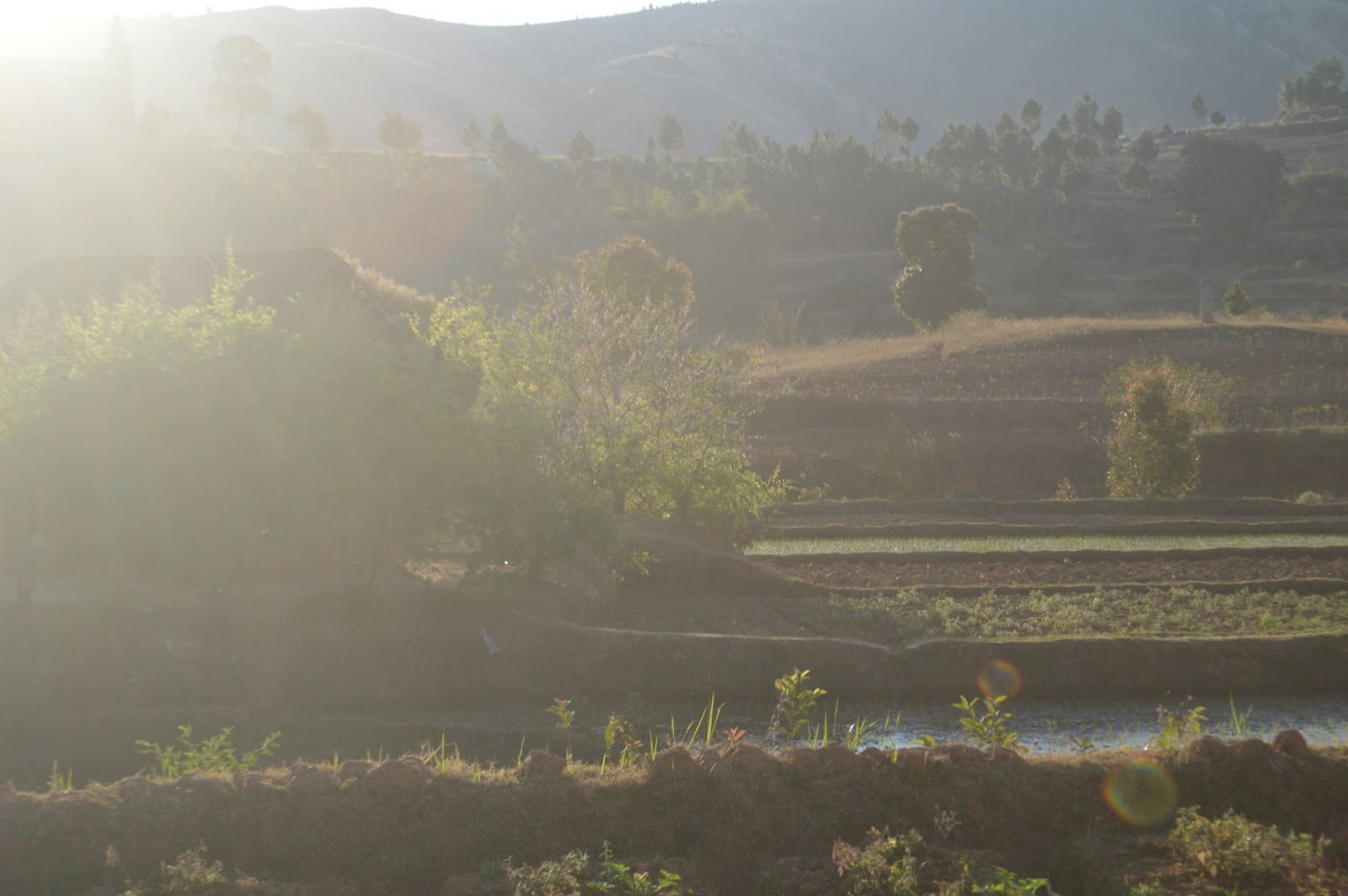
Rice Terraces near Antsiraabe
Surrounded by Kids in Madagascar
The set up had begun the day before with 'tents' made of
tarp, wooden benches and tables for food, the rice was cooking on charcoal
piles in the back. Beer, rum, and water
had been carried up the hill. Since there is largely no electricity, life takes place during
daylight only. The day starts at 5 a.m.
and ends at 6 p.m. People go to sleep at
around 8. Running water is also rare, so the washing is done in nearby lakes and
rivers, it is dried in the grass, and the washer women carry it back to town
on top of their heads. This means that festivities like a Famadihana start early and end early. No late night parties, in other words. And they are a lot of work to prep. A generator had been lugged up the hill for this one, so that music other than live instrumental music could be played on a stereo.
Rice Cooking for the Festival
Our lunch shift was at around 11:30.
Since we were considered part of the closer family - a great honor - we
were seated with them to eat. Feeding 200 people on a hilltop requires a bit of organization, so it was done in sets of 50-100. The aluminum dishes had to
be washed between shifts and the giant aluminum cups with rice water were shared among several people. Everyone got seated on the wooden bench, rice and pork stew were ladled out from a plastic bucket. The stew was extremely tasty but
also extraordinarily fatty. Irene's family, who is fairly well off (in part
because of the business Jochen brings), can eat meat once a week. Others may not see it for months. Maybe never.
So fat, when available, is much appreciated. Except by us rich people, who get too much of it and try to eat less!
Lunch - Rice Water for Sharing in the Big Pot
For me, eating that much fat is consequently less of a good
idea. It's not like I'm lacking in
calories. Plus all the extra money I spend eating out then costs me extra personal trainer sessions to lose (what a waste, when you really think about it that way). Anyway, Jochen gulped all his down
because he really loves it, but that turned out to be a mistake. It all came back out the wrong way that same evening. I guess not everyone can eat gobs of
fat without some form of either remorse or punishment, or both.
After lunch, the official ceremony began. Along with the
enthusiastic "music" played on old and half broken trumpets,
clarinets and drums, we trekked a half mile across the mountain over to the mausoleum. The clan all wore the color orange as it had been decided that it was the representative color for the event and the men wore hats
in addition (so they could be removed for the anthem, as far as I could
follow). Incidentally, hiring musicians
is expensive for the Malgasy, and since July and August are the months of the
exhumations, they have to be booked ahead of time (at least one year). The late "summer" months are the
winter months in Madagascar, with dry and sunny days, 80 degrees during the day
and around 40 at night. It is very comfortable
and dry weather.
The Straw Mats are Used for Carrying the Dead
These are the Mauseloums where the Dead rest
The mausoleums are made of brick, painted white, with a
cross on top. The majority of the
population here is Catholic, but as everywhere, local traditions like the
exhumations, are mixed in. Not everyone
can afford those, however, so most dead are buried underground - which does
not stop the tradition of exhumation, incidentally. Families pool their money to build a mausoleum,
in this case, about a dozen people were housed in the same grave. The doors are locked of course, and only the
clan leader has the keys. Opening the
doors requires official permission from the local government. There are no graveyards per se, you can find
the mausoleums together in groups of five or six, on the outskirts of town,
close by for people to see and to visit.
The Bodies are being Carried Outside
Before the mausoleum is opened, there is a lot of dancing, and during the unlocking of the gates, official family leaders climb on top
of the mausoleum and make speeches about the dead person. The tomb can only be opened with official permission of the park authorities (more correctly, the public officials in charge of the land). The key is kept by one of the elders. In this case, that was an older uncle.
After the tomb is
opened, the family members, and anyone else who wants to, can go inside to visit.
Then the anthem is played and the dead are carried outside, rolled up in straw mats that are carried up the hill for the occasion. Immediate family members are put together
into the same burial cloth. One of
the cloths, I was told, contained four or more people. There were a total of four cloths being
carried into the sun. There was a bit of
a mishap with one of them (Irène's father, who passed away 17 years before) -
the roof of the tomb had been leaky and the burial cloth had gotten moldy. This caused a few
tears among the immediate family, but it was decided just to leave the bodies
in the sun a bit longer to dry it up.
Children and Relatives are Spending Time with their Ancestors
After a couple of hours, more music, more dancing, and a lot more beer,
a fresh layer of cloth was wrapped around the bodies and closed up with a single
rope which, for reasons that escaped me, is not allowed to be cut. Everything is done with great care. The family gathers very closely around the
bodies, laying next to them and holding them at times. The children are shown their relatives and
are allowed to touch the silk.
Everything is very respectful and loving, and very natural at the same
time. There is no awkwardness around the dead as there usually is in the
West. I was allowed to take photos but
Gael, who had hijacked my camera with great pride and had taken dozens of
photos of the event (later posted on his facebook page), gave it back to me
when I wanted photos of the bodies. Too
emotional for him, he said.
Gael, Our Driver
As the day grew to a close, the bodies were brought back
inside - again with lots of music and dancing - and the festivities ended. I don't think a lot of white people are ever
invited to these events. That's what I
was told anyway. Not many Vazahy there
or anywhere else for that matter.
Back at the hotel, I calmed my own nerves with some South
African white wine and Zebu steak with fresh vegetables, salad and foie
gras sauce to the background sound of Western music. Creme caramel for dessert. A bizarre contrast to the day!
A Difficult Ride Home
Work started early again the next morning. The broker women began lining up at 7 a.m. - after all, we were only gem buying for 5 days and one of them was taken up with the festival. I woke up to the excited chatter in the yard and Jochen brought me a cup of coffee made in his room with filtered coffee. Ready for another day of buying....
More about my final purchases, photos and prices in my next blog entry.