Wednesday, March 25, 2015

New Price List Available for Pendants

I have been working on more price lists – I have them together for myself but I am constantly adding molds and new designs, so it is difficult to stay on top of it.  Here for now are prices for custom orders for some of my Petal, Hexagon and Gotham collections.  Remember, these prices do not include gemstones or chains. 

Here are some additional notes.

1. I can cast in 10 K gold also but you do not save that much money when you do.  Labor is the same, gold is about 30% less (because part of the casting price is casting labor).  I didn’t list any of these prices for that reason but the savings averages out to something like 10%.  Ask me for individual quotes.

2. If you’d like to make a pendant into an earring, multiply by two and add a little for ear wire.  Ear wire is more than a bail unless we use something simple.  So if you add lever backs but subtract the bail, you may add about $100 or so.  Less if it is a larger bail of course. 

3. My casting service offers almost any metal, more than I can list individually: 10K yellow and rose, 14K rose, yellow, white, 18K rose, yellow, white, 18K White Palladium, Platinum, Platinum Silver, Argentium Silver, Bronze, 22K yellow.  Even brass and copper are available.  However, many if not most components come only in white and yellow gold. In rose gold, I can get basic leverbacks and ear wires, basic bails, that’s about it.  Most 18K is special order, platinum silver does not exist in the findings world. 

4. I can combine pieces for pendants, i.e. add petals and hexagon components to a hexagon setting.  You can get a ballpark estimate for smaller parts by looking at my earring components and cutting those in half. 


5. A final word: why am I asking you to calculate?  Because some days I am so busy I lack the manpower to get all the quoting and photos done.  And my markup does not include all the time that is used for service.  The reason wholesalers have a smaller markup is not JUST to leave room for retailers.  It is also because they expect to sell more pieces and have less to no service costs.  I have wholesale markup, and I (try to) accommodate retail service.  Technically the formula doesn’t mix.  I try anyway!  Unless I start manufacturing overseas (no way!) I will have to compete with lower prices for finished goods.  It’s hard to do everything here, pay high labor costs, and offer good prices to you at the same time.  I’m not complaining, but I want to disclose how things are on my end so that you get a better sense of what to expect.


Description
Stone Size
Setting Style
Collection
14 K Price
Sterling Silver Price
1
Pillow Pendant with Sidestones
7x5mm
Pave, Prong
Gotham
$430.00
$265.00
2
Large Gotham Pendant with Sidestones
8x6mm
Pave, Prong
Gotham
$435.00
$310.00
3
Small Gotham Pendant with Sidestones
6x4mm
Pave, Prong
Gotham
$340.00
$240.00
4
Large Gotham Pendant Engraved
8x6mm
Prong
Gotham
$235.00
$105.00
5
Small Gotham Engraved
6x4mm
Prong
Gotham
$210.00
$100.00
6
Art Deco Circle Pendant
1.5mm, 1.2mm
Pave, Bezel
Gotham
$965.00
$630.00
7
Art Deco Circle Pendant
$745.00
$410.00
8
7 x5 mm Stone Octagon Bezel Pendant
7x5mm
Pave
Hexagon
$235.00
$140.00
9
8x6 mm Stone Octagon Bezel Pendant
8x6mm
Pave
Hexagon
$250.00
$140.00
10
4 Stone Hexagon Pendant
3mm 
Pave
Hexagon
$240.00
$150.00
11
Oval and Two Rounds Hexagon Pendant
3mm/4x3
Pave
Hexagon
$215.00
$130.00
12
6mm Hexagon Bezel Pendant
6mm
Pave
Hexagon
$200.00
$120.00
13
3 Stone Hexagon Pendant
4mm
Pave
Hexagon
$255.00
$150.00
14
Victorian 5 Petal Flower Pendant
3.5mm, 3mm
Pave, Bezel
Petal
$230.00
$140.00
15
Victorian 4 Petal Flower Pendant
3.5mm, 3mm
Pave ,Bezel
Petal
$260.00
$130.00
16
5mm Center Stone Sunflower Pendant
5mm/1.5mm
Pave, Prong
Petal
$355.00
$230.00
17
6mm Center Stone Sunflower Pendant
5mm, 1.5mm
Pave, Prong
Petal
$325.00
$205.00
18
Oval Sunflower Pendant with Sidestones
7.5 x 5mm, 1.5mm
Pave, Prong
Petal
$412.00
$240.00
19
Victorian 5 Petal Pendant Engraved
3mm
Bezel
Petal
$180.00
$40.00
20
Oval Petal Pendant Engraved-Large
7.5 x 5mm
Prong
Petal
$225.00
$100.00
21
8 Petal Sunflower Pendant Engraved with 5mm Stone
5mm
Bezel
Petal
$195.00
$100.00
22
Oval Sunflower Pendant Engraved
9x7mm
Prong
Petal
$375.00
$135.00
23
Oval Sunflower Pendant with Sidestones
9x7mm, 2mm
Prong, Pave
Petal
$500.00
$250.00
24
Gatsby Pendant with Basket & Sidestones
7.5-8mm, 1.2mm
Prong, Pave
Petal
$380.00
$230.00


Gotham

5) Small Gotham Engraved
1) Pillow Pendant with Sidestones
2) Large Gotham Pendant with Sidestones
4) Large Gotham Pendant Engraved


3) Small Gotham Pendant with Sidestones
6-7) Art Deco Circle Pendant


Hexagon
8) 7x 5mm Stone 
Octagon Bezel Pendant
9) 8x6 mm Stone 
Octagon Bezel Pendant
13) 3 Stone Hexagon Pendant
11) Oval and Two Rounds 
Hexagon Pendant


10) 4 Stone Hexagon Pendant
12) 6mm Hexagon Bezel Pendant


Petal


14) Victorian 5 Petal Flower Pendant


15)Victorian 4 Petal Flower Pendant
16) 5mm Center Stone Sunflower Pendant 


17) 6mm Center Stone 
Sunflower Pendant


19) Victorian 5 Petal Pendant Engraved


18) Oval Sunflower Pendant 
with Sidestones
 20) Large Oval Sunflower Pendant Engraved
23) Oval Sunflower Pendant Engraved 
with Sidestones
22) Oval Sunflower Pendant Engraved

23) Gatsby Pendant with Basket
& Sidestones


Friday, March 6, 2015

Why have Mandarin Garnet, Tsavorite Garnet, and Mahenge Spinel Become so Expensive?

A couple of months ago, I saw a discussion on PriceScope about availability of Tsavorite and Mint Garnet, Mandarin and Spessartite Garnet, as well as Mahenge Spinel, all of which come from the same regions in Tanzania and Kenya.  As a vendor, I can’t post on PS – which is a good idea by the way – but the question was an interesting one so I want to post my two cents here on my blog.

Mint Garnet

As one reader on PriceScope commented, it is certainly true that worldwide demand for these gems, especially demand in China, has grown exponentially.  This is particularly true for pink spinel, less so for Mandarin garnet, which is not as popular a color in the east.  Pink is considered he most popular at the moment (mainly in the form of tourmaline), then green and other colors, then oranges and yellow. 


It is also true that supplies, at least at the moment, are limited.  I say "at the moment" because as every gem dealer knows. one deposit gets used up, but another discovery may be around the corner.  Many areas around the Mozambique belt (Kenya, Tanzania, Mozambique) are unexplored, and one never knows what turns up where.  The Mahenge valley has been sifted through fairly well from one end to another with the yield being small and lighter colored, Tsavorite production is down, by estimates, about 90%.

Pink Mahenge Spinel

Production, however, cannot strictly be measured in terms of availability.  Production can be down because of fuel and explosives or tool shortages as well.  Most African nations are poor, and depend on influx of foreign cash.  That cash, in turn, can vanish at a moment's notice if it is needed elsewhere, so from what I have heard, foreign investors familiar with local culture never simply pay up front.  They stay in the area and supervise production for the duration of the investment.  The following relevant story was related to me by my geologist friend Jochen Hintze.  A local had told him that there was a deposit of a particular gemstone that couldn't be mined because of a shortage of money.  So Jochen offered to invest but only if he was brought to the site to inspect it, stayed in the mine during production, and would receive 50% of the material that was found.  After some back and forth the terms were agreed to and he was taken to the location of the mine (many such locations are kept secret among locals).  The journey required a jeep and one day's travel.  When they arrived at the top of the mine shaft, Jochen was told that he could not go inside.  He asked why and was told that there was no fuel to start the compressors that push air into the mine, so there was a danger of suffocation.  Jochen was exasperated.  It would have been easy for him to just bring the fuel and pay for it.  But he didn't want to go back a second time, and so the deal fell through.  Whatever pretties are down in that mine, they are probably still there.

Tsavorite Mine, somewhere in Tanzania
(Photo courtesy of Jentsch-Mineralien)
Mahenge Spinel Mine, Tanzania
(Photo courtesy of Jentsch-Mineralien)

This story, I am told, is fairly typical for the production problems encountered in these regions.
Of particular interest is also the story of the Loliondo mines in Tanzania, which produce Spessartite as well as particularly strong and beautiful colors of Mandarin garnet (the more fanta colored version of spessartite).  When the gems were first discovered above ground (this is an area in which gems can be mined at the surface, so technically there is no "mine"), production was good.  At one point, a woman the locals call "six fingered mama" bought the rights to dig in the area, but the local tribe, the Masai, prevented her from exercising her rights.  Gunfights ensured and some people died.  As a result, the local government forbade any further mining in the area, and so there are no more Spessartites until further notice.  This has gone on for some time now, a couple of years at least, and there is only a little bit of illegal mining here and there.  Until the situation is resolved - if it is ever resolved - there will not be any Spessartite hitting the market.  Consequently, there is a crunch, and prices have shot up.


Lolindo Spessartite Mine, Tanzania
(Photo courtesy of Field Gemology)


Friday, February 20, 2015

Diary From My First Tucson Show

As I reported a couple of blogs ago, this year I took a big step forward for me in my gemstone endeavors because I went to Tucson for the first time.  Hosting over 55 shows with more than 20,000 vendors, the relatively small Arizona town turns into a theater of tents, cramped with visitors from all over the world, buying and selling gems, fossils, minerals.  You have to plan your trip carefully, otherwise you get totally overwhelmed.


AGTA Show Video From Outside the Show

I mainly visited two shows, the AGTA (American Gem Trade Association) Gem Fair which consists of about 200-300 mostly American dealers, and the GJX (Gem and Jewelry Exchange) show in a big tent across the street from the AGTA, which has several hundred foreign vendors.  Just walking up and down all the aisles of each show takes a couple of hours, and because I had a limited budget, I took notes, photos, and collected business cards before I started shopping.  That is, with the exception of Dudley B.'s booth, a wholesale and show dealer only (no web presence, phone calls only, and no retail), who travels all over the world to collect unusual pieces.  I immediately stocked up on unheated Ceylon sapphires from him because his booth, as usual, was overrun with sapphire buyers within 30 minutes of the show's opening - in fact I couldn't get my invoice written up till the end of the day so they just took my business card and stuck it into a baggie until they had time.  Dudley also had some tiny cobalt spinel, demantoids and Vietnamese lavender spinel that I looked at (and bought throughout the week).  Dudley, who is pictured in the photo below, is the small, athletic, health food type, generally quiet until you ask him an interesting gem question ("interesting" being the relevant term here), then he'll open up and chat (mostly about the properties of the gems, the mining, how much can be gotten at what prices, and so forth).  Dudley does all of his own buying and he is connected to families in Sri Lanka and elsewhere who have been supplying him for decades.

Dudley B.
Pretty much by the end of the day I realized that I would not have enough spending money, which is why I started selling Brazilian Paraiba Tourmalines right away (thanks to my FB fans who promoted my link, sent me new customers and requested custom listings).  The owner of the booth with the Paraibas, Jerry, was pretty happy - and impressed I will admit - because every morning I would show up, buy another piece or two of the items I had eyed and photographed before, then sell it and show up again.  It was pretty funny actually.  Because Paraiba prices are astronomically high, buying a bunch for stock was out of the question for me.  According to Josh L. from my lab, I made some nice purchases there (I am currently getting some of the Paraibas certified for copper content).  Sadly, filming was not allowed in either show but I took a brief clip from the gallery at the AGTA show from the top, outside of the actual show floor.  These shows are heavily guarded and everyone worries about thievery (makes sense...).

Brazilian Paraiba Tourmalines
 Another interesting vendor was a small team of Israelis operating out of Thailand, whom I met at the GJX pavillion.  These guys mine almost exclusively spinel (you know how much I like those) but only from Vietnam, Sri Lanka and Burma (not Tanzania).  Their collection of Vietnamese spinel from the Trumchum mines was incredible, they said it took them 3 months to collect about 200 pieces, and they do not display those until they get to Tucson where they hope to sell them all in one shot, directly to jewelers and other gem dealers.  All single pear shapes are set aside until a match turns up.  Consequently, there were about 10 sets of matched pear pairs of which I bought three. Some of these spinels also have color change properties, they exhibit soft hues of pink in incandescent lighting.

 Vietnamese spinel
 Vietnamese spinel
On my last day, I got to chat with some German dealers that featured Hauynite, a (super expensive and tiny) gem that is only available in one place in the world, the Eiffel in Germany.  The gems are a strong cobalt blue and don't require treatment.  They are soft though.  Anyway, I did buy some melees. 

Hauynite
My final treat was a visit of my friend Jochen's show at the Arizona Mineral and Fossil Show at the Hotel Tuscon City - an indoor outdoor show where vendors set up in their hotel rooms with the lower rows sprawling onto the yard.  Jochen, a seasoned and well traveled geologist with a weathered appearance, doesn't sell fine quality or cut gems, he mainly deals in rough and specimens that he buys directly from Tanzania, Madagascar, Kenya and even the Congo.  Aside from knowing just about everything there's to know about mineral specimens, Jochen also speaks French and Swahili, so he can get around the more isolated parts of the world with ease.


Arizona Mineral and Fossil Show, Outside and Inside the Shop of Jentsch Mineralien

My only regret about my visit is that I didn't get to see much of the Arizona landscape except from my hotel room at the Westin (I got two free nights as a VIB - Very Important Buyer).  But I will go again next year, and I'll try to stay an extra two days during which I will (force myself to) go to some of the national parks, or maybe visit a ghost town and an old copper mine.

Saturday, February 7, 2015

How to Design onto a Basic Pendant Shape

This little video clip came about largely by accident.  I just started playing with some of my gems to see if I could fit the right sizes onto my new Art Deco pendant and Debbie started filming and shooting photos.  So I decided to use the video and show you how I decide which gems go where.


As you can see, this pendant is cast in 14 K yellow and not rose gold.  According to my latest survey (thank you for filling it out), yellow gold was more popular than I thought so I am making a few more pieces.  The issue with yellow gold is that it can sometimes look gaudy with colored stones.  It brings out the colors of any gem very strongly and if you don’t tone it down a bit by not mixing too many colors, it can look cheap.  On the other hand, I love the way certain pink gems look in rose gold, especially ruby and tourmaline.  And I love a pink yellow or pink orange combo in general.  This is why I opted for a ruby and yellow sapphire combo.  My spessartites were too light, not quite orange and not quite yellow, and they didn’t make for good contrast.  The yellow sapphires were better.


To check out the stone size and determine how many gems can fit, you set the gems upside down onto the pendant using a tweezer.  All sizes need to be exactly the same, down to 1/10th of a mm.  You can also measure the width of the parts to be pave set, but you need to subtract .1mm from each side if you want millgrain.  I often play it by ear, just making sure I have a little bit of metal showing on each side.  As you can see, I was able to fit 4 rubies on each side.  I used the sapphires for the rest.


After getting the pendant back from the setter, I faced another design dilemma.  I had originally planned to pen-rhodium the inner circle of the pendant, but it turned out that that looked weird – I didn’t take photos but it was just “off” somehow.  The yellow sapphires weren’t saturated enough in that size to stand out. So instead of going white, I went with a deeper yellow and had the polisher use 22k gold on all the parts that were sapphire, and the result, in my view, looks great. 

Setting costs for this pendant were very high because we used so many small gems, but I really like the result.  The yellow sapphires on the inner rim might be heated, the rest of the gems are not heated.  The little bezel is not part of the original casting, I decided that I might use different sizes or shapes of gems in the opening, so I will be adding those bezels or settings depending on what gems I pick.


Thursday, January 22, 2015

Stone Setting by Pierre

I am slowly learning how to add little video clips to my blog so here is my first one.  It was my practice piece but then I thought it came out nice enough to share.  In this video, Pierre explains how he is prong setting 3mm diamonds into a diamond eternity band.  First he opens the ring up underneath, then he drills the seat, pops in the diamond and gently pushes the prongs over the stone.  They pop into place perfectly.  And the end, Pierre shapes the prongs into perfectly round little “balls” for an even appearance.


As most of you already know, there are many different kinds of setting techniques, and each takes a separate set of tools and a separate skill set.  Simple prong setting is the easiest, and it is least harmful to the stone.  In his office, Pierre is equipped with a huge microscope, flex shafts, beading and millgrain tools, clamps of all types, ultrasonic, and who knows what else.  To be fully equipped, especially for setting micro pave under a scope, you need to invest several thousand dollars.

Pierre has been in the jewelry trade since he was 14, and has decades of experience just setting stones.  Still, some of my gems present unique challenges to him.  Most setters set diamonds, or rather, most of what is set in industry are diamonds, and those are hard to break.  Many colored gems can get scratched or chipped by the tools that are needed to push the metal over the gem and file down the prongs, so a very steady hand is needed, and gems do break on occasion.  That’s why setters do not guarantee the stones they set.  Too much risk is involved and insurance is crappy and expensive.  It is therefore best to go over your project with the setter carefully, making sure the gem can withstand the tools that are needed for the particular setting job.  Gems are inspected for inclusions or cracks which can present additional risks.

Another challenge is getting a tiny piece of jewelry to stay in place and not bend or move while the setter works on it.  Rings are the easiest because you can put them into the clamp, but pendants sometimes have to be set in shellac, or setting cement, a wax like substance that melts when warmed up.  To remove the shellac, the jewelry piece has to be warmed up in water and then cleaned in the ultrasonic.  Sometimes stones break during that process – I once had an aqua pendant that cracked because it got overheated while the shellac was being removed.
An image of Pierre and I my assistant took while i was shooting the above video :) 

Customers often wonder why setting costs so much.  One reason is the equipment, plus there is the rent on 47th street that has to be paid (figure on maybe $2000 a month for a small office).  And then it takes time.  Setting a pair of earrings may take only 10 minutes, but pave setting an entire ring can take an afternoon.  So if a setter charges $300 for that job he is within his rights.   I generally pay gladly for good work, but for my markup it presents a problem of course.  Technically, the setters I use make jewelry that goes for thousands of dollars, not hundreds, and so the setting cost can be more easily absorbed.  On the other hand, I find nice setting work addictive, and I like my gems to be hugged by prongs that got filed down into tiny claws, or perfectly rounded so they look like beads (you can see how that works in the video).  

Friday, January 9, 2015

My First Trip to Tucson

I am so excited.  On February 2nd, I am leaving for my first Tucson show ever.  I will be there for the entire week, working part time and shopping part time, making new connections and getting a better sense of availability and pricing of gems.

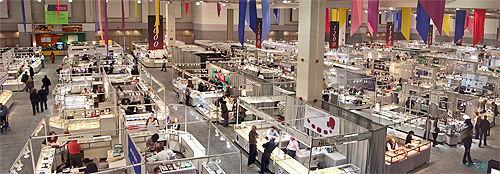
For those of you who don’t know that much about Tucson, it is the largest gem show of the world.  It takes place once a year, from mid-late January to mid-late February.  Actually Tucson isn’t one show, but consists of approximately 40 different shows, all taking place in various hotels and convention centers.  There are gem shows, bead shows, mineral and fossil shows and more, some are wholesale only, others are open to the public.  Some of the hotel shows are actually taking place in the hotel rooms themselves, so the dealers display their wares during the day and they sleep in the same room at night.  Someone told me this tradition arose because so many dealers would sell out of their rooms at night, or before and after the shows.  Therefore it made sense to just sell out of the rooms, period.
Here’s a link to the Tucson gem shows taking place this February: http://www.tucsongemshows.net/coming.html


The show I’ll mainly be attending is the AGTA Gemfair.  That is one of the largest, maybe the largest show; it takes place at a convention center, and it is wholesale only.  I got free tickets because I am working for two days for my favorite gem dealer, Prima Gems, and then roaming around the rest of the time.  My friend Jochen Hintze from Jentsch Mineralien will also be exhibiting but at one of the mineral shows, so I will look in on that as well.  I doubt I’ll be able to go to all 40 shows though, lol.
A lot of gem dealers actually go to Tucson a few days before their show and make wholesale appointments to sell out of their hotel rooms, so it is said that many important trades and deals happen before any of the shows start.  I’m not big enough to participate in this, but I may nevertheless benefit through my gem dealer friends.

Budgeting is very important when you go to Tucson.  People spend hundreds of thousands of dollars there, and I have nowhere near that kind of cash.  I have to decide on a number, and I have to be very careful.  I have trained myself to be willing to walk away from a good deal and think about it first, and of course I can ask people I know there for advice before purchase.  Thanks to the survey I just ran, I have some ideas about what you guys are interested in, but more suggestions are welcome.   
You may see a gem sale in my shop around the time I am gone, which Debbie will manage (she will also manage my kitties while and house sit my wares).  That sale will allow me to raise some more money if I see interesting stuff.

Here’s the AGTA exhibitor list, as you can tell, there are a few hundred there, and that’s just gems.

What will I buy?  In a way, I don’t know.  One thing about these shows is that you need to be open minded.  When I go to the JA Show in NY, which has maybe 20-30 gem dealers, I go with a list, I meet my regular sellers, and then I just look around for deals.  I will do some of that in Tuscon also, but additionally I will want to find some unusual and rare stuff.  Unheated Ceylon sapphires are something I always chase after.  They are in my mind among the best long term gem investments that one can make.  Even low heat sapphires are ok, so long as there’s no other treatment, and of course the best color is blue, then purple or bi-color or purplish blue.  A nice star sapphire cab might be good, and of course, if I had the money, the bigger the better.  Meaning like 2-3 carats (if I have to buy I top out at that price range).  Mahenge spinels are another good investment, or Burma spinels, but I already have the source for the former.  The latter are hard to find.  The rest is just, well, whatever turns up.  Tsavorites are a bit dark for my taste, and I do have a source there as well.  So I will probably focus on Ceylon sapphire and Burma spinel, and then see what else is out there.  Someone mentioned I should look for Paraiba tourmalines, the problem with those is that you cannot determine origin on the spot, and many sellers price Afghan or African material very high so you don’t know what you’re getting unless you go straight to a lab.  For stuff like that, it is best to clear the source with other gem dealers, get references, and then make a more cautious purchase – insofar as that’s possible with Paraibas given the price.

African Tourmaline Rough (from which my unheated Tourmalines are cut)
I will keep you posted and will try to take some little videos for you that I’ll put on Facebook.