Thursday, June 23, 2016

What Makes Rare Gems Rare?

There is so much talk about rare, or "rare" gems these days.  All of us sellers - myself included - use the term a lot, and I imagine it must be hard for consumers to know what to believe.  And of course, each story is different. Not all gems are rare because there aren't any, however contradictory that sounds.

It is hard to sketch a comprehensive picture of the very complicated gem and gem supply world but what I can do is provide a few examples in the form of anecdotes, so here goes: 

1. Red Beryl: the red variety of emerald (bixbite) has so far been found only in one location of the world: the Wah Wah mountains in Utah.  I spoke with the owner of the land in Tucson.  There is still red beryl in the ground.  But the surface area has been mined and further mining will require more heavy duty equipment.  This is costly, and given that bixbite already costs thousands of dollars per carat, there is a question of whether or not the market can bear the additional cost.  So mining has stopped for the time being.


2. Mahenge Spinel: again, while spinel is found in many places, the town of Mahenge that produced this color gem is only a small region in Tanzania.  Initially large pockets of the material was found, to the tune of blocks the size of 50kg.  The spinel crystals had concentrated in larger pockets just a little under the surface.  Now mining has to go deeper and the yield is smaller in the lower regions of the ground.  Geological estimates are that there is not much more to be found.  Mining is still going on but much reduced - my friend Jochen Hintze from Jentsch Mineralien was there last summer.  The rough goes mainly to a few larger buyers with special agreements with the locals.

3. Loliondo Mandarin Garnet: here the situation is different.  Currently the ongoing mining is illegal.  The area belongs to a tribal group called the "Masai" and the Masai don't want anyone to invade their land.  There was some local unrest (people killed) and as a result, the government has forbidden any mining in the area.  Some material gets out but it is not sold as having a particular origin.  It just turns up on the markets in Aruja Tanzania.  Also there is still a bit of older stock people have available because orange is not a color that sells very well.

Mandarin Garnet, Hauynite, Paraiba

Purple Garnet, Mahenge Spinel, Hauynite

4. Paraiba Tourmaline: stricly speaking, the only gem that should be called "Paraiba" is a tourmaline that originates from the town of Paraiba in Brazil.  Similarly colored material from other locations can be called "copper bearing" or paraiba color.  The mining area in Brazil - also fairly small - stopped producing larger quantity over a decade ago.  For a while, production was good so there is a fair bit of material here and there, but smart sellers hold on to it and release it little by little.  And prices just keep going up.  The mines produce only small and not very clean melee.  I've also now seen paraiba that is in the host rock (just bits of blue and green mixed with grey) sold on the market.  Also not cheap.

Paraiba, Hauynite

5. Hauyne, or Hauynite: hauyne is mined only in one small area in the Eiffel, Germany.  It is a bi-product of some other type of mining going on there.  The material is still available but due to a mining accident the owner of the property does not permit any mining of hauynite, so all that's left is what's on the market now.  Naturally this could change.  But still, if only one small area produces the mineral, it will never be cheap.  This is according to the German company that sells the material.  

Moonstone, Paraiba, Hauynite
6. Cobalt Spinel: the true neon blue cobalt color comes only from one rice field in Vietnam, and a couple of very nearby locations, less than a mile apart.  The rough is so heavily included that the yield is less than 2%, according to Dudley Blauwet from Dudley Blauwet gems.  By comparison, a minimum expected yield of a piece of rough should be 20%.  So that means that instead of maybe $700/ct, cobalt spinel goes for $7000/ct.  Cobalt spinel, out of all the gems listed here, is the rarest.  (After that, bixbite).

Cobalt Spinel, Paraiba Tourmaline
So from this you can form a sort of vague picture of the situation.  Most rare stones are found in one location only, and when something happens in that location, then the supply gets choked off.  That something could be local unrest, an accident, lack of mining supplies etc.  Or it could be that the cost of mining does not justify the effort to produce more.  People may want cobalt spinel or bixbite, but they don't want to pay 10K for a dirty morsel of something or other.


Thursday, May 26, 2016

Eternity Band 101, Melee Gems and - YES - Las Vegas

Recently I'd been asked by customers to offer eternity bands for some of the melee gems I've been selling on my site.  The paraibas and hauynites especially lend themselves to those, and I hope to get more of both at the JCK and AGTA show in Vegas in early June.  I'm totally psyched already, this time I want to take a little more advantage of the glitz in between gem purchases - I bought new dresses and I want to see Circe de Soleil.

Of course I'm going to look for more of the holy grail stone - Paraiba - but also sapphires from Dudley, more pretty emeralds, and whatever else you guys wish for me to find.  I definitely want to get other melee options for multi-stone layouts, halos and the new eternity styles I am going to carry.

When I was in Tucson in February, I got a lot of questions like "how many stones do I need for a half eternity band with 1mm paraibas," and I couldn't answer them quickly enough because I was so busy doing other things.  This time, I am planning ahead by summarizing eternity band 101 for you to mull over.

Let's start with some basic math.  Below is a simple table that tells you how many gems you need for a full, half, or quarter eternity band.  I just listed three ring sizes, but I think you can infer down or up what you might need. I just wanted you to have an idea of how much ring coverage you get with how many stones.  For your own band, I can do any number you like.  For fewer stones, I recommend an uneven number of gems - it just looks better.

Ring Size
Full / Half /Quarter Eternity
2mm Stone Size

Full / Half /Quarter Eternity
1.5mm Stone Size
Full / Half /Quarter Eternity
1mm Stone Size
6
32/ 16 /9
42/ 21/ 11
63/ 32/ 17
7
34/ 17/ 9
42/ 22/ 11
63/ 33/ 17
8
34/ 17/ 9
42/ 23/ 11
63/ 34/ 17

What else do you need to know to construct eternity bands?

1. Ring with and depth.  For millgrain pave you need .5mm of band on each side, so a 2mm stone will require a 3mm ring.  For scoopdown or fishtail pave, you need the width of the gem only.  The band thickness should be 1.5-1.8mm.  The thinner the band, the more likely it is that it bends, and then stones fall out.  Both my setters can do any of these styles, pave work is their strong suit.

If you google the different setting styles and you'll get a lot of images for each.  Here are a few for you.


Photo Credit: 90210 Jewelry
2. Sizing: ring sizing is best done before the ring is made.  Eternity bands are hard to size - full eternity bands cannot be sized at all and partial eternity bands still carry the risk of gem breakage or gem loss when the band is bent in the sizing process.

3. Pricing: For 14 kt gold figure on $120-180 for a standard eternity band.  So that's not too bad.  But since I have all my gems set locally, the real hidden cost is setting.  With pave work, millgrain, and polishing and or rhodium, setting a stone comes to about $12-15.  So a full eternity band for a ring with 1mm stones is, at minimum, $750 just for setting.  I can get it done cheaper if I buy a pre-fabricated band for just standard prong setting and use cheaper setters, but then I can't do this kind of pave work.  For all these styles, every single bead is cut and shaped by hand.  That's why it costs so much (at least here in the US).

Hope this blog entry helps you in your decision making process, whether it is for my site or any other.

You'll hear from me next from Vegas, most likely through Facebook since I don't want to overwhelm you with mail.  Stay tuned.

Ruby and White Gold Fishtail Pave Ring Set by Ethan S.


Thursday, May 12, 2016

What I Have Learned about Paraibas

This blog entry has been a long time coming - I should have written it over a year ago, when I first started buying Paraibas on my inaugural visit in Tucson.

I have seen and admired Paraiba tourmalines ever since I got into the gem business in 2009.  At that point, I knew little about buying and grading gems, but I was already attracted by their neon glow.  I bought one single piece to make a tie bar for my best friend in Germany - I think I paid only about $100/ct to a group of Brazilian guys at a New York Gem show.

Paraiba tourmaline is named after its location, Paraiba, a small town in Northern Brazil.  While tourmaline has been known as a gemstone variety for hundreds of years, this particular vibrant neon variety was only discovered in 1989.  The mine yielded Paraibas for five years, then production stopped and the mines closed.  

What makes Paraiba tourmaline so attractive is its strong blue to turquoise to green and also purple color, caused by the trace mineral copper (I've actually never seen a faceted purple one, not to my knowledge anyway, because I may not have identified it as Paraiba).  Hence the term 'copper bearing'.  Copper bearing tourmalines have since been found in Nigeria, Afghanistan and Mozambique.  But their color is not quite as intense (with Mozambique being the closest).  Often, these other copper bearing tourmalines are also termed "Paraiba" though this is technically false.  "Paraiba color tourmaline" would be more apt.  So when buying Paraibas, it is always worth asking where the gem is from.  Some labs, notably, AGL, can also identify the origin of these tourmalines, though usually pieces larger than 3mm are needed for an origin analysis.  When buying a Paraiba, you should request that the origin is written on the invoice or that it is on the back of the box.  I always have that done.  Also consider working with someone who has a good reputation and if you can, who is a member of the AGTA.  I exclusively buy Paraibas that way.

The single most important factor in pricing Paraiba tourmalines is their color.  The more blue, and the more vibrant, the more expensive they are.  So a vibrant green is less expensive than a vibrant windex blue, with a vibrant turqoise being in the middle.  Even more opaque blue Paraibas can cost more than much cleaner green ones - with much discretion being up to the seller of course.

The photo below shows you four different color grades of Paraiba.  The left two gems are copper bearing but from another location, they show, by comparison at least, a lot more extinction, despite their beautiful color.  The most vibrant gem is the small oval, which also had the highest price tag. The large oval should have cost more because it is also very blue, but it didn't - go figure.  The cheapest was the green pear shape, after that the emerald shape on the right.

Copper Bearing African and Paraiba Tourmaline
Clarity is next in the ranking, though for tourmaline the standards on clarity are pretty low.  Even emeralds are ranked by more stringent standards.

Paraiba tourmaline melee cost approximately 2x as much as diamonds, sometimes 3x as much, in the wholesale market.  Hence the high price tag you see on my blog.  Setting, meanwhile, of Paraiba melee, is difficult.  Pierre, my setter, says it's like setting soap. He's very good and still they crack often.  Softer metal are needed because the way gems are held down is by pushing metal over the gem with sharp tools.  A good eye and steady hands are also needed.  The fact that a lot of Paraiba are included is part of the trouble, inclusions make a gem more brittle and less able to withstand pressure.


Paraiba Tourmaline Cabochons, Including a Rare Cat'e Eye
In terms of Paraiba tourmaline care, avoid ultrasonic if you can.  Some ultrasonic machines contain chemicals that are like acid in their solution, other "shake" so hard that they shatter the gem from within.  So if need be, just a very short bath in ultrasonic is best, and you should always disclose that the gem is a valuable Paraiba.  Steam should be applied from further away - it is very hot (by definition) and high pressure.


And what about availability of the gem, now that the mines are closed?  Well, I do see Paraiba available with many high end dealers in New York (maybe 25% of them).  But there are few pieces, fewer every year, and prices appear to be unlimited toward the top.  Just last week I saw two pieces that were over 100K.  Pretty they were.  One was mostly big - a high domed cab with ridiculous color.  The other was a several carat windex blue faceted oval.  Maybe I can sneak some shots for you in Vegas in early June.

Here are some Paraiba Tourmaline Designs I've made in the last 2-3 months:


Monday, April 18, 2016

Edison Gem Show and Glowing Rocks

On the first weekend in April, my friend Jochen Hintze came to NJ to vend at the Gem and Mineral Show in Edison, NJ.  The show is organized by Marty Zinn, who also hosts the show in Springfield MA (and one in Tucson of course).  The Edison show is a bit smaller but it is growing every year, so it is fun to go nonetheless.  Steve from New Era Gems always vends, and you can normally find another couple of gem dealers that new to the scene.

This year, I made the acquaintance of Neil Garrioch and his daughter.  Neil is an architect by day but also has a geology degree - he told me that geological work paid very poorly so he switched into architecture.  Neil owns "The Unexpected Gem" and is based in Philly.  His gems were indeed unexpected, he had two entire trays with kornerupine - my friend R, who had joined me, bought a few pieces, and I got 4 pairs and 2 singles (3/4 of the material is already sold).  The most rare form of Kornerupine is a dichroice teal blue with traces of green and purple.  Pieces over 1/2 carat are very rare.

Here's a video of me selecting the gems:


Neil also sold me what may be one of the only unheated morganites I ever got (Brazilian), now listed on Etsy, as well as some sphene and the gorgeous diopside scissor cut I put up this weekend.

The Edison gem show also always has an exhibit of fluorescent minerals.  This is because many of the world's fluorescent gems come from the Sterling Hill Mines in Franklin, NJ.  Since the mine is located less than an hour drive from my house, I went there last August to collect a bunch of glowy rocks.  Jochen, who is also a geologist by trade and who was passing through on his way to the Springfield show, went with me and showed me how to hammer the rocks to open them up.  He also showed me which surface characteristics to look for.  I came home with 70 pounds of rock, which is still sitting in a bucket in my bathroom.

This April, we finally had occasion to split apart the rocks a bit more, so we created the giveaway for you.  These rocks contain mainly Willemite, Hardystonite and Calcite, though you may find other glowy stuff in there.  On ebay and other websites, these rocks appear to go for quite a bit of money ($60-600 for very rare minerals).  But I bought mine for $1 a pound since I collected myself, so we're not charging.  If you want more from my bucket after the giveaway, feel free to contact me.  I'd charge shipping though since some of these rocks are heavy.


You might have fun watching this video, in which Jochen explains what you can see in the rocks, and then the next video where they glow in the dark in my bathroom.


Note that you need a shortwave UV light, not a longwave!  So not your regular blacklight. Otherwise, no sparkle.

Enjoy.

Monday, April 4, 2016

Your Custom Order Step By Step

I guess it should have been obvious: the more gems I list, the more custom orders I get.  In turn, there are more and more little details to keep track of every day.  Some orders are really fast, others take forever, and if any mistake creeps in we start over - if a stock item is made in the wrong metal or with the wrong stone we just list it that way, obviously that's not gonna work with a custom piece.

Anyway, I thought it might be helpful for you to see what goes into a custom order with our shop (or pretty much any jewelry shop), and what happens next, in what order, and where the challenges are.

As you know, custom orders divide into two kinds for us.
(1) Custom items created from stock pieces: i.e. the 5mm round sunflower pendant in rose gold with color change garnet and hauynite.
(2) New pieces made from scratch in CAD.  This includes modifications to existing pieces because once you make one change (i.e. the size of the center), everything else changes (the height, the number of outside petals or melee, etc).

Now that I take so many custom orders, it is my job to advise on color combos, setting styles, and metals, i.e. suggesting that a particular stone should not be set in a harder metal, or should be prong set and not bezeled.  This takes a lot of back and forth.  Brandy, my CAD designer, then makes an initial 2-D drawing or layout of how the ring would look from the top.  We need that to start because we need to see how many gems are needed if they go into a halo, or petals, or we need to see how many stones can be put into a row, or in which type of layout.  Without that it is hard to calculate stone cost (and it is nearly impossible to do it before having this layout).

Example of Three Ring Layouts
After that we collect the other details from the customer.  We need the ring size so we can make the file in the right size, and the metal so we can calculate weight.  Exact weight can't be determined until after the model is finished of course, so we have to estimate when customers ask us.  Sometimes we use an order form, which is still in 'draft mode' so it hasn't been put on the blog.  But you can look at it here.  Otherwise we just create the listing on Etsy and/or in Excel.


Once gems are purchased for the job, or once the details are hashed out and a custom listing is made, we create what is called a "Job Envelope".  That's where we put all the details of the order, which are also kept updated in Excel.  Here's a photo of what it looks like.

The job envelope stays with the order until completion, and all parts that have to be purchased as well as all gems go in there.  The steps needed are listed in the order in which they come up.


Custom Job Envelopes


Assuming it is a stock item, we first order the piece from our casting service, Taba casting.  They stock each of our molds, which has a certain number (at some point these will be incorporated into our SKU to avoid mistakes at this juncture).  We order rings in the size they are needed because those can be sized in the wax.  And we order in the desired metal of course.  Taba takes about a week to turn an order around.

Then all pieces go into pre-polish, where the sprue is being cut and the piece is tumbled and cleaned (all castings need a little TLC before they can go to setting).  

Before & After Pre-polish

After pre-polish, they either go straight to setting or to jewelry work.  Earrings and pendants need posts, bails, jump rings, eternity chains or bracelets need to be soldered together.  This all happens prior to setting.  Rings can go straight to setting, which is why rings are fastest to make.  We try to have most of the basic supply items on hand (posts, jump rings, etc) but we still end up getting some items every time we go into the city.

Setting is next.  If stones break during that process I have to supply more.  If I remember, I put extra melees into each job envelope so I can save myself a trip back home. Pierre is my setter, as you know, but I also have a backup guy, Ethan, now that my shop is growing and I need more help. Both are traditionally diamond setters but they have adapted their tools and their skills to deal with my colored stones.

From setting, the piece goes to final polish.  This is where rhodium is applied to white gold as well, and all the dirt and grime from setting is washed out in ultrasonic (ultrasonic has to be very brief with colored stones but Arman, my polisher, is used to it by now).

As you may gather, each step involves a different person because each job is specialized - each needs its own tools and skill set.  All the people I use are located on the same block or one block away but we still run around all day between stops.  We usually map out our route as best we can ahead of time but we have to go back and forth when parts have to be purchased or other questions come up.  Each person wants a few days to complete their job, except final polish which is same day.  So the more steps, the more time it takes.  If something goes wrong, i.e. a part melts down a bit during soldering, we may have to start over because we don't stock everything in all metals.  We do stock scroll earrings now, but little else (too many parts, too much money).  

A note on engraving.  Alex, my engraver, hand engraves my pieces before the mold is made.  So it doesn't become part of the custom order process unless a piece is made in CAD from scratch.  This saves time, though it slows down production of a first piece. Alex is a true artist, he works for the top design houses in NY (and me, lol).  And he will not be rushed.  Sometimes he has a piece for a month.  The result is worth it however.

Well, this about sums it up.   I hope this blog entry provides a little clarity as to why not everything goes as fast as we hope, and why a few things are way faster than you expect (i.e. setting a gem into a scroll stud).  And how mistakes can creep in (= everywhere).  

Custom pieces, despite the difficulty they pose, seem to have become our signature style. So we appreciate both your support, and your patience, as they are being created.

Thursday, March 17, 2016

Diamonds are a Girls....

Since I deal mainly in untreated gemstones, I have stayed away from using colored diamonds.  Most of them are irradiated and while I make exceptions for heat treatment, irradiation is a no go - it's the reason I don't carry Morganite.

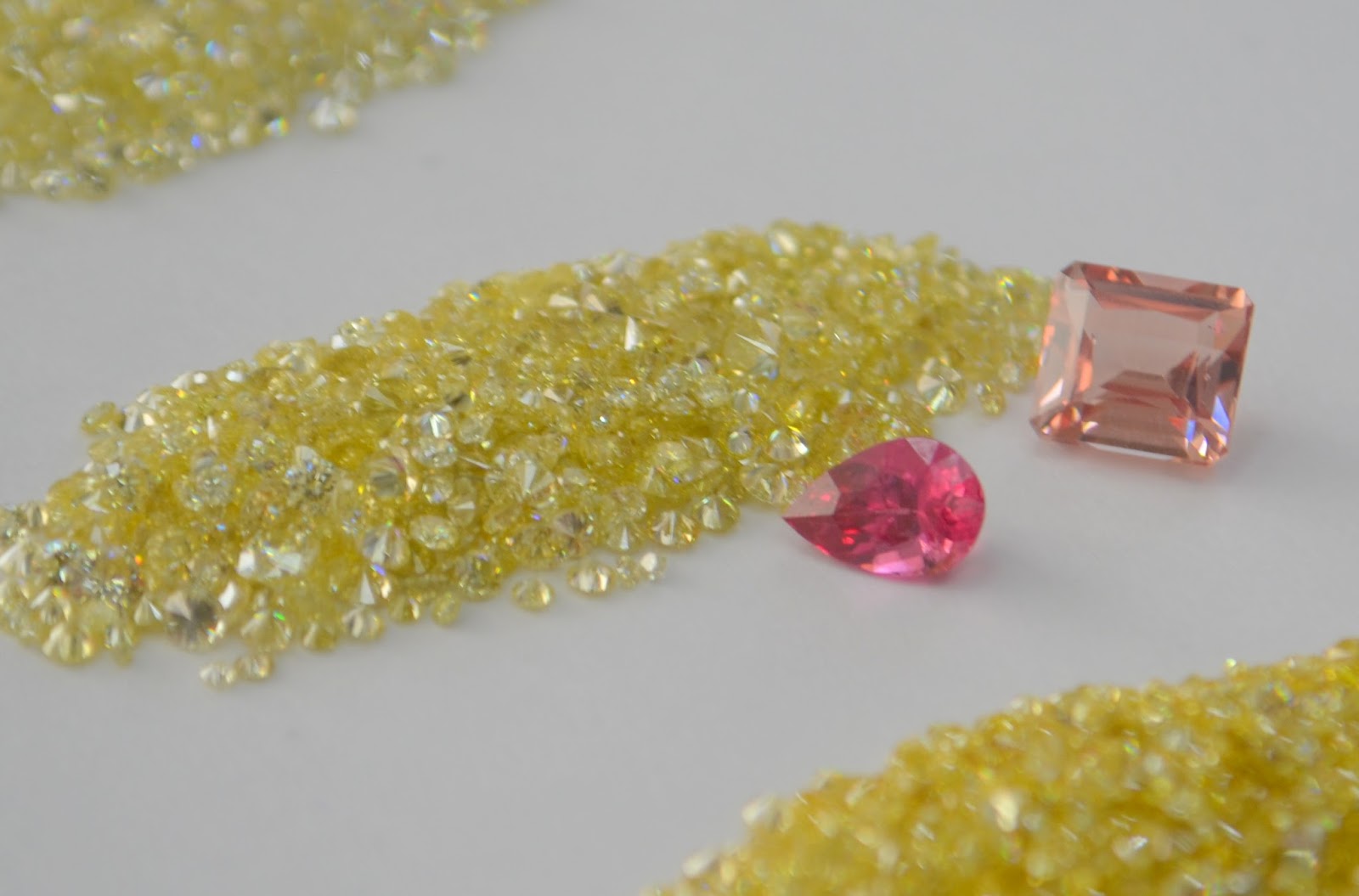
In the last few months, however, I started to increasingly play with natural yellow and pink diamonds, so I thought it might be fun to share some of my insights, and offer out colored diamond melee for custom designs.

There are only a few natural colors of diamonds: yellow, pink, orange and cognac (to browns), blue, grey, and green.  There are very few natural red diamonds, but those are out of all of our price ranges.  All of these colors are ranked by intensity.  The more intense, the more expensive.  The lighter colors have to be used in bunches, and should be set in the right color gold to enhance them (so pink diamonds should be set in rose gold).
 
Natural pinks are the most expensive.  They are usually Australian, from the Argyle mines.  They cost up to $50,000 per carat in the melee sizes.  Here are a few that are lower priced (meaning $3000-12000 per carat).  The colors are Fancy Light Pink, Fancy Light Pink, and Fancy Intense Pink.

Fancy Natural Pink Diamonds

Fancy Pink Diamond and Tourmaline

Fancy Pink Diamonds, Mahenge Spinel and Tourmaline

Yellow diamonds mainly come from the Argyle mines as well, though some of them can be from India.  Here are the more affordable shades of yellow.  They are $1000-3000 per carat.  They are called Fancy Light Yellow, Fancy Yellow, Fancy Intense Yellow and Fancy Vivid Yellow.  Fancy intense is my favorite.

Fancy Light Yellow, Yellow, Intense Yellow and Vivid Yellow

Fancy Yellow Diamonds, Malaya Garnet and Mahenge Spinel

Fancy Intense Yellow and Mahenge Spinel
My favorite new colors were blue and grey, however.  Those diamonds come from Easy Africa.  The grey of these diamonds is not created by black piques (inclusions) but is actually in the body color of the gem.  I am adding a photo of white diamonds for comparison.  They greys are $2500 a carat, the blues are (sticker shock alert): $23000.  Note that my markup is not my standard, it is a much lower add on because that's how this works.  Diamonds are high priced and thus have lower markups than colored stones.

Natural White Diamonds (F Color)
Fancy Greyish Blue Diamond with Vietnamese Spinel

Natural White, Fancy Greyish Blue and Fancy Blue Diamonds
Fancy Greyish Blue Diamonds with Mahenge Spinel


Fancy Blue Diamonds with Tourmaline

Fancy Greyish Blue Diamonds with Hauynite
I could have taken oodles more photos but this is all there was time for.  The dabs of colored stones are giving you some ideas of how to make designs.

Below is a diamond melee size chart so you can calculate costs.


Wednesday, March 2, 2016

Stone Carving with Sonny Grant at the Tuscon Gem Show

As I'm sure you know, not many thing are made in the US by hand any more, especially small arts and crafts.  It doesn't pay the rent, things can be made cheaper elsewhere.  So you might imagine my delight when I came across soapstone carver Sonny Grant at the Marty Zinn show in Tucson.  I was just strolling across the lawn of the Inn Suites hotel, where the show was hosted, to get a cup of coffee at the restaurant, when saw this guy busily sawing away at a piece of rock - soapstone, it turned out - and creating enormous amounts of rock dust in the process.  

I got curious and drew closer, and a conversation unfolded.

Here's How I found Soapstone Carver Sonny Grant
I asked Sonny what he was working on, and he told me that the rock I was looking at would turn into an owl within the next 30 minutes.  Mesmerized, I stopped and turned on my cell phone camera (with Sonny's permission of course).  After a couple of minutes, remembering that I was originally going to get coffee, so I went indoors, and then came back.

The little owl was starting to take shape.


Sonny is a Tlingit Indian from Juneau Alaska.  A graphic designer by profession  (presumably the rent paying profession ,that is),  A few decades ago, Sonny became drawn to the Eskimo art of stone carving in the mediums of alabaster, marble, and soapstone.  He studied with various Inupiaq eskimo carvers and has now been making sculptures for 30 years.  Sonny also carves in wood, ceramic, slate, ivory and bone.  His small works of art are exhibited in galleries all over the US, as well as in Canada. 

Sonny's tools are very simple, I took a few shots of them so you could see.  Just a saw, carving knives, chisels and rasps.  After cutting out the basic shape of the owl, he sprays it with a finish that brings out the marbled texture of the stone.  The eyes are cut of the owl at the very end.

The designs are simple as well, but that's just what I love about them.  A few curves and shapes only, but you know exactly what each thing is because its essence has somehow been captured in the stone.

I took a few little films while Sonny was working.  And - of course - I knew from the first moment that the owl had to be mine.  After all, I watched it come into existence.  I am looking at it right now, in fact, and it is sitting in the cabinet of my shelf, proudly staring back at me.


To learn more about him check out his blogspot http://sonnygrantstudios.blogspot.com/


Watch the live demo below