Showing posts with label GIA. Show all posts

Thursday, May 9, 2019

Padparadscha – Lab Certification Roulette

Guest Blog by Inken Krause, Enhoerning Jewelry

Entire book chapters and countless longish essays have been written about the ideal color of Padparadscha sapphire and the cultural history of this special color descriptor so full of romantic idealization and metaphoric meaning. Now Yvonne has asked me to edit a short guest blog (emphasis on short), so I will try to work on a more practical question.

What does a sapphire look like that will, in all likelihood, be ennobled as Padparadscha by the most important American/European* gem labs?

Several labs, AGL among them, agreed that this 2 ct unheated Ceylon sapphire is a Padparadscha. The perfectly balanced mix of orange and pink leaves very little room for doubt.
This 2 ct Padparadscha was most likely tested for color stability by AGL, although they do not explicitly mention this on the report. I hope they will start doing this on future reports. 


Color -- Hue

Modern definitions of Padparadscha ask for a pink-orange (called type “sunrise“) or orange-pink (called type “sunset“) color. Purists tend to prefer the sunrise type. The color mixture between pink and orange should be well balanced. If either pink or orange is very weak, most labs do not grant the pad label, and any hint of brown is a deal breaker for most of them. Some labs are very strict and exclude any yellowish (not orange) or lavender-purplish (not pink) color. In my experience, the New York based AGL is rather tolerant about purplish hues, but absolutely unforgiving about brown. Of the American labs, GIA tends to be the strictest when it comes to hue (see the round stone example below).

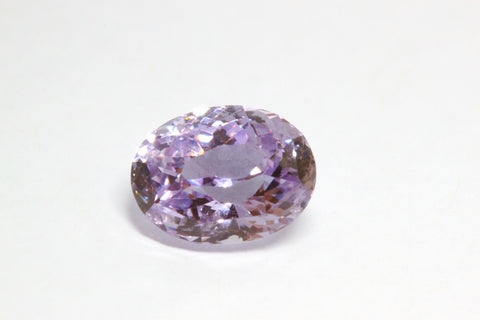
AGL certified this 4 ct unheated Ceylon sapphire as Padparadscha, GIA disagreed and called it “pink sapphire“.


This 2 ct unheated Ceylon sapphire was certified “Pad“ by AGL, and the color is so well balanced that almost any other lab would follow. It leans slightly to the orange side, making it a sunrise Padparadscha.


This 4 ct unheated Ceylon sapphire was certified as Padparadscha by an Asian lab, but AGL (with good reason) decided it is only a ‘light purple’ fancy sapphire, although there is indeed a very slight orange modifier.


Color -- Tone

Tone is the least critical aspect of Padparadscha color. Most labs will accept a wide range of tone (lightness/darkness), as long as the tone corresponds well to the saturation level. Higher saturation can have higher tone. A low color saturation with a high value of tone often leads to a brownish or grayish appearance of the gem. A sapphire with a strong grayish appearance will not be considered a Padparadscha by most labs.

This 2 ct unheated Ceylon sapphire was certified Padparadscha by several major labs, including AGL. It shows a slight grey modifier, but the orangey-pink color predominates in daylight.


Color -- Saturation

Saturation is the most tricky aspect of Padparadscha certification. Almost all Western gem laboratories ask for a light (“pastel“) to medium saturation in pad sapphire. The color should be “delicate“. However, in practice, lab certification can work differently. Many labs routinely reject pink-orange/orange-pink sapphires and do not grant the desired color descriptor if they find the saturation to be too light! (Happened many times to me and my stones). However, it is very rare that they reject a sapphire as a non-pad because of too high saturation, unless there is a brownish modifier. Almost no lab can resist the beauty of an intensely to vividly saturated pink-orange/orange-pink sapphire, even if these stones do not meet their official requirements for (lower) saturation. AGL seems to be notorious for this paradox, but I have seen it on lab reports by GRS and even the highly respected Gübelin lab as well.

This 1 ct unheated Ceylon sapphire was certified by AGL as “Pale orange-pink“. Because of the “pale“ it did not pass as Padparadscha but was labeled fancy sapphire.


Color -- Stability?

The color of a Padparadscha needs to be stable and may not fade over time and/or in the absence of UV light. Color stability in pad (and other color fancy-) sapphire is a hot topic right now and deserves another blog entry of its own. In the meantime, please feel free to read some latest research here: https://www.ssef.ch/wp-content/uploads/2018/03/2018_Padparadscha_colour_stability_facette.pdf

Most of the laboratories mentioned in this text routinely do color stability tests on potential Padparadscha sapphire and do not grant the color designation if a stone does not pass. If you buy a Padparadscha these days, make sure that it comes with a reputable lab report that is not older than a year. Even the most respected laboratories did not test for Padparadscha color stability until a couple of years ago.

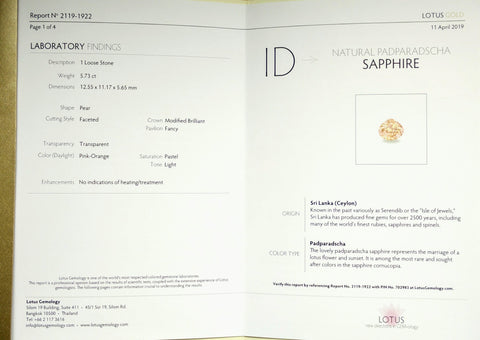
This 5 ct Padparadscha was tested for color stability at Lotus Gemology, although they do not explicitly mention this on the report. I hope they will start doing this on future reports.


Geographic Origin?

For Padparadscha purists (like me) a real pad is from Ceylon (Sri Lanka) or from Burma (Myanmar). The very rare Padparadschas from Burma are incredibly beautiful. However, many mining locations produce Padparadscha sapphire, for instance Madagascar. A fair number of fancy sapphires from Madagascar do not pass the “pad test“, however, due to color stability issues. Pad-like sapphires from Umba, Tanzania, often do not get certified as Padparadscha due to brownish modifiers (or, sometimes, too much saturation).

Treatment?
Again, Padparadscha purists (like me) have their own view on things and think that only an unheated pad-color sapphire is a real Padparadscha. All of the labs mentioned in this article, however, certify heated (heat-only!) sapphire as Padparadscha, too, if the color is right. None of the labs mentioned in this article will give the precious title to sapphires that have undergone Beryllium-heating or any other invasive treatment.

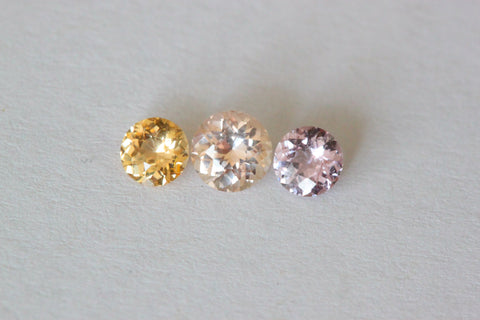
Three Ceylon sapphires, all unheated/untreated. The middle one shows almost perfect Padparadscha color. The one on the left does not show enough pink. The one on the right is rather high in saturation for a Padparadscha, but shows a good balance of orange and pink (all of these are available through Cecile Raley Designs).


This 1.99 ct unheated/untreated Ceylon sapphire is currently available in Yvonne‘s Etsy shop. It is of the “sunset“ type and has a good to very good chance to be certified as Padparadscha by, for instance, AGL.


* comments made in this blog entry apply, to the best knowledge of the author, to the following gem labs: AGL, C. Dunaigre, GIA, GRS, Gübelin, IGI, Lotus Gemology, SSEF; this blog article does not make any promises about lab results for your sapphire.

Thursday, March 15, 2018

What Color is this Gem – really? Commonly Asked Color Questions and Difficult Answers

Nature doesn’t make it easy, does it?  Is it a ruby or a sapphire?  Is the Paraiba more greenish or more blueish?  Does the tourmaline have a sooty appearance in indoor lighting?  Is the color change on this garnet complete and does it change from a teal blue to a purple or a teal green to a red?   Does the sapphire have secondary hues of violet or purple?  Does the spinel glow, does it have open color?
As a gemstone seller, I have faced all these questions  and more.  Just last week I got a request for a round matched pair of 5mm gems – seafoam color.  When we finally sorted out what seafoam green meant, I realized I would have called that a lighter teal blue-green, and my idea of seafoam was more greenish than hers (maybe we were thinking of different vacation spots, lol).  Which is fine, there’s lots of disagreement on color names, as is evidenced when you get color samples for repainting your wall at Home Depot or Lowes. 
Does this sapphire have secondary hues of violet?
Seafoam colors, or mint?  Both?
Which, if any, of these tourmalines is seafoam color?
Is this paraiba more greenish or more turquoise?
Do you think this paraiba is blue or turquoise?
GIA has developed a helpful color reference booklet and chart. Below is the link to the booklet: https://www.gia.edu/doc/ColDiaChartBklt.pdf
Another question I often face is about extinction – this happens at least twice a month, no joke.  How much extinction is there, is it half the stone, or the entire stone, the top half or the bottom..?  All my photos are taken in natural lighting with the light coming from one direction (namely outdoors).  I’ve tried taking photos with the lighting behind the stone but that doesn’t look good.  In order to avoid half of the gem looking dark, I have to go outside in the afternoon, put the stone on my outdoor table with the lighting directly behind me.  But sometimes that provides too much light and no amount of correction fixes it (it’s also rather cold in the winter and we don’t like losing stones in the front yard).  And ANY oval stone (and many pears) will look dark on one side if the light is not directly behind you.  Lightboxes have not worked for me, artificial light doesn’t work for many stones (i.e. mandarin garnet looks washed out, mint garnet looks too gray).  So you make do and hope that your additional description sheds more light onto what the stone looks like – pun intended. This can backfire if the description and the photos are too far apart.  Needless to say we spend oodles of time doing photos and listings, so at times trying to get it just right, especially with cheaper gems, takes more time than I can charge for the gem.  Nobody wants to pay $25 in photography time for a $10 gem.
Does this Burmese spinel have extinction? Open Color?  Left photo: indoor natural lighting coming from the right, right photo: outdoor natural lighting from behind the camera.

Does this Mahenge spinel have extinction?  Left photo: indoors natural lighting from the right.  Right photo: outdoor natural lighting from behind the camera.

Here are some additional challenges to accurate representation of gems:
  1. Monitors vary and not everyone knows how to balance out the colors when they get a new computer (there’s a function for this in the control panel, under color management).
  2. Cameras differ and so do the programs you can use to color correct photos. My Motorola photos do not look like the pictures I take with my Nikon, my older iPad basically sucks. My old “Picasa” software is no longer supported and I really liked the way it color corrected.
  3. Natural lighting conditions vary from place to place and season to season, and with the weather. My Tucson and Las Vegas photos are usually much brighter than my New Jersey photos. Dimmer winter light often brings out grey casts in sapphires, tourmalines and spinel. Showing color change requires very artificial conditions that do not obtain in most homes (i.e. fluorescent and LED lighting do not show color change, and dark regular incandescent light doesn’t show much color in the first place). Dudley Blauwet always tells me which Kelvin value (the unit of measurement used to describe the hue of a light source)  can be seen in particular areas in Sri Lanka and that those conditions are different from over here.  Well that’s very informative but doesn’t provide much practical advice on what to do, neat travel locations excluded.
Paraiba in direct sunlight taken in Tucson, AZ
Morganite in indirect sunlight taken in Tucson, AZ
Paraiba taken indoors without natural lighting
  1. Color vision differs from person to person. I don’t just mean that some people are color blind, I mean that most of us do not see everything on the color spectrum. If you want to freak yourself out, try one of these color vision tests online: http://www.color-blindness.com/ishihara-38-plates-cvd-test/#prettyPhoto
  2. Historical gem classifications and chemical ones do not overlap. We already know that most bright red rubies from old crown jewels are actually spinel, which can often be found in the same deposits. But it also used to be thought that ruby and sapphire were two different minerals. So when you get borderline colors, you have to make an executive decision as to which is which.  And even depending on where these distinctions are made (i.e. India or over here) you get different classifications, which in turn affect price.  The recent Madagascan rubies I got from Dudley Blauwet evidence this.  Dudley told me he had a hard time deciding where to draw the line to pink sapphire, but knowing that he’s better at this than I am, I kept his classifications.  This doesn’t mean that GIA would agree, however. And many labs use different color names for their classifications.  For example, a "purplish pink" ruby at GIA is a "pinkish red" ruby at AGL and Gubelin.  And a GIA "red ruby" is a often "pigeon blood red" at GRS.  So if you want your ruby to be pigeon blood red you can't give it to GIA.  One almost gets the sense that these gems change color as they travel.  However, the difference in terminology has to do with what each lab considers the scientifically correct color term.
What's the color of this ruby?
  1. Finally, here’s a real doozy for you. Some color names are trademarked. So “grape garnet” cannot be used in a description of purple Mozambique garnet, unless you are Parle jewelry.  You can only call it “purple garnet” or “grape colored garnet” (which is, incidentally, the same gem).  “Mint” garnet is currently in the process of facing the same fate, so in future I will have to say “mint color” or “light color tsavorite” or light “grossular garnet.” “Lotus garnet” is already the trademark for Malaya garnets.  So gem colors can be trademarked just like cuts, i.e. “Asscher”.   
So what can a prospective buyer, and especially one that is new to colored stones, do?  You can always ask a vendor for clarification on the description, ask for additional photos or a video, and last but not least, you can look at some well known shops in the retail world and make price and quality comparisons.  Swala, Pala, Gemselect, Wildfish, and many others have good photos and descriptions that are helpful for price and color comparisons.  And of course, you should go to gem shows in your area, if possible, or even just some shops that have a few colored stones, and start looking.  The more time you spend looking at things, the better you get at making judgments of your own.
What are the colors of he two sapphires on the left?

Saturday, May 9, 2015

Tourmaline: Heated or Unheated?

It has been a while since I blogged about a particular type of gemstone, but having heard some new and interesting things about tourmaline, I thought I’d share.

As many of you have noted, a lot of gemstone prices have risen sharply in the last couple of years.  But tourmaline?  Isn’t that a common gem?  Yes, it is, but world demand for this gem has gone up, especially the bright pink variety called “rubellite,” which is very popular in China.  But green tourmaline is also popular, and prices have risen correspondingly.  For green tourmaline, I would say roughly speaking, prices have doubled in the past couple of years, and for rubellite, prices have tripled.  The indicolite variety, especially brighter colors, has nearly vanished from the market.  And brighter, less sooty green and blue-green gems, demand a premium.  Anything that is bright green – even a tiny bit neon – is super expensive. 

What about tourmaline treatments?  As most of you know, most of the rubellite variety is heated to intensify color by brightening the gem.  But the green variety is heated also.  Heat treatment cannot be done at home, it requires special equipment (a ceramic oven) and it takes a few days.  The heat is kept low, about 500-700F, and it has to be steadily increased over hours or days, with a longer cool down period at the end.  For this reason, labs have a hard time telling if a tourmaline is heated or not. High heat treatment in gems leaves traces in the crystal structure, low heat does not.  Most labs, including GIA, will not certify tourmaline as unheated, so unless you know where your gem is coming from or you own the rough, you should assume that the gem is heat treated.  Guesses can be made but that is all they are (the same is true of aquamarine, the more greenish variety is less often heated than the more intense blue but labs are unlikely to provide a certificate for an unheated aqua).  One way you can guess, by the way, is by looking at how clean the gem is.  Gem dealers who routinely heat tourmalines told me that if the gem is not squeaky clean, it can break or at least fracture during the heating process, and then it becomes worthless.  So gems with inclusions are much less likely to have been heated.

Results of heating a tourmaline vary.  I found a neat entry on PriceScope where you can see photos of the change of a pink tourmalines:


For greens, I can provide some photos below.  Below is a batch of green tourmaline from an undisclosed mine “somewhere in Africa.”  Next to it photos of some gems from the same batch after heating.  As you can tell from the photos, the gems got brighter but their color also changed.  The hues of blue are all but gone and the gems take on a grassier and warmer color.  They are also brighter.


Left: Unheated Tourmaline; Right: Heated Tourmaline


 Here's how the rough looked before cutting: