Showing posts with label setting. Show all posts

Monday, April 4, 2016

Your Custom Order Step By Step

I guess it should have been obvious: the more gems I list, the more custom orders I get.  In turn, there are more and more little details to keep track of every day.  Some orders are really fast, others take forever, and if any mistake creeps in we start over - if a stock item is made in the wrong metal or with the wrong stone we just list it that way, obviously that's not gonna work with a custom piece.

Anyway, I thought it might be helpful for you to see what goes into a custom order with our shop (or pretty much any jewelry shop), and what happens next, in what order, and where the challenges are.

As you know, custom orders divide into two kinds for us.
(1) Custom items created from stock pieces: i.e. the 5mm round sunflower pendant in rose gold with color change garnet and hauynite.
(2) New pieces made from scratch in CAD.  This includes modifications to existing pieces because once you make one change (i.e. the size of the center), everything else changes (the height, the number of outside petals or melee, etc).

Now that I take so many custom orders, it is my job to advise on color combos, setting styles, and metals, i.e. suggesting that a particular stone should not be set in a harder metal, or should be prong set and not bezeled.  This takes a lot of back and forth.  Brandy, my CAD designer, then makes an initial 2-D drawing or layout of how the ring would look from the top.  We need that to start because we need to see how many gems are needed if they go into a halo, or petals, or we need to see how many stones can be put into a row, or in which type of layout.  Without that it is hard to calculate stone cost (and it is nearly impossible to do it before having this layout).

Example of Three Ring Layouts
After that we collect the other details from the customer.  We need the ring size so we can make the file in the right size, and the metal so we can calculate weight.  Exact weight can't be determined until after the model is finished of course, so we have to estimate when customers ask us.  Sometimes we use an order form, which is still in 'draft mode' so it hasn't been put on the blog.  But you can look at it here.  Otherwise we just create the listing on Etsy and/or in Excel.


Once gems are purchased for the job, or once the details are hashed out and a custom listing is made, we create what is called a "Job Envelope".  That's where we put all the details of the order, which are also kept updated in Excel.  Here's a photo of what it looks like.

The job envelope stays with the order until completion, and all parts that have to be purchased as well as all gems go in there.  The steps needed are listed in the order in which they come up.


Custom Job Envelopes


Assuming it is a stock item, we first order the piece from our casting service, Taba casting.  They stock each of our molds, which has a certain number (at some point these will be incorporated into our SKU to avoid mistakes at this juncture).  We order rings in the size they are needed because those can be sized in the wax.  And we order in the desired metal of course.  Taba takes about a week to turn an order around.

Then all pieces go into pre-polish, where the sprue is being cut and the piece is tumbled and cleaned (all castings need a little TLC before they can go to setting).  

Before & After Pre-polish

After pre-polish, they either go straight to setting or to jewelry work.  Earrings and pendants need posts, bails, jump rings, eternity chains or bracelets need to be soldered together.  This all happens prior to setting.  Rings can go straight to setting, which is why rings are fastest to make.  We try to have most of the basic supply items on hand (posts, jump rings, etc) but we still end up getting some items every time we go into the city.

Setting is next.  If stones break during that process I have to supply more.  If I remember, I put extra melees into each job envelope so I can save myself a trip back home. Pierre is my setter, as you know, but I also have a backup guy, Ethan, now that my shop is growing and I need more help. Both are traditionally diamond setters but they have adapted their tools and their skills to deal with my colored stones.

From setting, the piece goes to final polish.  This is where rhodium is applied to white gold as well, and all the dirt and grime from setting is washed out in ultrasonic (ultrasonic has to be very brief with colored stones but Arman, my polisher, is used to it by now).

As you may gather, each step involves a different person because each job is specialized - each needs its own tools and skill set.  All the people I use are located on the same block or one block away but we still run around all day between stops.  We usually map out our route as best we can ahead of time but we have to go back and forth when parts have to be purchased or other questions come up.  Each person wants a few days to complete their job, except final polish which is same day.  So the more steps, the more time it takes.  If something goes wrong, i.e. a part melts down a bit during soldering, we may have to start over because we don't stock everything in all metals.  We do stock scroll earrings now, but little else (too many parts, too much money).  

A note on engraving.  Alex, my engraver, hand engraves my pieces before the mold is made.  So it doesn't become part of the custom order process unless a piece is made in CAD from scratch.  This saves time, though it slows down production of a first piece. Alex is a true artist, he works for the top design houses in NY (and me, lol).  And he will not be rushed.  Sometimes he has a piece for a month.  The result is worth it however.

Well, this about sums it up.   I hope this blog entry provides a little clarity as to why not everything goes as fast as we hope, and why a few things are way faster than you expect (i.e. setting a gem into a scroll stud).  And how mistakes can creep in (= everywhere).  

Custom pieces, despite the difficulty they pose, seem to have become our signature style. So we appreciate both your support, and your patience, as they are being created.

Thursday, March 17, 2016

Diamonds are a Girls....

Since I deal mainly in untreated gemstones, I have stayed away from using colored diamonds.  Most of them are irradiated and while I make exceptions for heat treatment, irradiation is a no go - it's the reason I don't carry Morganite.

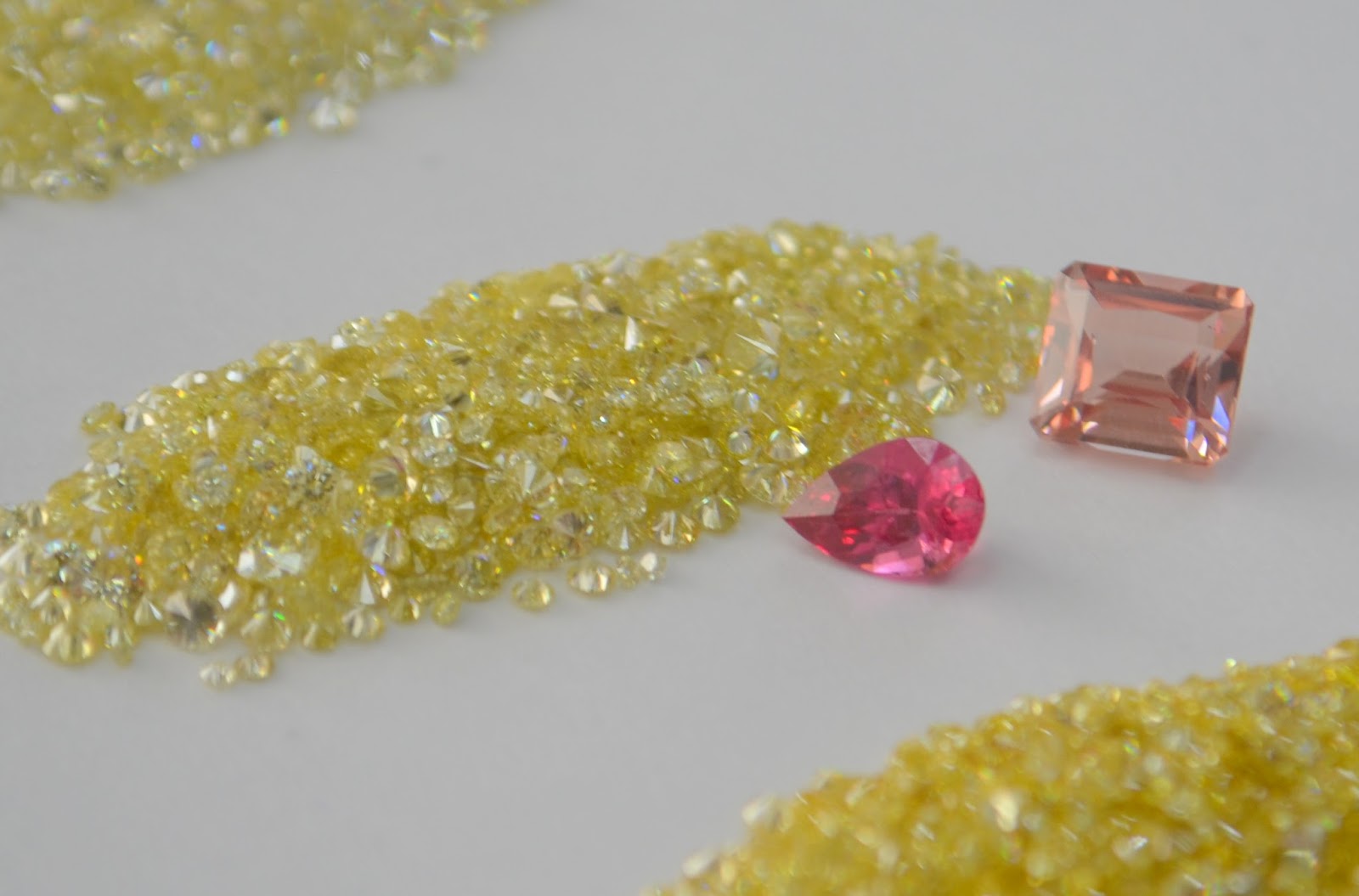
In the last few months, however, I started to increasingly play with natural yellow and pink diamonds, so I thought it might be fun to share some of my insights, and offer out colored diamond melee for custom designs.

There are only a few natural colors of diamonds: yellow, pink, orange and cognac (to browns), blue, grey, and green.  There are very few natural red diamonds, but those are out of all of our price ranges.  All of these colors are ranked by intensity.  The more intense, the more expensive.  The lighter colors have to be used in bunches, and should be set in the right color gold to enhance them (so pink diamonds should be set in rose gold).
 
Natural pinks are the most expensive.  They are usually Australian, from the Argyle mines.  They cost up to $50,000 per carat in the melee sizes.  Here are a few that are lower priced (meaning $3000-12000 per carat).  The colors are Fancy Light Pink, Fancy Light Pink, and Fancy Intense Pink.

Fancy Natural Pink Diamonds

Fancy Pink Diamond and Tourmaline

Fancy Pink Diamonds, Mahenge Spinel and Tourmaline

Yellow diamonds mainly come from the Argyle mines as well, though some of them can be from India.  Here are the more affordable shades of yellow.  They are $1000-3000 per carat.  They are called Fancy Light Yellow, Fancy Yellow, Fancy Intense Yellow and Fancy Vivid Yellow.  Fancy intense is my favorite.

Fancy Light Yellow, Yellow, Intense Yellow and Vivid Yellow

Fancy Yellow Diamonds, Malaya Garnet and Mahenge Spinel

Fancy Intense Yellow and Mahenge Spinel
My favorite new colors were blue and grey, however.  Those diamonds come from Easy Africa.  The grey of these diamonds is not created by black piques (inclusions) but is actually in the body color of the gem.  I am adding a photo of white diamonds for comparison.  They greys are $2500 a carat, the blues are (sticker shock alert): $23000.  Note that my markup is not my standard, it is a much lower add on because that's how this works.  Diamonds are high priced and thus have lower markups than colored stones.

Natural White Diamonds (F Color)
Fancy Greyish Blue Diamond with Vietnamese Spinel

Natural White, Fancy Greyish Blue and Fancy Blue Diamonds
Fancy Greyish Blue Diamonds with Mahenge Spinel


Fancy Blue Diamonds with Tourmaline

Fancy Greyish Blue Diamonds with Hauynite
I could have taken oodles more photos but this is all there was time for.  The dabs of colored stones are giving you some ideas of how to make designs.

Below is a diamond melee size chart so you can calculate costs.


Tuesday, September 2, 2014

Some Thoughts on the Challenge of Making Custom Quotes

Now that I have so many gemstones for sale, I get considerably more requests for custom quotes than I did in the past.  And I face new challenges.  I have been thinking that if I share some of these, perhaps I can get some suggestions from you as I develop price lists and a custom form for my new webpage.

               Making a quote minimally involves calculations on the following three factors:

1. Gemstones:  this math is easy if you have picked out your stone, but if I have to multiply out, say, sidestones for a pendant or ring, or diamonds for a halo, then that involves more.  I usually just “ballpark” smaller colored stones (1-2mm sizes) but I have to calculate out diamonds exactly.  Each size and each grade will change the calculation.  So a half pointer G/H VS is different from a 1 pointer G/H SI.

2. Metal cost:  this can be tricky.  It is easiest if I have an existing ring that I can weigh or that is one of my molds, because I have the weights listed in my mold sheet.  Then I multiply by the current gold price. If I have to make the ring from scratch, I have to consult a catalog that gives me the weights of metal strips in different mm sizes and thicknesses.  The weight is usually in 14 K yellow, so that involves conversions if it is platinum or 18k.  For silver I just ballpark because silver is cheap.  Another factor that influences weight is the finger size.  A size 5 is much lighter than a 9.  I have lists for that also, that is, how many mm metal strip I need for which finger size.  With gold, you need to be exact because just ¼ gram in weight can make a big difference.  I also have to calculate some metal loss, or the cost of the sprue, so I add a little % to each calculation.  Finally, settings can vary drastically in price, and there are no price lists that contain every single setting in every single size (for instance, bezels weigh more than prong settings, but some prong settings are more hefty than others, and each mm size makes the setting heavier).  Plus gold prices change every day so when you shop, you pay a % markup on that day’s spot price.  As you get more experienced, you learn to estimate better, and that helps.  But the rule of thumb in the market is not to underestimate because if you cut it too tight, you can very quickly lose money, especially when your markup is low (mine is very low by industry standard).

Metal Strip Price List for 10K Flat Wire
3. Labor: labor breaks down into several categories.  If it is a casting, then you add casting labor.  That’s only a few dollars, so that’s good.  If you have to make a mold, you add that in.  If there is 3-C printing or CAD work involved, that’s another price depending on the time it takes to make it.  If there is soldering, I have a rough idea of what each type of soldering costs and I add that in. Then there is setting labor.  Setting labor depends on stone size, bezel or prong, millgrain or pave.  And of course the number of stones.  So a ring with 12 sidestones that are 2mm, with a 6 mm center, pave, can be very different from a 3 stone ring that’s prong set.  Finally, you have to add polishing and plating costs (i.e. rhodium). 

Sample Page from Settings Catalog - Look at all those Sizes and there are Pages and Pages of this Stuff
Now this was the simple calculation.  When you get to a complicated CAD design then often you have to make a 2-D or even 3D rough drawing before you can get the pricing exact.  That means the customer has to be very specific about what she wants, or provide me with a budget first, otherwise the back and forth can be endless.  And if I have to send out 3 possible quotes involving three design alterations, I can easily be sitting for an hour just to do the math.

At the very end, I add my wholesale markup, which has to account for the following factors: my own time and labor which involves quotes, photos, seeing the order through, all customer communications, shipping time.  I work approximately 40 hrs a week just running the shop.  Then there is assistant’s overall time helping with the shop, shipping costs, overhead (computer cost, travel to NY, electric, etc), Etsy cost, PayPal or Direct Checkout cost, as well as development costs when I make new designs, putting orders together, accounting costs, and costs for items not sold, items wasted, items broken (not negligible!).  What does that add up to?  Very very minimally, you have to double your cost once you’ve worked out the initial item cost.  But a safer calculation is x1.2-1.5 depending on how much your other costs are.  Everyone in industry – just about any industry – tells you that even for wholesale, if you don’t do at least double, you will go under.  I frequently get chided by people for not being careful with my own costs, and I’m not saying this to make you feel guilty!  My shop does very well but I work hard for that.

Complicated enough for you?  Now you know why custom shops usually charge so much money.  By the time the customer is satisfied and the numbers are correct, you can have spent more time than it takes to actually make the piece.  Well, I’m overstating of course, but it is definitely more involved than what meets the eye.  That’s why so many shops just have basic designs and price lists based on those, as opposed to making everything to order.